Programmatic SEO Checklist
Programmatic SEO Checklist
QA every generated page for verified data, unique value, indexability, links and rendering before release.
Which programmatically generated pages are ready to release and which to hold, with the specific checks each one fails.
- Excel workbook (.xlsx), opens in Google Sheets
- PDF field guide, 9 to 11 pages
- Blank and worked CSV templates
- DataForSEO import script
Free, no email required. Version 3.0, updated November 2026.
=IF(K13="","",IF(K13<>"Ready","n.a.",IF(L13=0,"Meets listed checks","Hold for fixes")))The formula above is the real one from cell M13. Scroll it sideways to read the whole rule.
Connected to the DataForSEO API
This template is designed around one DataForSEO endpoint. Pull the data, convert it with one command, and the workbook does the rest.
DataForSEO On-Page APIA crawl of your site: URLs, status codes, canonicals, inlinks and sitemap membershipon_page/task_post
Save the JSON responseThe full API response, kept as your source of truth.response.json
Run the import scriptOffline. No API calls, no credentials.dataforseo_import.py import --template 37 --csv
Paste at A13Dashboard, checks and action list update instantly.Programmatic SEO Checklist.xlsx
Column map for this template:Filled by the APIAudit trail (automatic)You add
What the programmatic SEO checklist decides
Programmatic SEO can build thousands of useful pages, or thousands of thin ones that drag a whole site down. The difference is quality control at release: verified data, something genuinely useful on each page, and the technical basics.
This programmatic SEO checklist runs five acceptance checks on every generated page: data verified, unique value, indexability, links and rendering. It counts open checks and marks each page Meets listed checks or Hold for fixes, so a batch is released page by page, not all at once on faith.
Who it's for
- SEOs launching location, product, comparison or directory pages at scale
- Developers building page templates from datasets
- Content teams reviewing generated pages
- Agencies accountable for a pSEO launch
Where it fits in your workflow
The programmatic SEO checklist answers one question. These three templates answer the questions around it:
- Schema Markup Audit Template: which pages and schema types are ready to release, and which fail on syntax, required properties, content mismatch or policy.
- Indexability Audit Template: which pages that should be indexed have a technical conflict, which are technically fine but still not indexed, and which were never meant to be indexed.
- XML Sitemap Audit Template: which URLs should be removed from your XML sitemap (or fixed), which eligible URLs are missing from it, and which are fine.
What's inside the download
One ZIP with the workbook, a 10-column input template (blank and filled), the PDF field guide and an offline script that converts saved DataForSEO responses into the input CSV. The workbook has five tabs.
How the programmatic SEO checklist calculation works
Open checks = 5 − (data verified + unique value + indexability + links + render verified). Zero open checks = Meets listed checks, otherwise Hold for fixes.
The key formula, exactly as it appears in the workbook
=IF(K13="","",IF(K13<>"Ready","n.a.",IF(L13=0,"Meets listed checks","Hold for fixes")))
| Result column | Plain-English formula | What it tells you |
|---|---|---|
| Open acceptance checks | 5-SUM(Source data verified,Useful distinction verified,Indexability verified,Navigation verified,Rendered content verified) | Count of unmet release conditions. |
| Release review | IF(Open acceptance checks=0,"Meets listed checks","Hold for fixes") | Template/URL review outcome based on actual evidence. |
The results you will see
Meets listed checksHold for fixes
Green meets the checks, red needs fixing first, amber needs a human decision and blue marks an opportunity. Rows with missing or out-of-range inputs are held back in the Input check column until they're fixed, so a half-filled row never sneaks into a total.
How to use the programmatic SEO checklist
- Release in batchesGenerate a small batch first. One row per page with its template and record ID.
- Verify the dataSpot-check each page's facts against the source dataset. Mark 1 only if correct.
- Judge unique valueDoes the page offer something a user can't get from the template alone? Be strict.
- Check tech and renderIndexable, internally linked, and renders correctly with JavaScript. Release only pages with zero open checks.
The worked example in the Workspace tab. Clear the lime input cells, paste your CSV at A13 (values only) and every result recalculates.
Fill the programmatic SEO checklist with DataForSEO
Every template in this library is built to run on DataForSEO data. This one uses DataForSEO On-Page API: a crawl of your site: URLs, status codes, canonicals, inlinks and sitemap membership.
This is a sign-off workflow. DataForSEO responses are the evidence you attach; the human checks stay manual by design.
- Request the dataSend this request with your DataForSEO API login (HTTP Basic auth).
POST https://api.dataforseo.com/v3/on_page/task_post [ { "target": "yourdomain.com", "max_crawl_pages": 1000 } ]
Post the crawl task, wait for it to finish, then request on_page/pages with {"id": "<task id>", "limit": 1000} and save that response.
- Save the full JSON responseSave the complete response, not just the task ID, next to the template folder.
- Convert it with the included scriptIt runs offline, makes no API calls and never sees your credentials.
python3 Automation/dataforseo_import.py import --template 37 --csv --input my-filled.csv --output my-inputs.csv
- Add what the API can't knowTemplate, Source record ID, Source data verified, Useful distinction verified, Indexability verified, Navigation verified, Rendered content verified, Evidence
- Paste at A13Clear the demo rows, paste the CSV values at Workspace cell A13 and the dashboard updates.
| Fills automatically from DataForSEO | You add |
|---|---|
| Page URL | Template, Source record ID, Source data verified, Useful distinction verified, Indexability verified, Navigation verified, Rendered content verified, Evidence |
Source reference fills automatically with the task ID, endpoint, location, language, device and snapshot time, so every row is traceable. Before a big pull, estimate the cost with the DataForSEO pricing calculator. The same steps, plus an example request file, are in the download's Automation folder.
Worked example: Northbeam Outdoor
Every template ships filled with data from Northbeam Outdoor, a fictional outdoor-gear retailer that appears across all 40 workbooks, so you can see what useful output looks like before you add your own. This workbook has 12 example rows.
Only five of 12 example trail pages are ready. Most holds trace back to unverified data or missing unique value, which are dataset and template problems, not page-by-page fixes.
Top 10 by open checks
| # | Page URL | Open checks |
|---|---|---|
| 1 | https://www.northbeam.example/trails/ny/slide-mountain/ | 2 |
| 2 | https://www.northbeam.example/trails/ny/hunter-mountain/ | 1 |
| 3 | https://www.northbeam.example/trails/me/mount-katahdin/ | 1 |
| 4 | https://www.northbeam.example/trails/nh/mount-washington/ | 1 |
| 5 | https://www.northbeam.example/trails/vt/camels-hump/ | 1 |
Input fields
Keep the columns in this order when you prepare a CSV. A missing observation stays blank; use 0 only for a measured zero or a verified No. Fields marked DataForSEO can be filled automatically by the included script.
| CSV field | Column | Meaning and rule | Source |
|---|---|---|---|
| url | Page URL | Exact absolute URL. Keep case and query parameters unless a documented normalization rule applies. | DataForSEO: url |
| template | Template | Named programmatic page type. | Your records |
| record_id | Source record ID | Stable underlying business-data identifier. | Your records |
| data_verified | Source data verified | 1 after checking source data completeness and correctness. 1 = Yes, 0 = No. | Your records |
| unique_value | Useful distinction verified | 1 after a human confirms this URL serves a distinct useful task. 1 = Yes, 0 = No. | Your records |
| indexability | Indexability verified | 1 after status, robots, noindex and canonical checks. 1 = Yes, 0 = No. | Your records |
| links | Navigation verified | 1 after checking the page is reachable in useful site navigation. 1 = Yes, 0 = No. | Your records |
| render_verified | Rendered content verified | 1 after checking the actual rendered output and key content. 1 = Yes, 0 = No. | Your records |
| evidence | Evidence | Link to a dated crawl, screenshot, ticket or source that another reviewer can inspect. | Your records |
| source_ref | Source reference | Task ID, export filename and observation scope. Retain the untouched source response separately. Optional. | DataForSEO: source_ref |
Reading the result honestly
Generating many URLs is not evidence of demand or usefulness. Acceptance checks should protect real user tasks.
Limits. A sample cannot prove every generated page is correct. Automated record-level checks and reviewed edge cases remain necessary.
Programmatic SEO checklist mistakes to avoid
Tips from practice
- Track indexation of each batch with the indexability audit.
- Add generated pages to sitemaps only after they pass QA.
- Use the schema audit for structured data on templates.
Frequently asked questions
What is programmatic SEO?
Creating many pages from a template and a dataset to target large sets of related queries, like locations, products or comparisons.
Is programmatic SEO spam?
Not inherently. It becomes scaled content abuse when pages exist mainly to rank without providing real value.
How do I QA programmatic pages?
Verify the data, confirm each page has unique value, check indexability and internal links, and make sure it renders correctly.
How many pages should I launch at once?
Start with a small batch, monitor indexing and quality signals, then scale gradually.
Use it with these templates
Each template answers one decision. These are the ones that feed into, or follow from, the programmatic SEO checklist.
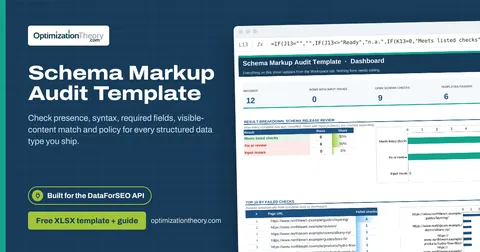
18Schema Markup Audit TemplateOn-Page API
Check presence, syntax, required fields, visible-content match and policy for every structured data type you ship.
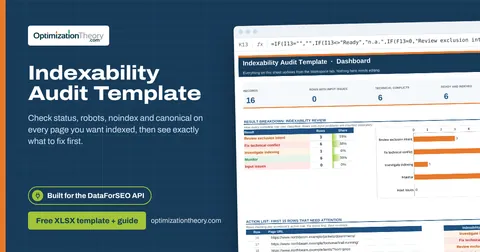
11Indexability Audit TemplateOn-Page API
Check status, robots, noindex and canonical on every page you want indexed, then see exactly what to fix first.
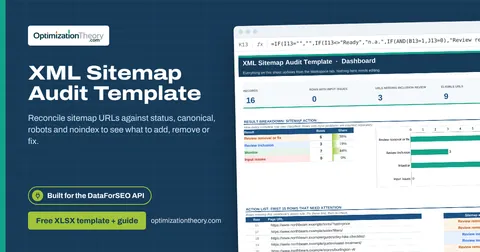
17XML Sitemap Audit TemplateOn-Page API
Reconcile sitemap URLs against status, canonical, robots and noindex to see what to add, remove or fix.
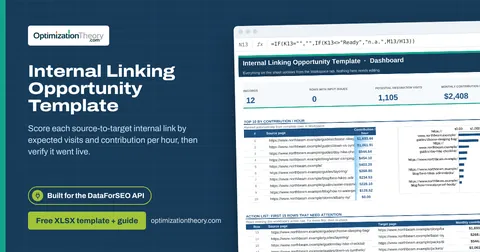
16Internal Linking Opportunity TemplateOn-Page API
Score each source-to-target internal link by expected visits and contribution per hour, then verify it went live.
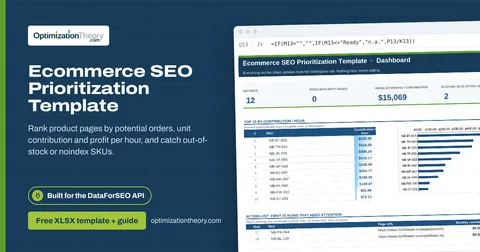
36Ecommerce SEO Prioritization TemplateLabs: Keyword Overview
Rank product pages by potential orders, unit contribution and profit per hour, and catch out-of-stock or noindex SKUs.
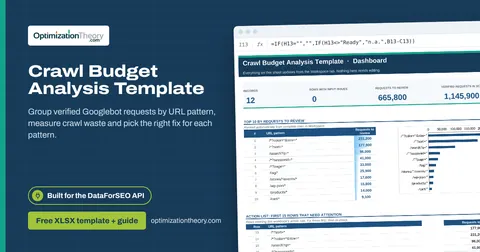
14Crawl Budget Analysis TemplateOn-Page API
Group verified Googlebot requests by URL pattern, measure crawl waste and pick the right fix for each pattern.
Part of the SEO Business & Delivery Toolkit
Get all 10 SEO Business & Delivery templates in one ZIP, or the complete set of 40 SEO and GEO templates with the 401-page field handbook.
Further reading on Optimization Theory

Built by Jourdan Rombough, technical SEO and GEO consultant with 15+ years in search. About Jourdan or get an SEO plan.
More on digital marketing in our blog
See all posts