Ecommerce SEO Prioritization Template
Ecommerce SEO Prioritization Template
Rank product pages by potential orders, unit contribution and profit per hour, and catch out-of-stock or noindex SKUs.
Which products deserve SEO work first, based on the profit each could earn per hour invested, and which are blocked by stock or indexing.
- Excel workbook (.xlsx), opens in Google Sheets
- PDF field guide, 9 to 11 pages
- Blank and worked CSV templates
- DataForSEO import script
Free, no email required. Version 3.0, updated November 2026.
=IF(M13="","",IF(M13<>"Ready","n.a.",P13/K13))The formula above is the real one from cell Q13. Scroll it sideways to read the whole rule.
Connected to the DataForSEO API
This template is designed around one DataForSEO endpoint. Pull the data, convert it with one command, and the workbook does the rest.
DataForSEO Labs: Keyword OverviewSearch volume, monthly history, difficulty and intent for a list of keywordsdataforseo_labs/google/keyword_overview/live
Save the JSON responseThe full API response, kept as your source of truth.response.json
Run the import scriptOffline. No API calls, no credentials.dataforseo_import.py import --template 36
Paste at A13Dashboard, checks and action list update instantly.Ecommerce SEO Prioritization Template.xlsx
Column map for this template:Filled by the APIAudit trail (automatic)You add
What the ecommerce SEO prioritization template decides
Ecommerce SEO often optimizes the products with the most search volume, which isn't the same as the products that make the most money. A high-volume, low-margin item can be worth less than a niche product with great margins and a clear buyer.
This ecommerce SEO template calculates unit contribution (price minus variable cost), potential monthly orders from search volume, target CTR and conversion rate, monthly contribution and contribution per hour. Products that are out of stock or not indexable are zeroed out and flagged so you don't optimize pages that can't sell or rank.
Who it's for
- Ecommerce SEOs and merchandisers
- Shopify, WooCommerce and BigCommerce store owners
- Agencies prioritizing product page work
- Teams deciding which SKUs to feature in content
Where it fits in your workflow
The ecommerce SEO prioritization template answers one question. These three templates answer the questions around it:
- Keyword Prioritization Template: which keywords deserve your next hours of work, ranked by the monthly profit each could add per hour invested, with every assumption visible and editable.
- SEO Forecast Template: how much additional traffic and monthly contribution a portfolio of keyword clusters could add, with every assumption visible.
- Schema Markup Audit Template: which pages and schema types are ready to release, and which fail on syntax, required properties, content mismatch or policy.
What's inside the download
One ZIP with the workbook, a 12-column input template (blank and filled), the PDF field guide and an offline script that converts saved DataForSEO responses into the input CSV. The workbook has five tabs.
How the ecommerce keyword research calculation works
Unit contribution = sale price − unit variable cost. Potential orders = volume × target CTR × conversion rate, only if available and indexable. Monthly contribution = orders × unit contribution. Per hour = contribution ÷ effort.
The key formula, exactly as it appears in the workbook
=IF(M13="","",IF(M13<>"Ready","n.a.",P13/K13))
| Result column | Plain-English formula | What it tells you |
|---|---|---|
| Unit contribution | Net selling price-Variable unit cost | Net selling price minus variable cost. Can be negative. |
| Potential orders / month | IF(AND(Available and purchasable=1,Indexability verified=1),Monthly searches × Target CTR × Conversion rate,0) | Gross modeled orders for eligible products. |
| Monthly contribution | Potential orders ÷ month × Unit contribution | Modeled contribution before fixed SEO cost. |
| Monthly contribution / hour | Monthly contribution ÷ Work hours | Opportunity comparison after unit economics. |
How to use the ecommerce SEO prioritization template
- Join catalog and keyword dataOne row per SKU: URL, target keyword, volume, price, variable cost, stock and indexability.
- Set target CTR and conversion rateUse realistic CTR for an achievable position and your product page conversion rate.
- Estimate effortHours to improve the page: copy, images, reviews, schema, internal links.
- Work the ranked listSort by contribution per hour. Fix stock or indexing first for flagged SKUs.
The worked example in the Workspace tab. Clear the lime input cells, paste your CSV at A13 (values only) and every result recalculates.
Fill the ecommerce SEO prioritization template with DataForSEO
Every template in this library is built to run on DataForSEO data. This one uses DataForSEO Labs: Keyword Overview: search volume, monthly history, difficulty and intent for a list of keywords.
Most of the data columns fill automatically. Add the business inputs listed below, then paste.
- Request the dataSend this request with your DataForSEO API login (HTTP Basic auth).
POST https://api.dataforseo.com/v3/dataforseo_labs/google/keyword_overview/live [ { "keywords": [ "your keyword 1", "your keyword 2" ], "location_code": 2840, "language_code": "en" } ]
- Save the full JSON responseSave the complete response, not just the task ID, next to the template folder.
- Convert it with the included scriptIt runs offline, makes no API calls and never sees your credentials.
python3 Automation/dataforseo_import.py import --template 36 --input response.json --output my-inputs.csv
- Add what the API can't knowSKU, Target CTR, Conversion rate, Net selling price, Variable unit cost, Available and purchasable, Indexability verified, Work hours
- Paste at A13Clear the demo rows, paste the CSV values at Workspace cell A13 and the dashboard updates.
| Fills automatically from DataForSEO | You add |
|---|---|
| Page URL, Keyword, Monthly searches | SKU, Target CTR, Conversion rate, Net selling price, Variable unit cost, Available and purchasable, Indexability verified, Work hours |
Source reference fills automatically with the task ID, endpoint, location, language, device and snapshot time, so every row is traceable. Before a big pull, estimate the cost with the DataForSEO pricing calculator. The same steps, plus an example request file, are in the download's Automation folder.
Worked example: Northbeam Outdoor
Every template ships filled with data from Northbeam Outdoor, a fictional outdoor-gear retailer that appears across all 40 workbooks, so you can see what useful output looks like before you add your own. This workbook has 12 example rows.
The headlamp and water filter beat the high-volume trail running shoe on contribution per hour. The hydration pack is out of stock and the merino crew is noindexed, so both are zeroed until fixed.
Top 10 by contribution / hour
| # | SKU | Contribution / hour |
|---|---|---|
| 1 | NB-BT-001 | $528.36 |
| 2 | NB-TN-014 | $418.08 |
| 3 | NB-JK-220 | $408.34 |
| 4 | NB-TP-055 | $316.17 |
| 5 | NB-SP-018 | $249.48 |
Input fields
Keep the columns in this order when you prepare a CSV. A missing observation stays blank; use 0 only for a measured zero or a verified No. Fields marked DataForSEO can be filled automatically by the included script.
| CSV field | Column | Meaning and rule | Source |
|---|---|---|---|
| sku | SKU | Stable product identifier stored as text. | Your records |
| url | Page URL | Exact absolute URL. Keep case and query parameters unless a documented normalization rule applies. | DataForSEO: url |
| keyword | Keyword | Exact query in the selected country and language. | DataForSEO: keyword |
| search_volume | Monthly searches | Provider monthly search-volume estimate. Use one market, language and source date. | DataForSEO: search_volume |
| target_ctr | Target CTR | Assumed organic click-through rate as a decimal. Calibrate by device, brand and SERP layout. Decimal: 0.08 = 8%. | Your records |
| conversion_rate | Conversion rate | Conversions divided by eligible organic sessions for the same segment. This is an assumption. Decimal: 0.08 = 8%. | Your records |
| sale_price | Net selling price | USD realized price after discounts, excluding collected tax. | Your records |
| unit_variable_cost | Variable unit cost | Product, fulfillment, payment and other variable selling costs per unit. | Your records |
| available | Available and purchasable | 1 after checking stock and checkout eligibility. 1 = Yes, 0 = No. | Your records |
| indexable | Indexability verified | 1 after verifying intended canonical indexability. 1 = Yes, 0 = No. | Your records |
| effort_hours | Work hours | Estimated implementation hours, greater than zero. | Your records |
| source_ref | Source reference | Task ID, export filename and observation scope. Retain the untouched source response separately. Optional. | DataForSEO: source_ref |
Reading the result honestly
A profitable unit does not make a demand forecast certain. Use expected realized prices and full variable costs.
Limits. Keyword search volume is not product sales. Variant overlap can overstate the portfolio if counted repeatedly.
Ecommerce keyword research mistakes to avoid
Tips from practice
- Check Product schema with the schema audit template.
- Link from buying guides to top products with the internal linking template.
- Re-run when prices, costs or stock change.
Frequently asked questions
How do I prioritize products for SEO?
Estimate potential orders from search demand, multiply by profit per unit, and divide by the effort to improve each page.
What is unit contribution?
Sale price minus the variable costs of selling one unit, such as product cost, shipping and payment fees.
Should out-of-stock product pages be noindexed?
Usually no. Keep temporarily unavailable products live; redirect permanently discontinued ones to the closest alternative.
Does this work for Shopify?
Yes. Export products and prices from Shopify, add keyword data, and paste into the template.
Use it with these templates
Each template answers one decision. These are the ones that feed into, or follow from, the ecommerce SEO prioritization template.
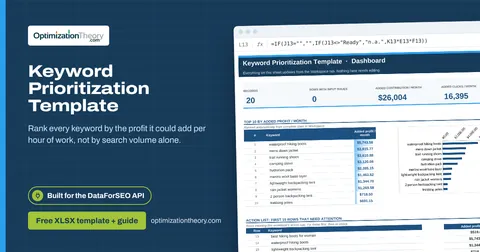
01Keyword Prioritization TemplateLabs: Keyword Overview
Rank every keyword by the profit it could add per hour of work, not by search volume alone.
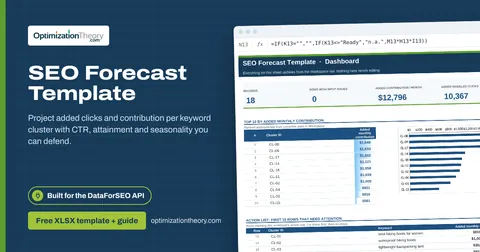
31SEO Forecast TemplateLabs: Keyword Overview
Project added clicks and contribution per keyword cluster with CTR, attainment and seasonality you can defend.
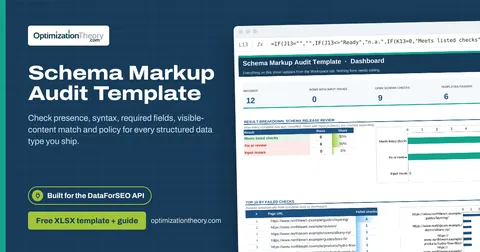
18Schema Markup Audit TemplateOn-Page API
Check presence, syntax, required fields, visible-content match and policy for every structured data type you ship.
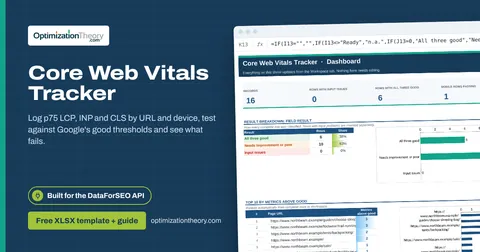
15Core Web Vitals TrackerOn-Page API
Log p75 LCP, INP and CLS by URL and device, test against Google's good thresholds and see what fails.
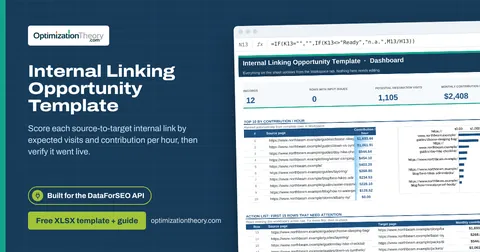
16Internal Linking Opportunity TemplateOn-Page API
Score each source-to-target internal link by expected visits and contribution per hour, then verify it went live.
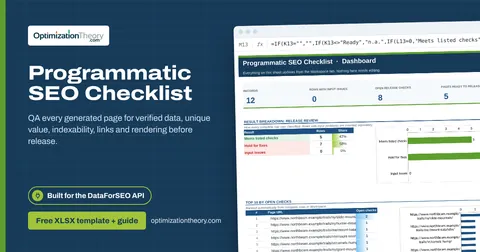
37Programmatic SEO ChecklistOn-Page API
QA every generated page for verified data, unique value, indexability, links and rendering before release.
Part of the SEO Business & Delivery Toolkit
Get all 10 SEO Business & Delivery templates in one ZIP, or the complete set of 40 SEO and GEO templates with the 401-page field handbook.
Further reading on Optimization Theory

Built by Jourdan Rombough, technical SEO and GEO consultant with 15+ years in search. About Jourdan or get an SEO plan.
More on digital marketing in our blog
See all posts