

- October 15, 2026
- Artificial Intelligence, SEO
Your SEO
Swiss Army knife.
Connect Claude Code to DataForSEO, add your site data, and turn a question into a keyword plan, a technical fix or a report you can use.
Go to the free SEO Prompt Builder tool↓
Claude Pro, about $25 of DataForSEO calls and the free Screaming Frog. With Sitebulb Lite it's about $63. Semrush Guru is $249.95 a month.
Most SEO work involves moving between tools. You find a promising query in Search Console, check the results, open the page, compare it with a crawl and put the recommendation in a spreadsheet. The decision is often simple. Getting everything in front of you takes the time.
Claude Code can take on much of that preparation. Give it DataForSEO and your site data, and you can ask it to investigate a question, collect the evidence and produce something useful: a keyword map, a prioritized fix list, a content brief or a redirect file ready for review.
That's the Swiss Army knife I want more SEOs to know about. I've been doing technical SEO for over 15 years, and what interests me is how much of the work between noticing a problem and preparing the fix now happens in one conversation. Here's how the pieces fit, where I use them, and how to get a useful first result.
Infographic · the whole guide on one pageSEO Expert's Secret Weapon: Claude Code + DataForSEOThe setup, the six APIs, both real runs and your first job, in one image you can save or share.View infographicHide infographic

What Claude Code and DataForSEO each bring to SEO
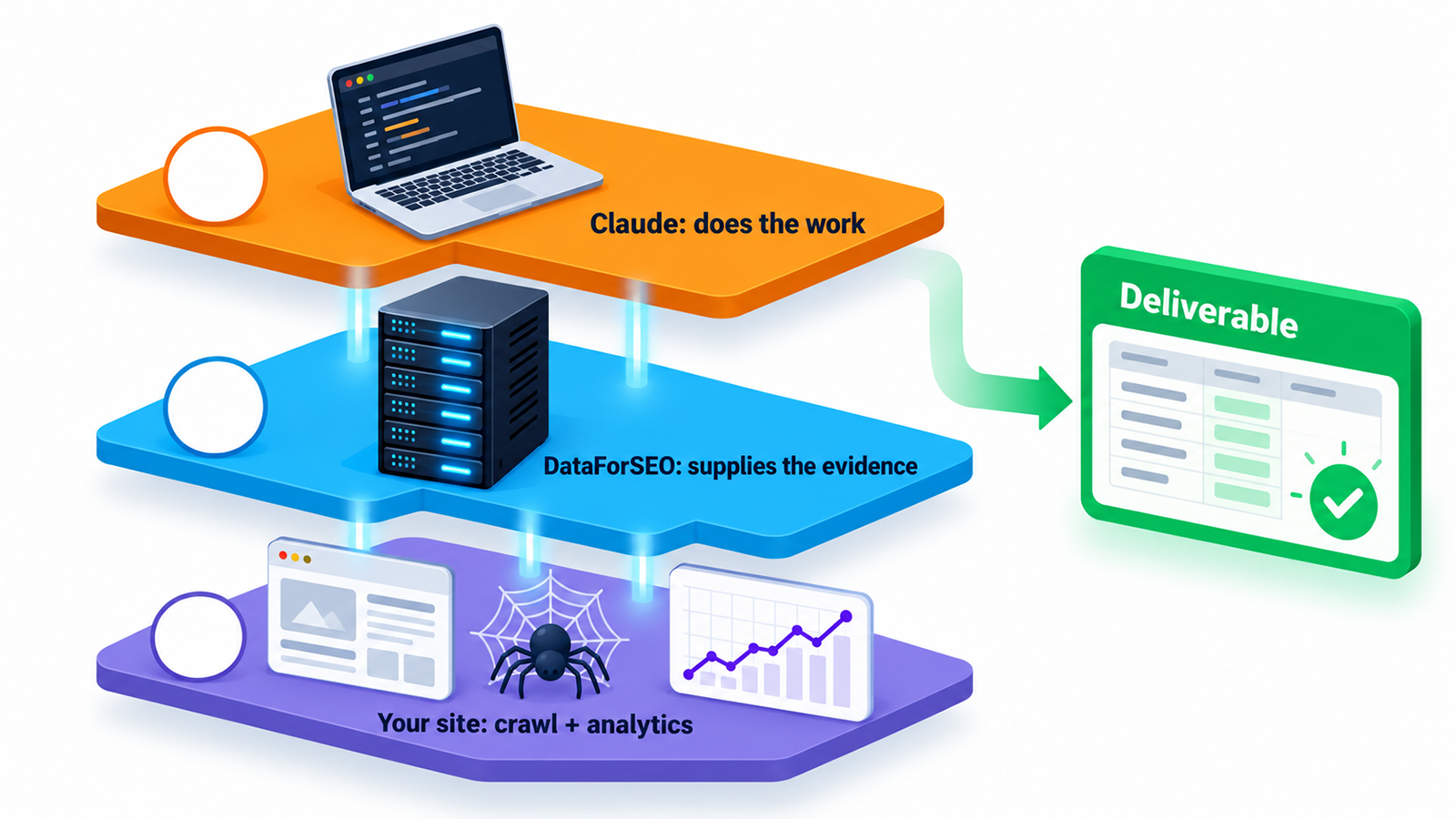
Claude does the work. DataForSEO supplies the evidence. Your crawl and analytics supply the context.
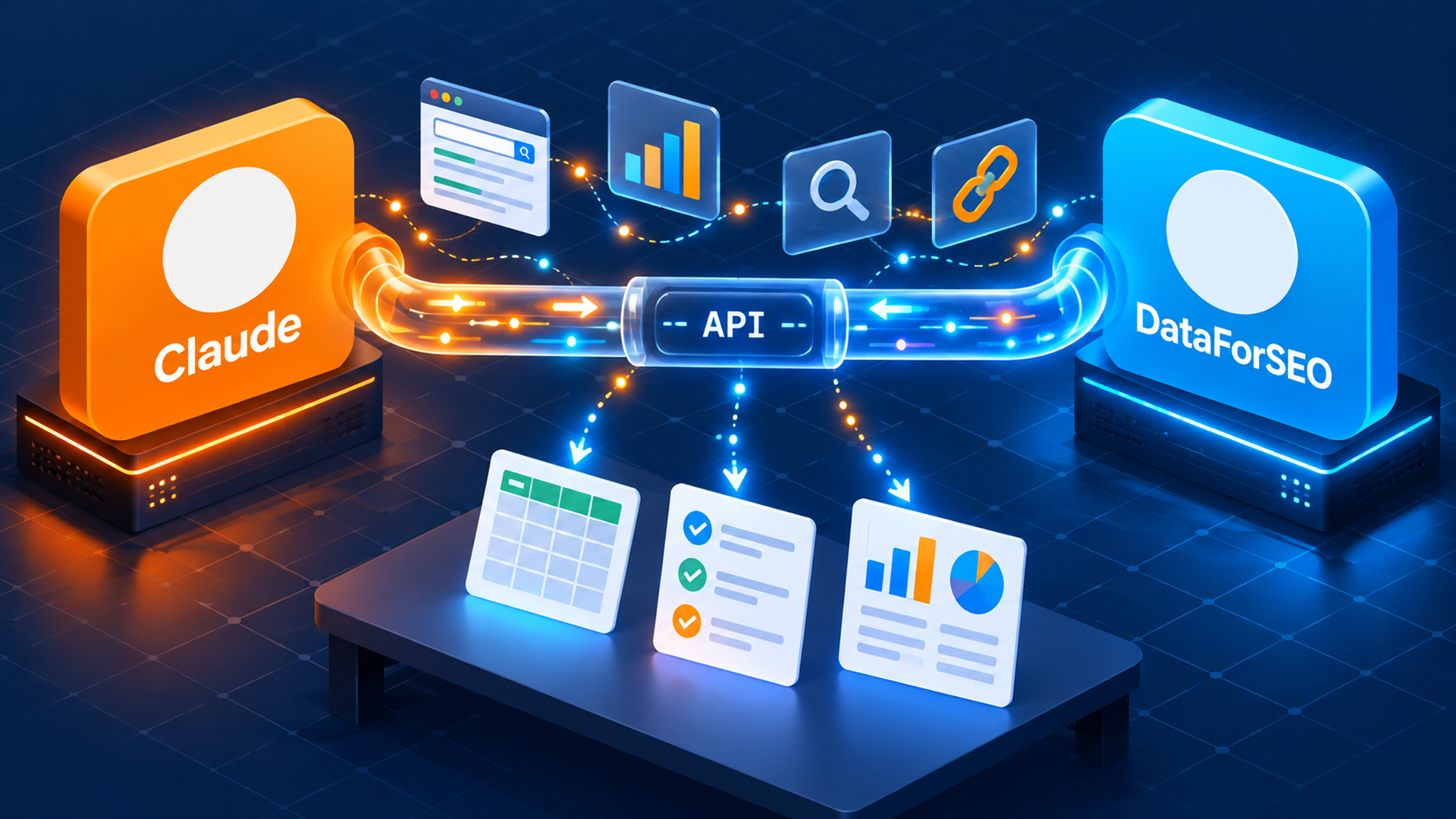
Claude Code is the working environment. It can read files, run scripts, use connected tools and create the output you ask for. DataForSEO supplies external search data: keyword metrics, live search results, ranking estimates, competitor data, backlinks and more through its APIs. Your crawler and analytics fill in the parts that belong only to your website.
This distinction matters. An AI with web access can research current information, but web search doesn't give it a dependable keyword database or your site's performance history. Ask for search volume without naming a source and you may get an unsupported number. Connect a data provider and you can require the actual result, market, collection date and source behind every recommendation.
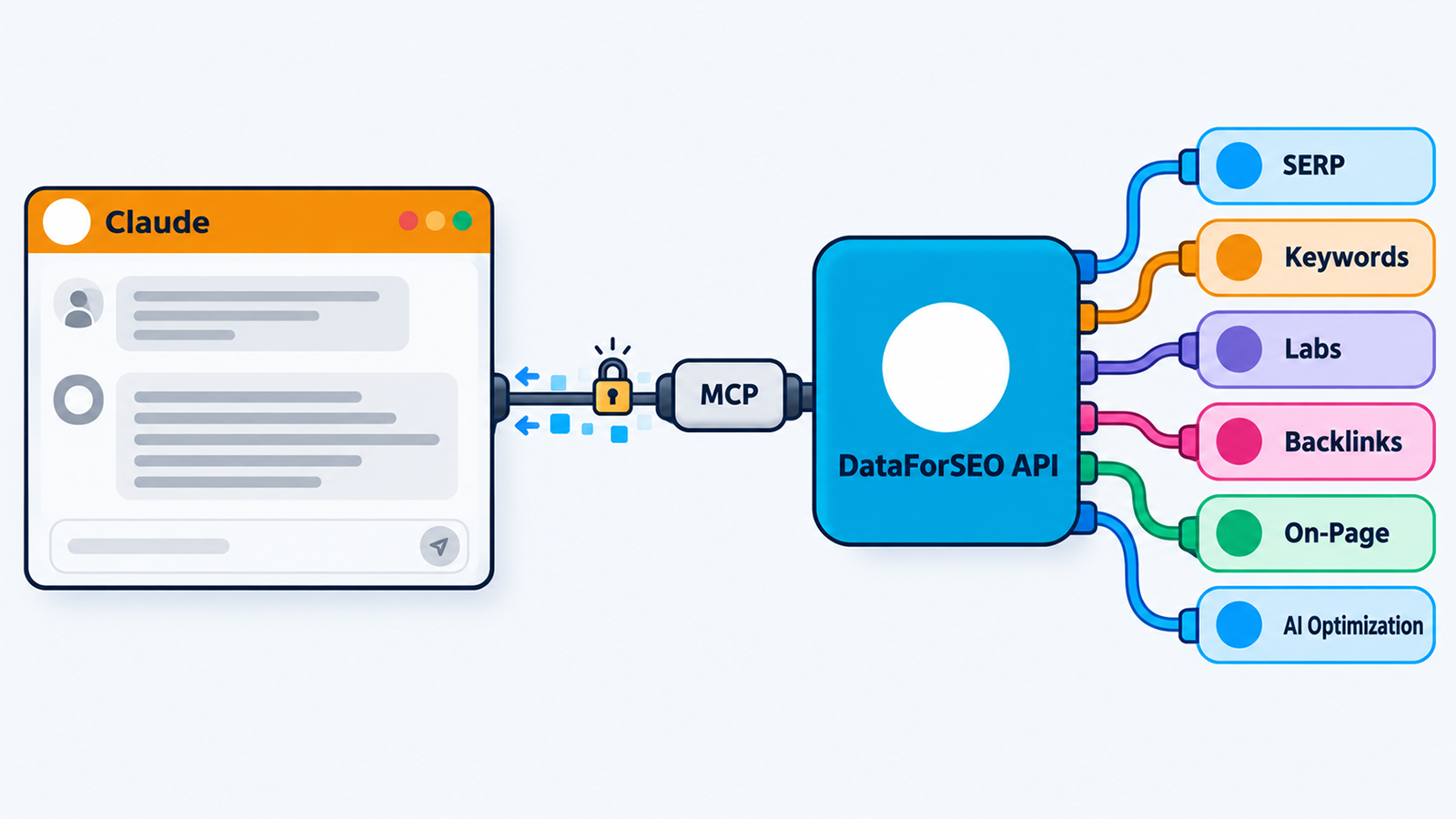
SERP API
Live Google results for any keyword, country or city: rankings, featured snippets, People Also Ask, AI Overviews.
Keywords Data
Google Ads search volume, CPC, competition and a 12-month trend for up to 1,000 keywords per call.
DataForSEO Labs
Keyword suggestions, what any domain ranks for, organic competitors, keyword gaps and traffic estimates.
Backlinks
Referring domains, anchors, new and lost links for any domain or URL.
On-Page API
Crawl and check pages through the API: tags, status codes, page speed and on-page issues.
AI Optimization
LLM Mentions, LLM Responses and LLM Scraper for ChatGPT, Gemini, Claude, Perplexity and AI Overviews.
Prices from DataForSEO pricing, its SERP and AI Optimization pages. Since July 2026, Backlinks and LLM Mentions are pay-as-you-go like everything else; the old $100 monthly commitment is gone, and Backlinks rates rose 20%.
How the pieces fit together
You set the outcome and the rules. Claude pulls the data and hands back something you can ship.
MCP, short for Model Context Protocol, is one way to connect the assistant to those tools. A skill is a different piece: saved instructions explaining how to do a recurring job. The connection gives access; the skill holds your process. You can use a connection without a custom skill, then save the workflow once you know it works.
You can see the same pattern across the industry. SE Ranking offers Claude skills that turn connected data into briefs and audits, and Ahrefs writes about encoding editorial expertise into skills. DataForSEO is the data layer in this guide, and its flexibility makes it a good base for building your own versions.
SEO teams already lean on Claude, but only 26% connect a data API
Tools SEO teams use for AI work, up to three per respondent. The data connection is the part most teams skip.
Connect DataForSEO and prove it works
Four steps, about ten minutes, and a test that costs pennies.
Claude Pro is $20 a month billed monthly and includes Claude Code, with usage limits. DataForSEO is pay-as-you-go, with a $50 minimum top-up and a balance that doesn't expire. That top-up is credit you spend on requests, not a recurring charge.
Follow DataForSEO's current instructions for your client. The hosted MCP endpoint is https://mcp.dataforseo.com/v3/mcp, and there's a local option that runs with npx -y dataforseo-mcp-server. Keep credentials in the connection settings or a local environment file, away from prompts and shared files.
Then run a deliberately small test. Ask for US search volume for five terms and one live Google results page, and require the raw data and the returned request costs. It proves the connection works and gives you a baseline for what a real result looks like.
Which crawler do you need?
Put your crawl and analytics exports in a project folder with a short description of the business: what it sells, where it operates, which pages matter and what counts as a conversion. That context helps Claude tell a commercially useful opportunity from a big keyword that just happens to be related.
Screaming Frog is free up to 500 URLs and $279 a year after that. Sitebulb starts at $18 a month. Claude can crawl a small site itself, but I wouldn't go past about 10 pages, and it won't be as thorough as a real crawler.
Claude can crawl about 10 pages. A real crawler handles the rest
How many pages each option handles comfortably, log scale. Arrows mean no fixed cap.
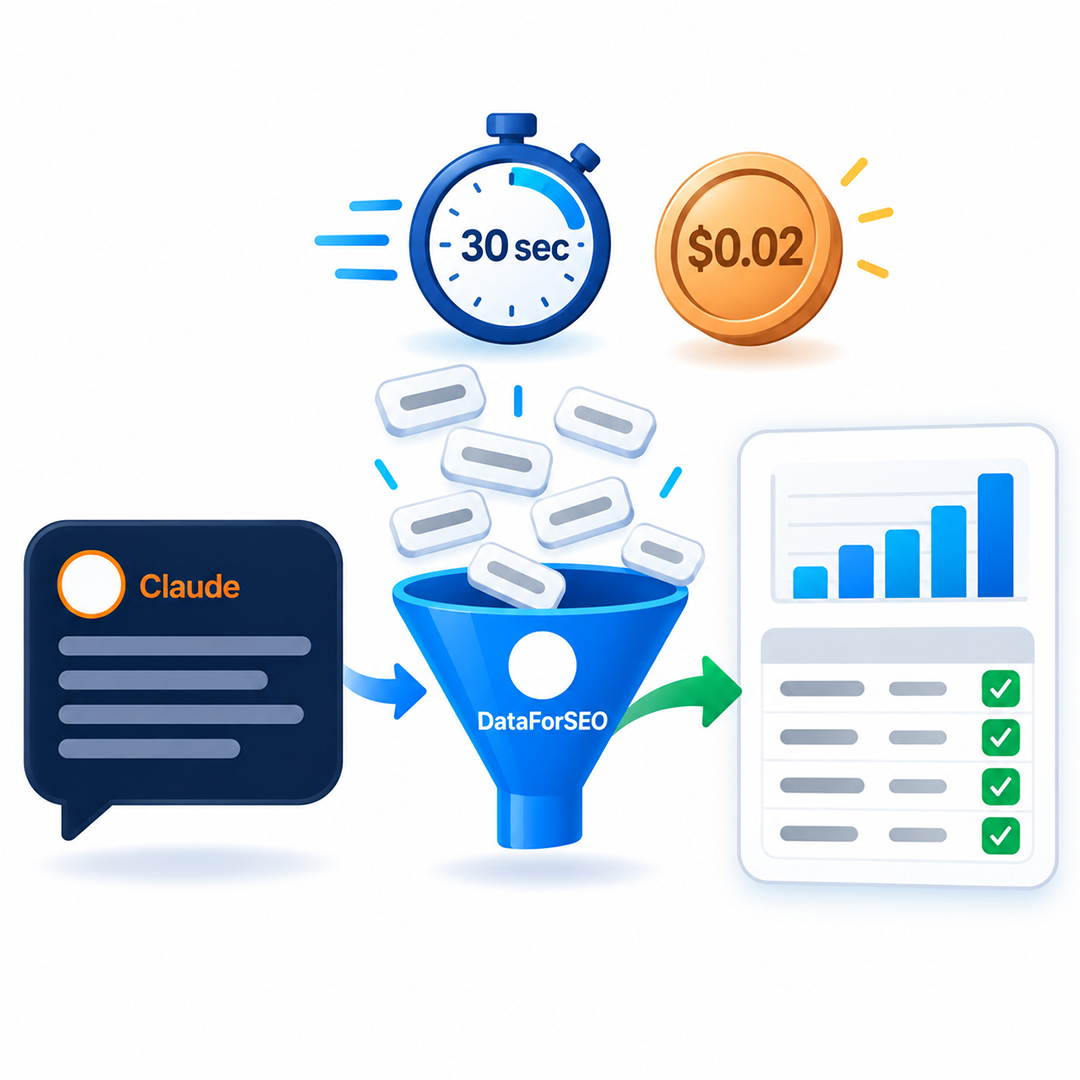
Two small jobs show why the setup is useful
Here are two jobs I ran on October 15, 2026, with the exact prompt, what came back, how long it took and what the API charged.
Find the page that's one push from page one
ranked_keywordspositions 8 to 20$0.019serp/google/organiclive top 10$0.002
59 keywords sit in positions 8 to 20, and every one of them points at a single page: the high-resolution Where's Waldo images post.
- The biggest variations, like "where's wally images" (#8) and "wheres wally pictures" (#9), show 8,100 searches a month each. Google groups close variants, so those overlap and shouldn't be added up.
- The title never says "pictures" or "Wally," the two words most of these searches use.
- The live top 10 is all galleries and image libraries (Shutterstock, Pinterest, Candlewick), so the page's format already fits.
Plus two new sections the data asked for: "hardest Where's Waldo" (ranking 13 to 19) and the beach scene (10 to 17).
- Make sure the new title still describes the page accurately.
- Treat the ranking data as a lead, not proof that a missing word caused the position.
- On your own site, confirm with Search Console. A third-party ranking snapshot and Search Console's average position measure different things.
- Change it, note the date, and measure over a consistent period.
Plan a drone photography site from one seed
keyword_suggestions200 rows$0.036
Lesson from the first try: I started with keyword_ideas, which drifted into "pilot flying j" and webcams ($0.048 wasted). keyword_suggestions stays close to the seed, and its exact_match option keeps the literal phrase.
KD is the median keyword difficulty for the cluster (0 to 100). The real estate and "near me" pages target 1,900 and 1,600 monthly searches with almost no competition, so they go first.
- Check each proposed page against what the business actually sells. A drone-buying guide may attract people who will never hire a photographer.
- Build city pages only where the business operates.
- A low difficulty score screens ideas; it doesn't prove a local query is easy. Look at the live results first.
- Pull a small sample before a large request. It saves cleanup and API spend.
Times are wall-clock from the first API request to the finished table; add a few minutes to read it over. These runs show research output and request costs, not measured ranking gains.

The SEO Prompt Builder
Type in your site once and all 16 prompts rewrite themselves for you. Pick a job, copy the prompt, paste it into Claude. That's it.
- 1
Enter your detailsWebsite, market, topic and two competitors.
- 2
Pick a jobFilter by category below.
- 3
Copy and paste into ClaudeClaude pulls the DataForSEO data and does the work.
Keyword research
Keyword research and clustering
Turn a seed topic into a short list of pages worth building.
See example outputsample data

Illustrative mockup of what Claude hands back for vuss.io, built with sample data. Open full size
Striking-distance opportunities
Find existing pages where a focused edit is worth testing.
See example outputsample data

Illustrative mockup of what Claude hands back for vuss.io, built with sample data. Open full size
Competitor keyword gap
Find relevant gaps without copying a competitor's whole strategy.
See example outputsample data

Illustrative mockup of what Claude hands back for vuss.io, built with sample data. Open full size
Technical SEO
Crawl audit to fix list
Turn hundreds of crawler warnings into work someone can implement.
See example outputsample data

Illustrative mockup of what Claude hands back for vuss.io, built with sample data. Open full size
Migration redirect map
Match old URLs to useful destinations and isolate the uncertain cases.
See example outputsample data

Illustrative mockup of what Claude hands back for vuss.io, built with sample data. Open full size
Structured-data review
Generate markup that fits the actual page and current requirements.
See example outputsample data

Illustrative mockup of what Claude hands back for vuss.io, built with sample data. Open full size
AI crawler log check
See which sections bots requested and what responses they got.
See example outputsample data

Illustrative mockup of what Claude hands back for vuss.io, built with sample data. Open full size
Content + AI visibility
Brief from the live SERP
Give a writer a clear angle and the evidence to back it.
See example outputsample data

Illustrative mockup of what Claude hands back for vuss.io, built with sample data. Open full size
Bulk titles and descriptions
Prepare metadata edits that keep each page's purpose intact.
See example outputsample data

Illustrative mockup of what Claude hands back for vuss.io, built with sample data. Open full size
AI citation tracking
Track a defined sample without confusing mentions with citations.
See example outputsample data

Illustrative mockup of what Claude hands back for vuss.io, built with sample data. Open full size
Original research study
Investigate a useful question with reproducible evidence.
See example outputsample data

Illustrative mockup of what Claude hands back for vuss.io, built with sample data. Open full size
Reporting
Weekly rank tracking
Produce a consistent snapshot and a meaningful change report.
See example outputsample data

Illustrative mockup of what Claude hands back for vuss.io, built with sample data. Open full size
GA4 report on demand
Connect organic landing-page activity to real business outcomes.
See example outputsample data

Illustrative mockup of what Claude hands back for vuss.io, built with sample data. Open full size
Paid and organic overlap
Find candidates for an incrementality test.
See example outputsample data

Illustrative mockup of what Claude hands back for vuss.io, built with sample data. Open full size
Ecommerce + local
Product listing audit
Improve listing relevance while keeping product details accurate.
See example outputsample data

Illustrative mockup of what Claude hands back for vuss.io, built with sample data. Open full size
Local SERP check
See what people in the actual service area are likely to find.
See example outputsample data

Illustrative mockup of what Claude hands back for vuss.io, built with sample data. Open full size
Six workflows, and the decisions that make them work
The prompts are a starting point. These are the judgment calls that turn the output into useful SEO work.
Keyword research that ends with a publishing decision
Start by describing the customer and what the business actually offers. Have Claude expand a focused seed list, pull metrics in batches and suggest clusters. Then have it check representative live results before assigning each cluster to a page. Similar wording can hide different needs: someone researching camera gear wants something different from someone hiring a photographer.
The deliverable should show what to publish, what to update and what to leave alone. For each recommendation, ask for a URL, the intended reader, the page format, a lead query and the reasoning. Include an "exclude" group so irrelevant keywords don't quietly become assignments. A useful extra check: ask which clusters compete for the same results. That reveals groups that belong on one page.
See example outputsample data
Illustrative mockup of what Claude hands back for vuss.io, built with sample data. Open full size
A crawl audit that produces implementation tickets
A crawl can produce hundreds of warnings without telling you which five fixes matter this week. Give Claude the crawl, a description of the important templates and any Search Console or conversion data. Ask it to group repeated problems by likely cause. One template fix can clear a hundred individual warnings.
The output gets useful when it includes the actual URLs, evidence, the proposed change and a way to verify it. A missing meta description needs a different response than an accidental noindex on a money page. Where business data is missing, Claude should say so instead of inventing "traffic at risk." And a link crawl can't find every orphan page alone: supply a sitemap or CMS inventory to compare against.
See example outputsample data
Illustrative mockup of what Claude hands back for vuss.io, built with sample data. Open full size
Content briefs that give a writer an angle
Claude can read live results, find recurring questions and outline a page. The brief gets far more valuable when you add material competitors don't have: an interview, product documentation, customer questions, original measurements or a worked example. Otherwise you get an organized version of what readers have already seen.
DataForSEO documents a practitioner workflow that moves from customer information through keyword and SERP research to a page concept and brief. The lesson that transfers: let the research shape the format and angle before anyone starts drafting. For an existing article, also ask what to cut or combine.
See example outputsample data
Illustrative mockup of what Claude hands back for vuss.io, built with sample data. Open full size
Internal links and redirect maps with reasons attached
Give Claude a crawl with page titles, extracted main content and existing links. It can find related pages that barely connect and propose links in specific passages: source page, destination, anchor and the surrounding sentence. That's an edit someone can review and ship.
Screaming Frog's semantic-similarity analysis is a useful shortcut for surfacing related pages and candidate redirect matches. Extract the main content first, since repeated menus and footers make different pages look alike. Similarity finds candidates; intent and content decide the final match.
See example outputsample data
Illustrative mockup of what Claude hands back for vuss.io, built with sample data. Open full size
Reporting that keeps a change separate from its cause
Reporting is a strong recurring job because the inputs and output can be defined once. Give Claude consistent date ranges, a conversion definition and the right account data. Google provides an official Analytics MCP server, but you can start with exports and keep version one simple.
Ask Claude to find where a change is concentrated, then bring in the evidence to investigate it. Falling clicks on one template deserve a different investigation than a sitewide dip. Remember that Search Console's query API doesn't guarantee every row, so document filters and limits before calling a dataset complete.
See example outputs (2)sample data
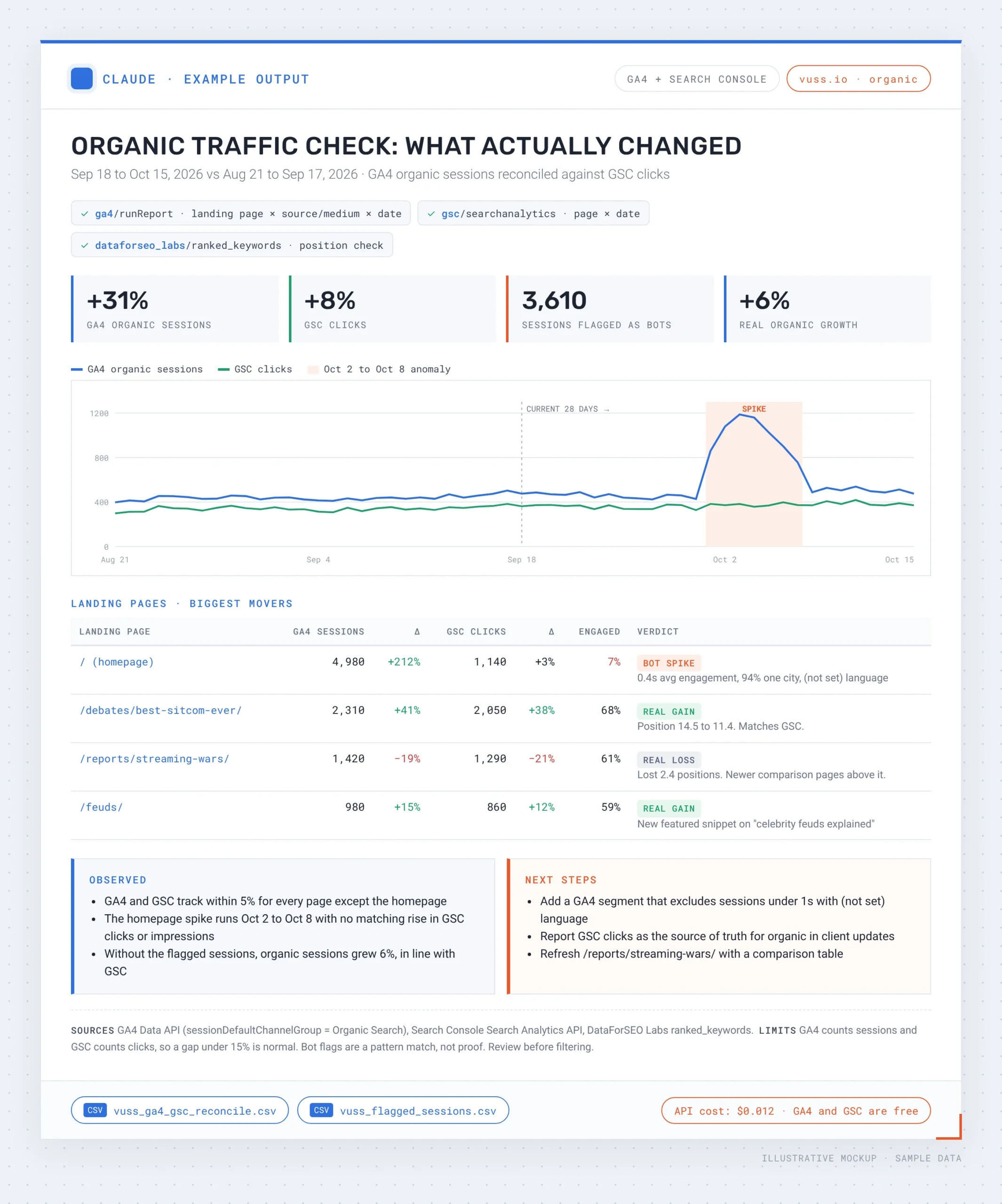
Illustrative mockup of what Claude hands back for vuss.io, built with sample data. Open full size 1 · Open full size 2
AI visibility checks with a defined measurement method
AI search research is useful when you know what the result represents. DataForSEO's AI Optimization suite separates several products: LLM Mentions searches a database covering ChatGPT and Google AI Overviews, LLM Responses queries models directly, and LLM Scraper captures consumer interfaces. They answer different questions, so report them separately.
A result retrieved during a web search isn't necessarily a source cited in the answer. DataForSEO's citation guide separates those fields. For bot logs, keep training crawlers apart from search and user-request agents; Anthropic documents separate roles for ClaudeBot, Claude-SearchBot and Claude-User. A crawl hit doesn't prove a citation or a visit.
See example outputs (2)sample data
Illustrative mockup of what Claude hands back for vuss.io, built with sample data. Open full size 1 · Open full size 2
ClaudeBot more than doubled its share of AI crawler traffic, from 9% to 20%
Share of AI crawler traffic, Cloudflare Radar, May 2026.
The small habits that make this setup useful
Be precise about what should come back, and save what works.
- Ask for the deliverable, not advice. "An SEO audit" leaves a lot for Claude to decide. "Ten implementation tickets with affected URLs and verification steps" is a job you can assess.
- Set the frame up front. Market, date range, files, business goal, output format and a spending limit.
- Save raw data before analysis. Pull a keyword dataset once and reuse it for clustering, the brief and the report. Every surprising recommendation stays traceable.
- Let code do the math. Joins, dedupes, calculations and validation run as scripts; the language model handles interpretation.
- Trim what you feed it. Cutting a Screaming Frog export from about 70 columns to 15 saves 52% of the tokens. More in my Claude cost breakdown.
- Save what worked as a skill. Include the decisions that mattered: exclusions, required evidence, how uncertainty should appear and what needs review. Anthropic's own marketing team works this way.
Keep your instructions current
"Generate FAQ schema" used to be on every SEO task list, but Google stopped showing FAQ rich results on May 7, 2026. For Google's AI features, its documentation says no special AI markup is required. A good workflow checks today's requirements before generating another file.
Where the time comes back
The savings come from pulling, sorting and formatting: the part of SEO that used to fill whole afternoons.
In Keyword.com's 2026 survey, 89% of SEOs using AI save at least 4 hours a week, and a third save more than 10. How much you get back depends on how much of your week is that kind of work.
89% of SEOs using AI save at least 4 hours a week
Teams with AI central to delivery were far more likely to save 7+ hours (81%) than teams still testing it (11%).
The same jobs, manual vs with an agent
Time per task, log scale. Some are vendor claims, so treat them as a direction.
What it costs, and where the value comes from
For focused jobs, the data costs cents. Most of the cost is the subscription and your review time.
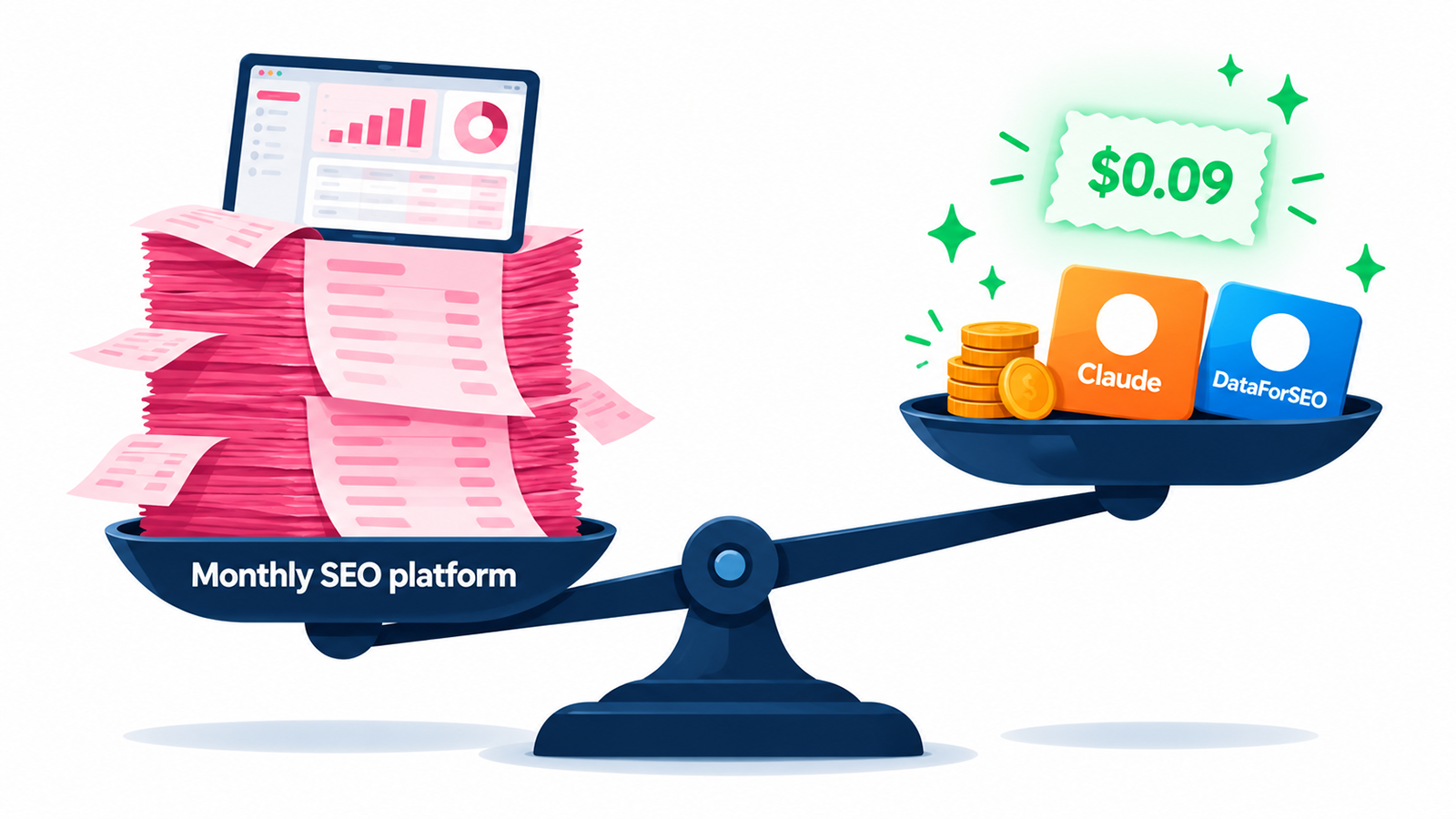
The two runs above used $0.021 and $0.036 of DataForSEO requests. The keyword volumes behind this article (35 terms in two calls) cost $0.18. Those numbers cover search data only, not the AI plan, a crawler license or the time to check the work. Plan for all four.
Here's the same work done both ways. Data costs are DataForSEO's published rates; Claude's work runs inside your subscription.
The everyday setup runs $540 to $756 a year. Semrush Guru is $2,999
Annual cost in USD at list prices.
Whether this replaces a paid SEO platform depends on the work you need. Teams may still value an established interface, saved projects, historical data and ready-made monitoring. This setup shines when your question crosses tools, or when the output you need doesn't exist in a standard dashboard.
| Capability | Claude + DataForSEO | Semrush |
|---|---|---|
| Volumes, SERPs, rankings, competitors, gaps | Yes | Yes |
| Backlinks and AI answer mentions | Yes (pay as you go) | Yes (higher tiers) |
| Traffic estimates | Estimated from rankings | Yes (clickstream) |
| Deep history and a polished UI | You build what you need | Yes |
| Writes the report, fix or page for you | Yes | No |
Does Semrush get its data from DataForSEO?
I've heard the claim and couldn't confirm it, so I won't state it as fact. Semrush's data page says it partners with unnamed third-party providers for Google SERPs, uses a clickstream panel for traffic and its own crawler for backlinks. What is public: plenty of SEO tools openly run on DataForSEO, like SEO Utils.
Claude is the example throughout, but the approach works in other assistants that support tools, files and code execution. OpenAI documents MCP support for Codex. Use the environment you're comfortable with and confirm it can reach the data your task needs.
Start with one page and one decision.
Pick a page you already care about. Supply its content, its Search Console data and a crawl if you have one. Have Claude check the live results through DataForSEO and prepare three changes, each backed by evidence. Set a small spending limit, review the output and ship the strongest one.
Record the change and check performance over a sensible period. When the workflow earns its place, save it as a skill. Then add a second job: a page plan, a fix list, an internal-link review or a recurring report. That's how the knife gets useful: learn what each tool does, pick the one the job needs, and finish with something you can ship.
- Optimization Theory, Priced 8 SEO Jobs on Every Claude Model
- DataForSEO MCP setup
- DataForSEO pricing and July 2026 pricing update
- DataForSEO AI Optimization API
- Claude plans and pricing
- Keyword.com, State of AI and Automation in SEO 2026
- SE Ranking, Claude Code for SEO
- Discovered Labs, Claude Code SEO playbook
- Anthropic, How the growth marketing team uses Claude Code
- Similarweb, AI bot funnel analysis
- Google Analytics MCP
- Google Search documentation updates
- Screaming Frog pricing and Sitebulb pricing (Capterra)
- Semrush, Where Semrush data comes from
- Keyword data: DataForSEO Google Ads search volume API, United States, pulled October 15, 2026
More Writing & Research by Jourdan Rombough
View all research



If AI can't find you, understand you and trust you, it won't recommend you.
Keywords tell you what they typed. Intent tells you what they meant. Fan-out tells you what they'll ask next.
Be a thing, not a string. AI remembers entities, not keywords.
The click isn't dead. It just has to be earned twice.
Schema is the business card you hand to every machine that reads your site.
If Googlebot can't reach it and AI can't parse it, it doesn't exist.
Good SEO grows quietly. Then all at once.
