

- October 29, 2026
- Artificial Intelligence, GEO & AEO, How To
The GEO Lab / Optimization Theory / 2026
THE COMPLETE GUIDE TO GEO
Generative Engine Optimization for SEO Experts
By Jourdan Rombough / Optimization Theory
Version 2.5.2. The web edition, the PDF (95 pages) and the field kit are all current. See what was corrected.
See inside the field manual
95 illustrated pages, free to download. Here are a few of the spreads.
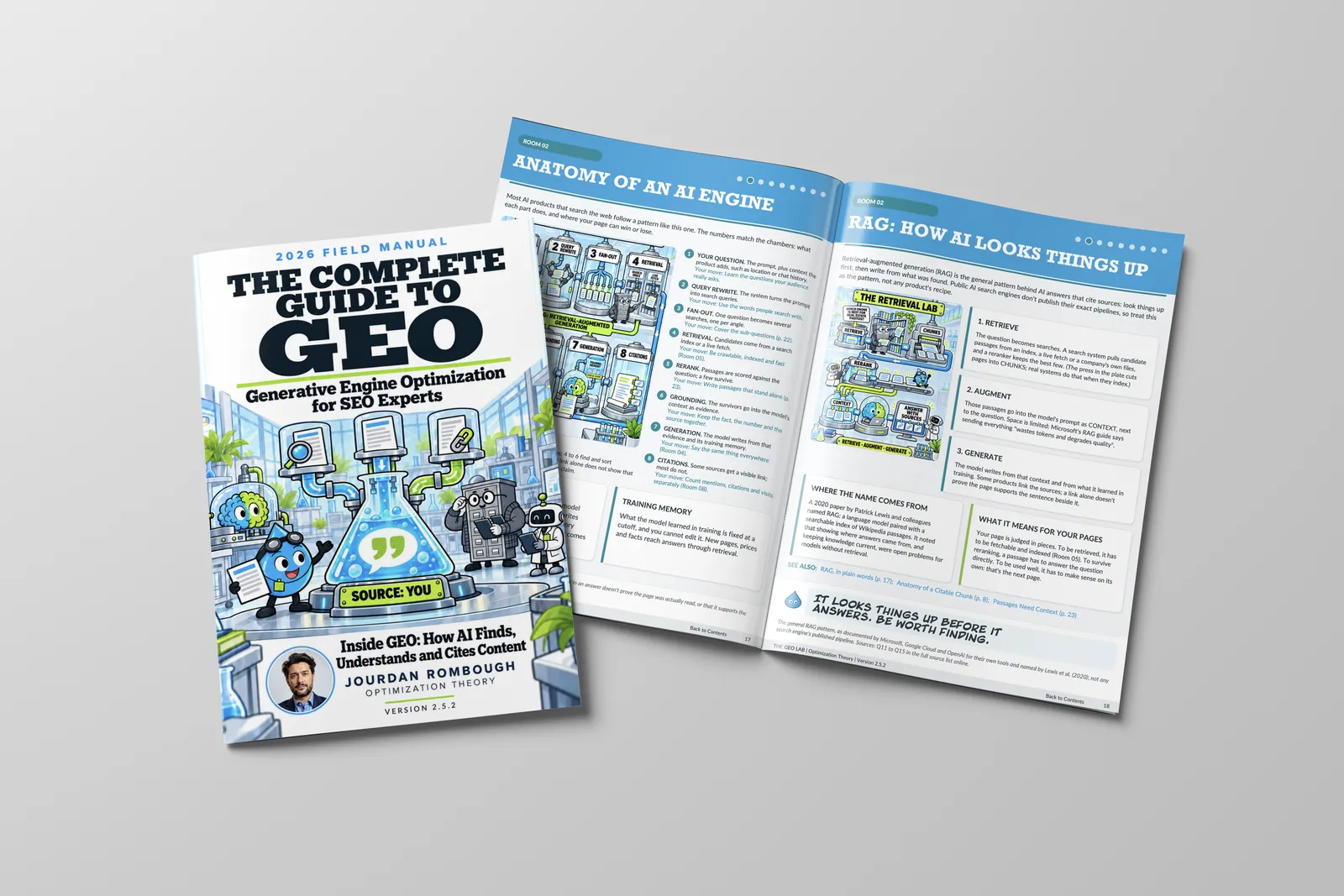
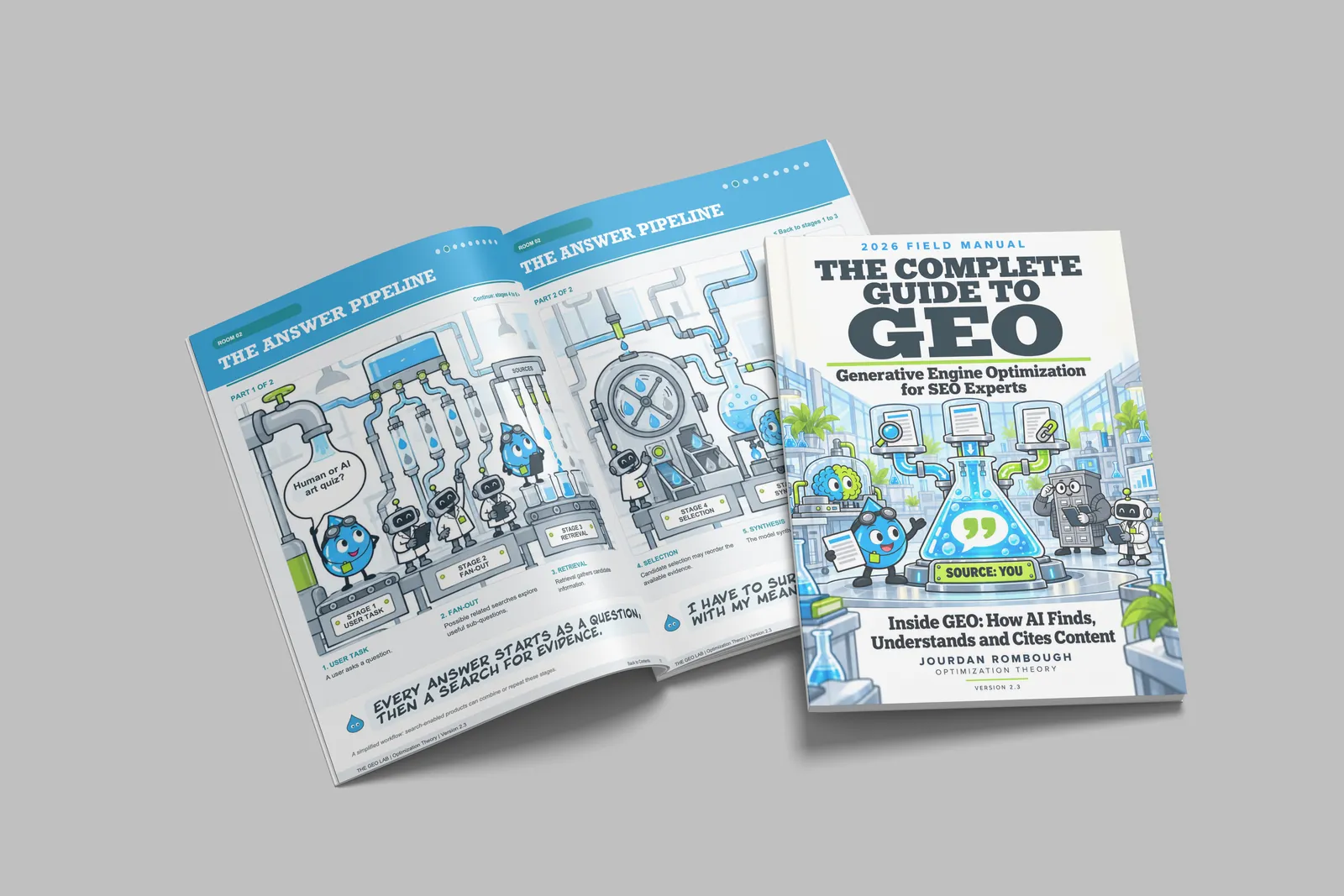
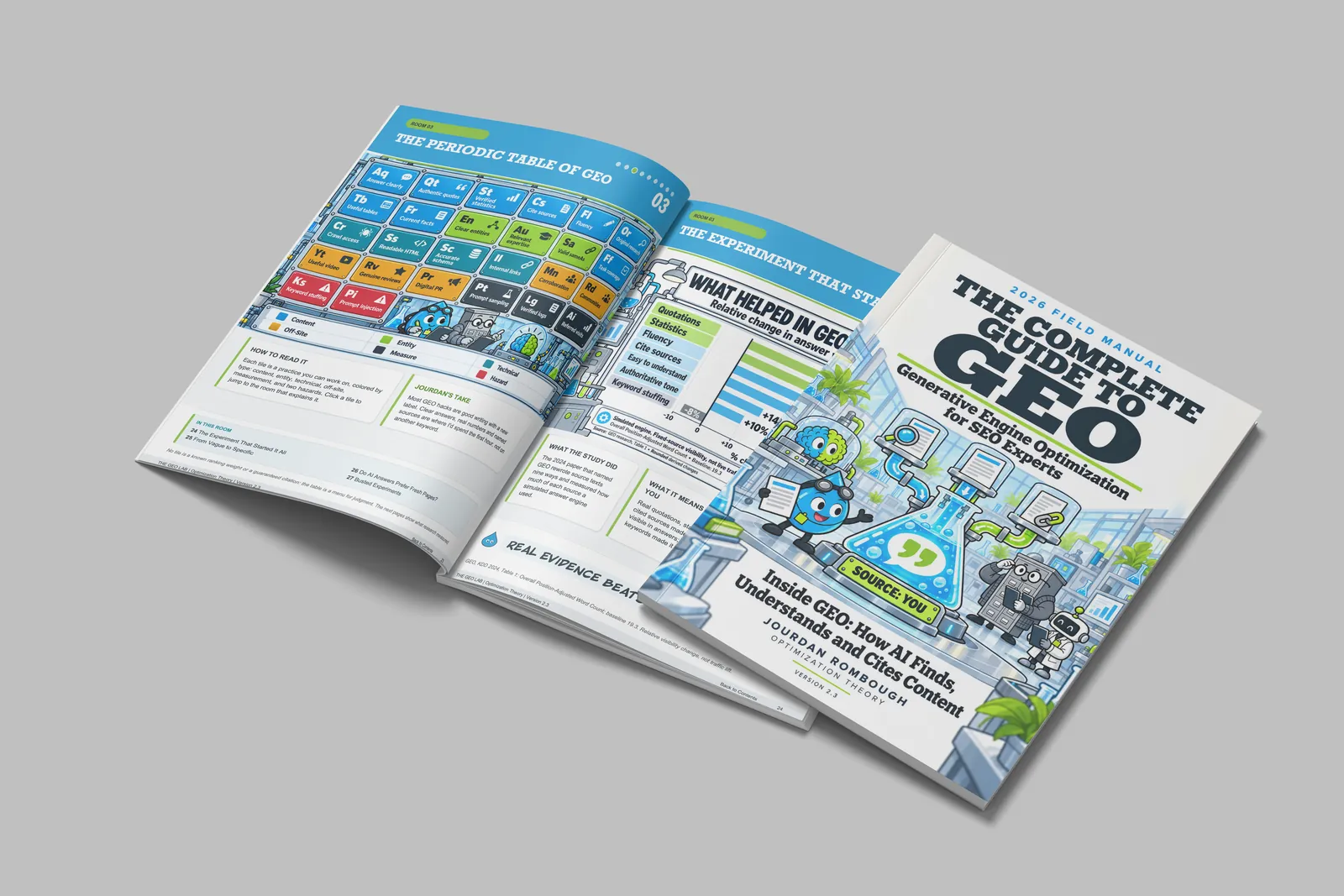
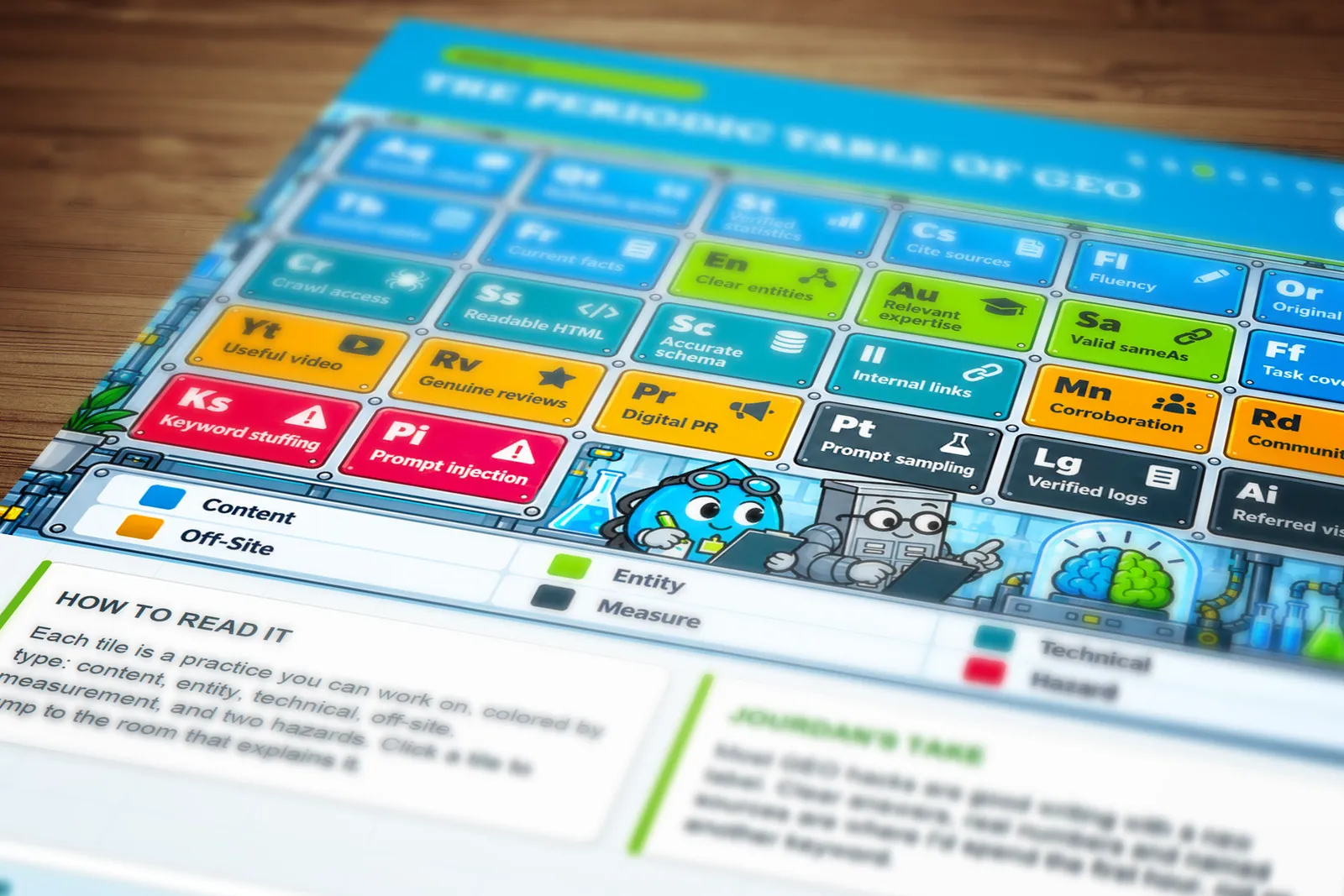
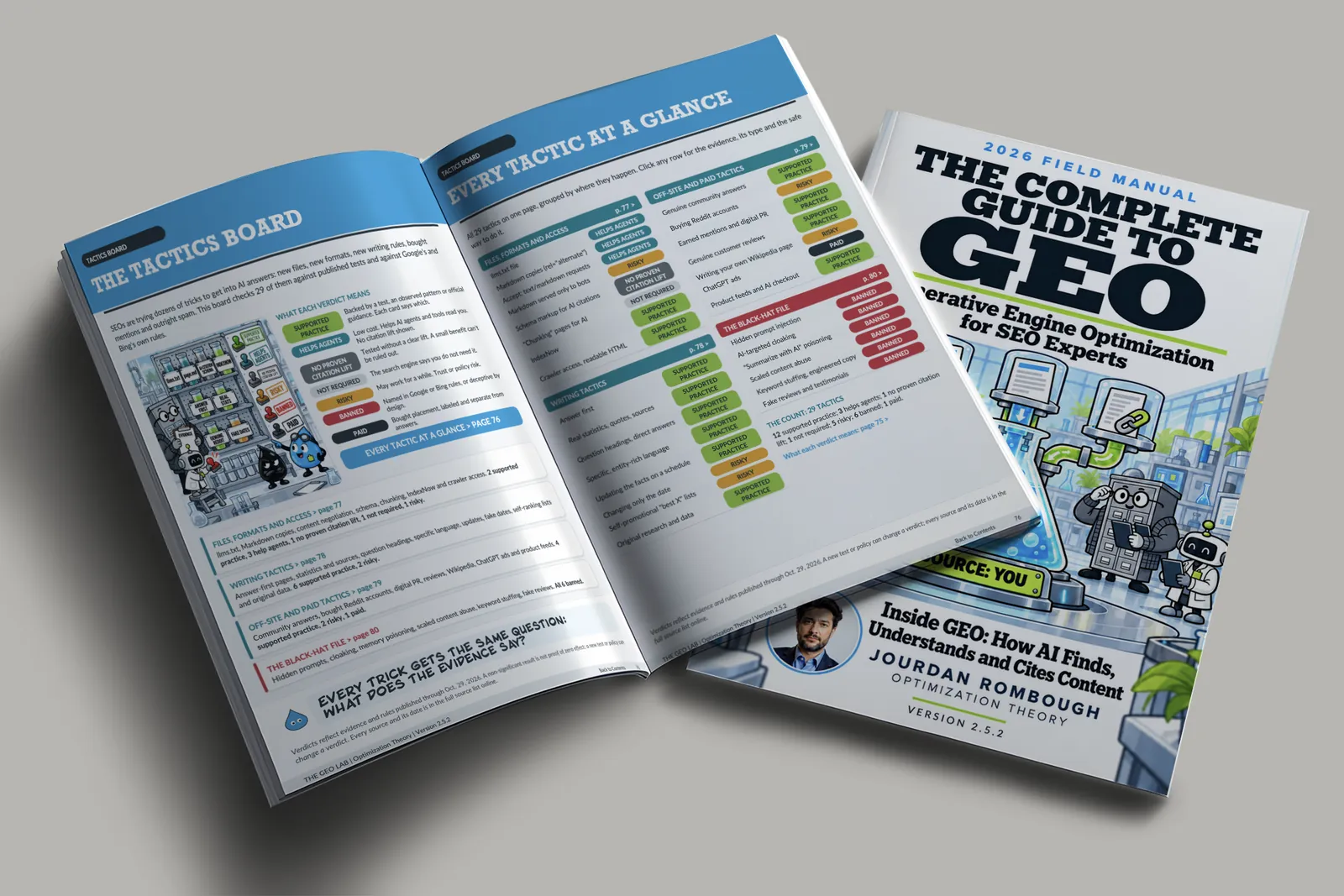
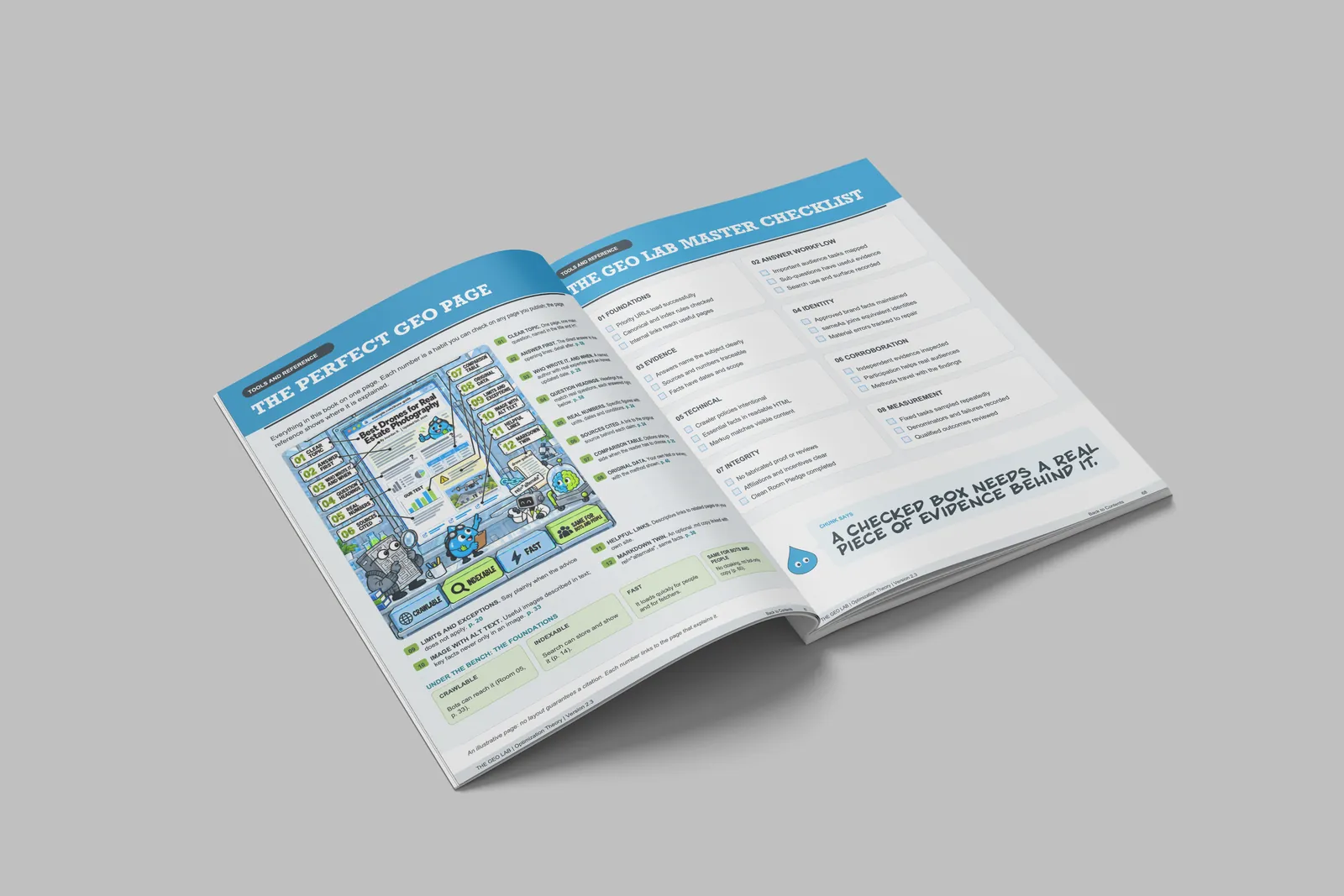
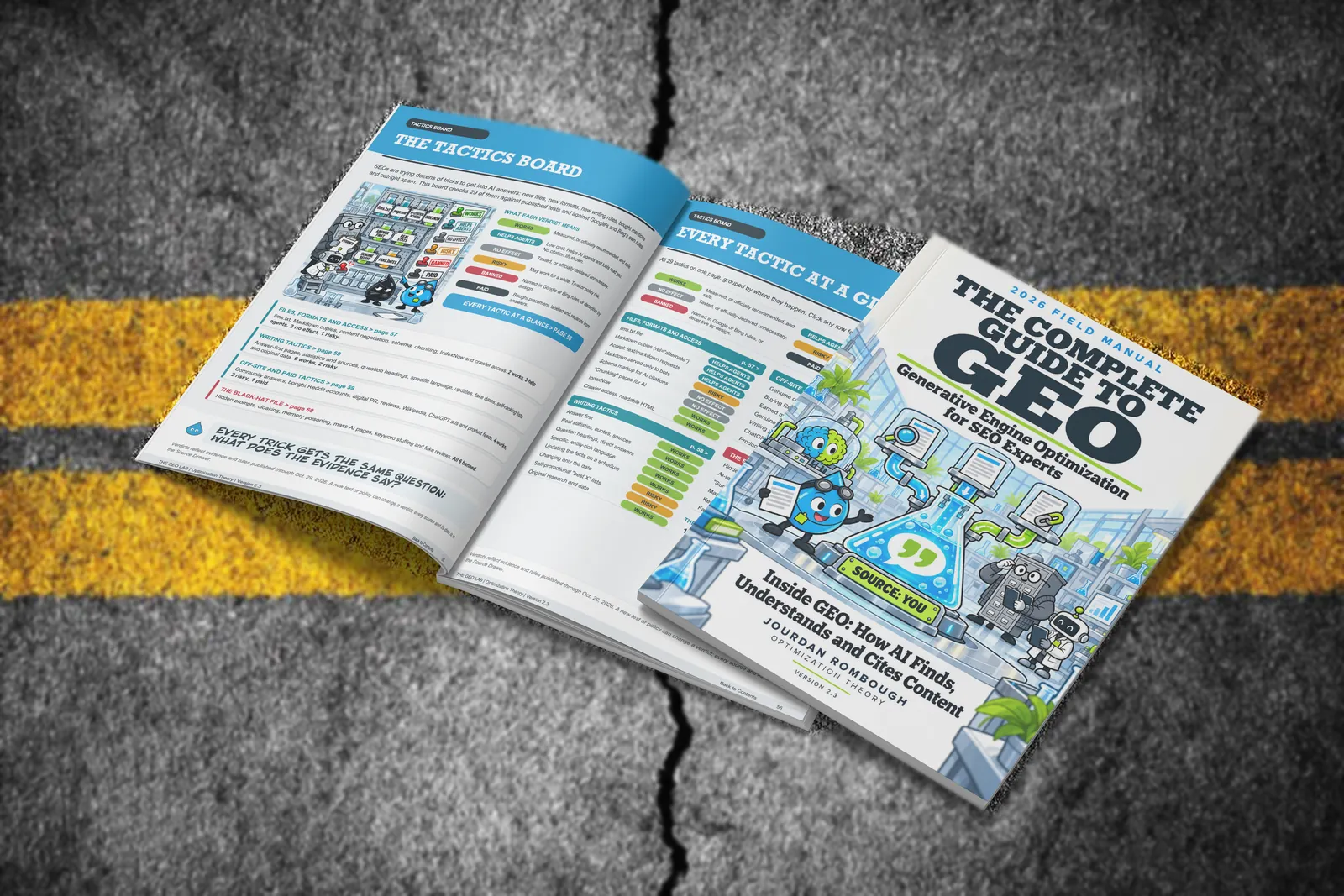
Read the introduction graphic as text
FOLLOW THE EVIDENCE
A field guide to better sources and clearer AI answers.
- DISCOVER: Help people and systems find your useful pages.
- UNDERSTAND: Make the answer, context and limits clear.
- VERIFY: Show the facts, methods and named sources.
- MEASURE: Track citations, visits and useful outcomes.
Useful pages. Checkable claims. Honest measurement.
The central flask is labeled EVIDENCE and SOURCE: YOU.
one connected lab
ready for your field kit
from access to outcomes
Your route through the lab
Nine rooms. One practical way to work.
Work through the manual in order, or choose the question you need to solve. Each room explains the idea, shows what it means on a real site and gives you something concrete to try.
 EXPERIMENT 01The Library FloodsSee why an answer can mention your business without sending a visit.↗
 EXPERIMENT 02Inside the Answer MachineUnderstand what can happen between a customer's question and the answer.↗
 EXPERIMENT 03The Periodic Table of GEOMake useful edits to a page, then test whether they make a difference.↗
 EXPERIMENT 04Brand DNAGive people and assistants a clear, accurate account of your business.↗
 EXPERIMENT 05The Technical AirlockCheck what the relevant crawler or assistant can actually read.↗
 EXPERIMENT 06Growing CulturesPublish work that gives other people a good reason to discuss it.↗
 EXPERIMENT 07Contamination ZoneSpot misleading tactics and avoid turning a weak claim into fake proof.↗
 EXPERIMENT 08Under the MicroscopeCount the right things, and see what a single answer cannot establish.↗
 EXPERIMENT 09The 90-Day ProtocolPlan a small, repeatable test with a clear next decision.↗
Lab orientation
Why this lab exists

Jourdan Rombough
Optimization Theory, Cooperstown, NY. More than 15 years in technical SEO. Builder of AI Citation Trace, PageRank Simulator and Black Hat SEO Terminal.
You already know how to help people find a website. This manual takes the next step: checking what happens when an assistant uses web sources to answer a customer's question. We will choose realistic questions, improve the pages that should answer them and keep a record of what the assistant actually says. The aim is useful, accurate visibility you can investigate and improve, with visits and enquiries measured separately.
Lab safety briefing
- Keep dates, populations and denominators attached to every number.
- Separate mentions, visible citations, referred sessions and business outcomes.
- Treat the apparatus as a teaching metaphor. Engines decide what to consult and select.
- Use authentic quotations, verifiable facts and direct instructions.
- Keep a record of your baseline, intervention, failures and uncertainty.
Meet the lab crew
Read the crew introductions and full roles
From the illustration
- CHUNK
- A passage from a web page, hoping to be quoted in an AI answer.
- THE BRAIN
- The AI model: it mixes what it learned in training with what it looks up.
- THE LAB TECHS
- Crawlers and fetchers that collect pages for search and AI systems.
- PROFESSOR INDEX
- The search index. Classic SEO keeps it running.
- SLUDGE
- Spam, fake reviews and made-up proof that pollute answers.
- THE DIRECTOR
- You: the person who decides what to publish, fix and measure.
Full roles in the manual
Chunk
One passage of your contentCarries the claim, subject and conditions through the answer pipeline.
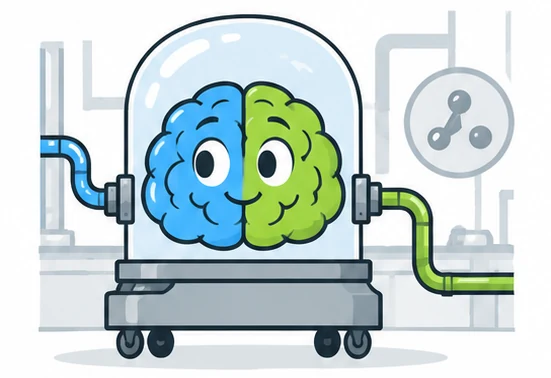
The Brain
The language modelCombines learned knowledge and supplied or retrieved material.
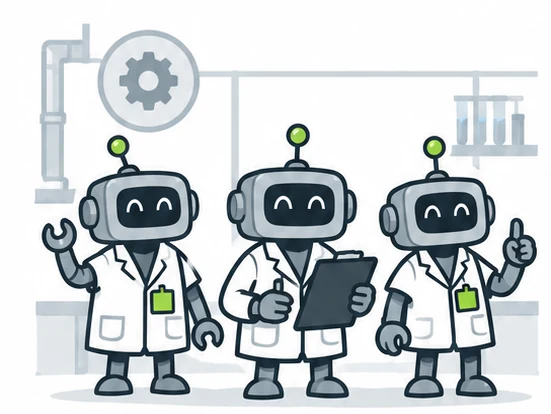
Lab Techs
Crawlers and fetchersTransport sources through provider-specific access routes.

Professor Index
Classic search foundationsKeeps discovery, indexation and coherent site structure working.
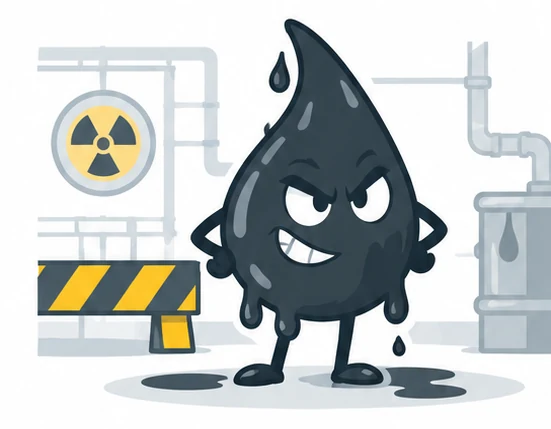
Sludge
Manipulation and false proofRepresents fabricated reviews, hidden instructions and contaminated methods.

The Director
You, the experiment ownerDefines the decision, records the method and judges the result.
GEO in 60 seconds
06. Measure the right outcome
Repeat tasks; separate citations, arrivals and value.
How a search-backed answer gets made
A question can trigger several jobs before a reply appears. This short route keeps those jobs in view; the eight-chamber key in the next room explains them in more detail.
-
Ask
A person asks a question.
-
Search
The system runs several related searches.
-
Retrieve
It gathers candidate pages and passages.
-
Select
It keeps the passages that fit best.
-
Write
The model writes an answer from them.
-
Cite
Some sources get a visible link.
Where your work fits
Be findable
Stages 2 and 3: pages that crawlers can reach and search can index, matching the sub-questions people ask. Explore Rooms 02 and 05.
Be the best passage
Stage 4: self-contained passages with a named subject, a direct answer, evidence and a source. Explore Room 03.
Be described right
Stages 5 and 6: consistent facts about you across the web, and independent sources that back them up. Explore Rooms 04 and 06.
Google: AI optimization and Search guidance; OpenAI API: web search sources and citations
The connected laboratory
Keep the whole system in view.
The rooms follow one connected piece of work: understand the customer's question, improve the source, check access and identity, then repeat the observation. Start at the beginning for the full method, or use the map to find the problem you are working on today.
Find the matching web section for any of the PDF’s 95 pages (Version 2.5.2)
The web edition groups related ideas together and keeps additional explanations in live text. Use these links when moving between the supplied PDF and this page.
- 01 / The GEO Lab
- 02 / Contents
- 03 / Why I Built This Lab
- 04 / How to Use This Guide
- 05 / Meet the Lab Crew
- 06 / GEO in 60 Seconds
- 07 / How an AI Answer Gets Made
- 08 / Anatomy of a Citable Chunk
- 09 / Lab Map
- 10 / The Library Floods
- 11 / The Click Drain
- 12 / Ways Back to the Web
- 13 / The New Engine Room
- 14 / SEO vs. GEO: What Changes
- 15 / SEO Is the Power Plant
- 16 / Inside the Answer Machine
- 17 / Anatomy of an AI Engine
- 18 / RAG: How AI Looks Things Up
- 19 / Chunking: Passages Travel Alone
- 20 / The Answer Pipeline: Part 1
- 21 / The Answer Pipeline: Part 2
- 22 / Query Fan-Out
- 23 / Passages Need Context
- 24 / The Crawl-to-Click Gap
- 25 / Engines Consult Different Shelves
- 26 / The Periodic Table of GEO
- 27 / The Experiment That Started It All
- 28 / From Vague to Specific
- 29 / Do AI Answers Prefer Fresh Pages?
- 30 / Busted Experiments
- 31 / Brand DNA
- 32 / The Entity Molecule
- 33 / The DNA Match Test
- 34 / Repair Wrong Answers
- 35 / Fill Real Decision Gaps
- 36 / The Technical Airlock
- 37 / The Badge Wall
- 38 / Clear the JavaScript Fog
- 39 / Specimen Labels
- 40 / Different Files, Different Jobs
- 41 / Publisher Controls: Choose the Right Lever
- 42 / Publisher Controls: Read the Panel
- 43 / Markdown for Agents
- 44 / Markdown: What the Evidence Says
- 45 / Who Pays for the Crawl
- 46 / Who Pays for the Crawl: Your Settings
- 47 / When the Agent Buys
- 48 / When the Agent Buys: The Timeline
- 49 / Can an Agent Complete the Task?
- 50 / Growing Cultures
- 51 / Web Mentions and AI Visibility
- 52 / Help the Community
- 53 / Useful Video
- 54 / Search With a Camera
- 55 / Evidence to Coverage
- 56 / GEO for the Local Shop
- 57 / Hazard Zone
- 58 / Why Formulas Don't Travel
- 59 / The Clean Room Pledge
- 60 / Under the Microscope
- 61 / The Prompt Test Rack
- 62 / Check the Answer, Then the Source
- 63 / Scoring Answers and Sources
- 64 / The Gauge Panel
- 65 / The Tracker Bench
- 66 / The Tool Shelf
- 67 / How to Run a Tracker the Lab Way
- 68 / Inside the Tracker
- 69 / Reading a Tracker Dashboard
- 70 / From Report to To-Do
- 71 / Built in This Lab
- 72 / The 90-Day Protocol
- 73 / Baseline, Audit, Build
- 74 / Observe, Report, Repeat
- 75 / The Tactics Board
- 76 / Every Tactic at a Glance
- 77 / Files, Formats and Access
- 78 / Writing Tactics
- 79 / Off-Site and Paid Tactics
- 80 / The Black-Hat File
- 81 / The Black-Hat File: Case by Case
- 82 / 90 Days of AI Traffic on vuss.io
- 83 / The Perfect GEO Page
- 84 / The GEO Lab Master Checklist
- 85 / Field Kit: Robots Policy
- 86 / Field Kit: Entity Graph
- 87 / Field Kit: Prompt Panel
- 88 / Field Kit: GA4 AI Traffic
- 89 / Field Kit: Markdown Alternates
- 90 / Field Kit: Test Your Markdown Setup
- 91 / Glossary and Lab References
- 92 / Glossary: Newer Terms
- 93 / Chunk Made It. Will Yours?
- 94 / How This Guide Was Made
- 95 / Back Cover
Corrected web edition / 2.5.1
What was corrected
This web edition updates crawl controls, the Cloudflare pilot’s denominator and shipped settings, merchant checkout paths, platform-specific review rules and the scaled-content-abuse label. It adds a publisher-controls matrix, an agent-usability check and a separate answer-quality rubric.
- Crawl settings and partner pilots
- Product discovery and checkout paths
- Review rules differ by platform
- Choose the right publisher control
- Can an agent complete the task?
- Check answer and source quality
The downloadable field kit and the PDF are both Version 2.5.2. The prompt-panel CSV keeps the same 22 columns, and the 95-page PDF includes the changes on this page.
Corrected edition / 2.5.2
What changed in v2.5.2
Version 2.5.2 corrects v2.5.1 and adds sections on RAG and chunking, AI visibility trackers and a week-by-week 90-day protocol. Each correction was checked on Nov. 2, 2026 against the sources listed as Q1 to Q20 (and K1 to K29 for the trackers) in the Source Drawer.
Earlier editions: what changed in v2.5 and what was corrected in v2.5.1.
New in v2.5.2
- RAG: how AI looks things up, from retrieval to a cited answer New
- Chunking: why every passage has to make sense on its own New
- The Tool Shelf: eight AI visibility trackers compared New
- How to run a tracker the lab way: an eight-step method New
- Inside the tracker: how answers are collected and counted New
- Reading a tracker dashboard: what each panel means, and what it doesn't New
- From report to to-do: a filled-in record and a holdout comparison New
- The 90-day protocol, week by week, with what can move in 90 days New
Corrected and updated
- The Library Floods: what this means for you
- Inside the Answer Machine: one question, traced
- The GEO benchmark: its figures measure fixed-source answer visibility
- From vague to specific: try it on your own page
- Fresh pages: the overall study size, 16.975M cited URLs
- Busted experiments: what to do instead
- The entity molecule: telephone, the service's provider bond and the person's sameAs
- The badge wall: what the Extended tokens and CCBot are
- Schema types: content the markup must match; examples are not complete property lists
- When the agent buys: why it matters and what helps
- Brand-mention research: Spearman ranges from −1 to +1; positive values shown
- Help the community: why it matters, the scene on the board and what not to do
- Three runs are a starting check for variation, not a sample size
- Crawler access: blocked pages and JavaScript-only facts, worded precisely
- Suspected automation: investigate it, label it and report its effect
- Markdown kit: a limited nginx demo, q-values and tests for q=0 and lookalike types
- Contact details: email and LinkedIn
- 49 new sources: Q1 to Q20 and K1 to K29
Updated November 3, 2026
- How this guide was made: where the facts come from, what the source IDs mean, and who made what New
- The PDF is now 95 pages: its eight printed Source Drawer pages now live only in this page's Source Drawer
- Source Drawer: P1 to P12 now link like every other source ID, and P5 (Google's Universal Cart launch) is added
- Image captions rewritten in plain words; on wider screens each illustration now stays beside its text as you scroll
The new cover and version labels match the 95-page PDF. In the field kit, only README.md and markdown-alternates.txt changed.
The Library Floods
Think of the library as the web you already know: pages, links, search indexes and people looking for help. The flood is the growing volume of answers assembled from that material. Your page may become part of someone's research without receiving the visit you expected. We'll start by separating the things that often get lumped together: being found, being named, being cited and receiving a useful visit. Then we'll choose the customer questions worth testing, rather than trying to be visible everywhere at once.
Jourdan’s take
When someone asks an assistant which tool to buy or how to solve a problem, they may read the answer before they ever see your website. I still care about rankings, because people and search systems still need to find good sources. But I also want to know what happens after a source is found. Does the answer name the business? Does it describe the offer correctly? Does a reader have a good reason to visit? Those are different questions, and each deserves its own check.
Worked example: Decision Map
Take a shop that sells drones for real estate photography. Before anyone buys, they ask the same few questions: which camera is good enough for listing photos, which flight rules apply where they shoot, and what the whole setup costs. Write those questions down first. They are the decisions the page has to support, and they become the tasks you check in AI answers later. This is a worked illustration, not a measured case: use it to map your own page's decisions before you change anything.
What this means for you
Keep doing the SEO basics: they are how your pages get found in the first place. Then ask one more question of every important page: if an answer quoted only one paragraph, would it get the facts right? Clear subjects, real numbers with dates and named sources make that easier.
Why generated answers change the job
In a familiar search journey, the result is an invitation to visit a page. A generated answer can do some of that page's work inside the search or chat experience: explain the process, compare the options or recommend a next step. The source may still matter even when the reader never opens it.
That creates several jobs for an SEO expert. Help the right page get found. Make its explanation useful enough to draw on. Check whether the answer preserves the facts. Then measure any visits and enquiries separately, so a visible brand mention doesn't get mistaken for a business result.
Once you can distinguish an answer's visibility from a website visit, the click studies become much easier to interpret.
What happens when the answer comes before the click
A useful answer can satisfy a question before the reader needs to leave the results page. That doesn't mean every AI summary removes a visit, or that every missing visit would have become a customer. It does mean we should question the old habit of treating impressions, rankings and clicks as one smooth progression.
The studies below describe different parts of that change. Pew observed how people browsed when a summary was present. Ahrefs compared search click-through rates using a different method. Keep those findings separate, and use them to form a question about your own site: which searches still give a reader a reason to click through?
| Pew browsing outcome | With a summary | Without a summary |
|---|---|---|
| Traditional-result click rate | 8% | 15% |
| Browsing-session ending rate | 26% | 16% |
900 U.S. adults. A session ending is a browser exit of at least five seconds. The comparison is observational.
58% lower position-one CTR
Ahrefs compared observed desktop CTR when an AI Overview appeared with a modeled counterfactual. This is a different study from the Pew comparison.
1% clicked a summary source
The denominator is visits to summary-bearing search-result pages in Pew's sample, not all searches or people.
Oct. 15, 2026: Google added more inline links to AI Mode and AI Overviews and began testing a section for official sites; it gave no click numbers. See Ways Back to the Web.
Read the research: Pew Research Center: browsing with AI summaries; Ahrefs: AI Overviews and click-through rates; Google: More ways to connect with the web from Search.
The next decision is which answer experiences deserve your attention in the first place.
In Pew's 2025 study of 900 U.S. adults, people clicked a regular result on 8% of visits with an AI summary and 15% without one, and more sessions simply ended (26% vs. 16%). It's an observed pattern, not proof the summary caused it.
Ways Back to the Web New in v2.5
7x
People using Preferred Sources have grown more than sevenfold since the start of 2026 (Google, Oct. 15, 2026).
WHAT GOOGLE CHANGED, OCT. 15, 2026
More inline links, placed higher in answers. A test section for official sites on task queries. News carousels in more places that highlight Preferred Sources. Related-article links with thumbnails. Clickable creator and publisher names on video results (test).
DO THIS
Write passages specific enough to earn the inline link. Make the one official page for each task (booking, support, pricing) unmistakable. If you publish timely articles, add Google's "Add as a preferred source on Google" button. Use one creator name across your videos and your site.
ChunkA link inside the answer is a door. Make the room behind it worth entering.
Google shared no click data with the announcement. Compare your own Search Console clicks before and after.
Read the sources: Google: More ways to connect with the web from Search; Google: How to select your preferred sources in Top Stories.
Choose the engines your audience actually uses
The audience figures below explain why AI answers deserve attention, but they aren't a market-share table. A monthly user count and a weekly user count answer different questions, and one person may use several products. Adding them together would create a misleading total.
For an SEO programme, the more useful question is narrower: where do your customers research this particular decision? A developer choosing an API may behave differently from a homeowner looking for a local service. Begin with the products you hear about in customer conversations and the assistants already sending recognizable visits, then test the same task in each selected experience.
| Product | Audience figure | Metric and context |
|---|---|---|
| Google AI Mode | 1B+ | Monthly active users, company reporting, July 2026 |
| Gemini app | 950M | Monthly active users, company reporting, July 2026 |
| ChatGPT | 1.2B | Weekly users, OpenAI DevDay 2026 recap, Sept. 29, 2026 |
Figures as each company reported them; the sources are linked below and in the Source Drawer. Claude, Perplexity and Copilot are additional products and modes to investigate for your audience.
Read the research: Google: company audience figures; OpenAI: company audience figures.
With the testing scope chosen, you can connect this work to the SEO practices you already know.
WHY THE NUMBERS DON'T ADD UP. Monthly users counts anyone active once in a month; weekly users counts a single week. Many people use several assistants, so the figures overlap. Read them as scale, not market share.
Build on the SEO work you already do
You don't have to abandon a sound SEO programme to start working on generated answers. Your crawl checks, useful pages, internal links and understanding of customer intent remain valuable. GEO adds a closer look at how an answer uses and describes the material it finds.
For example, a service page can rank and still leave an assistant unsure which region the business serves. A comparison page can be accessible yet omit the testing conditions behind its recommendation. These are diagnosable problems. The examples below connect familiar SEO work with an extra question to ask when reviewing an answer.
Keep the SEO foundation
Add a question about what happens when a source becomes part of an answer.
Crawling and indexing
Can the relevant search or retrieval system reach the page and read its essential content?
Helpful pages
If one passage is used in an answer, will its subject, facts and limitations remain clear?
Search intent
What decision is the person making, and which details do they need before they can make it?
Links and reputation
Which credible sources support the claim, and do they describe the same facts?
Visits and enquiries
Was the business named, was its site linked, and did anyone arrive or take a useful next step?
Monitoring over time
Does the pattern persist when you repeat the question under comparable conditions?
Before editing for answers, make sure the foundations can deliver the material you want an assistant to use.
SEO keeps the power on
A beautifully written explanation is of limited use to a retrieval system that can't reach it. Access, coherent site structure and clear main content help put the right source within reach. For Google's AI search experiences, the guidance cited here continues to rely on the foundations of Search.
That doesn't make access a promise of selection. An assistant may find several eligible pages and use a different one, or answer without consulting yours. Research such as C-SEO Bench also reminds us that what reaches the model and where it appears can affect the result. We control the quality and availability of our source more directly than we control its selection.
Now we can open the answer machine and distinguish material learned earlier from sources consulted for the current request.
Inside the Answer Machine
An assistant doesn't always search the web before answering. It may rely on information learned during training, use material supplied in the conversation, search for outside sources or combine several of those routes. That distinction matters when you're diagnosing a missing brand or an outdated fact. In this room we'll follow a simplified search-assisted answer from the user's request to the links they can see. The questions it raises are the useful part: what was searched, what was available and what did the answer actually say?
Jourdan’s take
A useful way to edit a page is to imagine that someone has copied just one paragraph into a message. Would the recipient know which product you're discussing, what the number means and when it was true? Assistants can encounter similarly limited pieces of a page. I put the essential context beside the claim because it helps any reader understand it. It also gives us something concrete to check when an assistant summarizes the page incorrectly.
Worked example: One Claim, Six Stages
Take one fact from the drone shop's buying guide: 'flight time 34 minutes.' On its own, the number could describe almost any drone. A useful passage names the model, the conditions of the test (payload, wind, battery temperature) and the date it was measured, so the claim keeps its meaning through retrieval and synthesis. You can then inspect an answer for a specific error: did it keep the model and the conditions, or attach the number to the wrong drone? This is a way to test a page, not a finding about any engine.
One question, traced: which drone is best for real estate photos?
What it already knows
From training, the model knows general facts, like what a gimbal does or why sensor size matters. That memory stops at a cutoff date. For you: you can't edit it.
What it looks up
With search on, it fetches current pages: reviews, prices, local flight rules. For you: this is where your page can get in, if it can be fetched, is up to date and states the answer plainly (see RAG: How AI Looks Things Up and Chunking: Passages Travel Alone).
- 01User task
- 02Fan-out
- 03Retrieval
- 04Selection
- 05Synthesis
- 06Source links
Two ways information can reach an answer
An assistant can respond using patterns and information learned during training. It can also work with material supplied for the current task, such as a document in the chat or pages returned by a search tool. A single answer may combine these routes, and the interface may show only part of what happened.
This is why a training crawler visit, a search citation and a referred session are different events. Allowing a crawler doesn't establish that your page trained a model. Seeing your link in an answer doesn't reveal every source the model used. Start with what you can observe, and avoid assigning a cause that the product hasn't exposed.
Information represented through model training.
External material supplied or consulted for the task.
An answer may use either or both inputs. Record whether search was used.
When search is used, a broad customer question may lead to several narrower information needs.
One question can create several searches
Someone asking for the best drone for real-estate photography is making several decisions at once. They may need to compare camera performance, photo and video requirements, total cost and operating restrictions. A search-assisted system can explore related questions before it composes a recommendation. That's the idea behind query fan-out.
For content planning, this is a reason to understand the whole decision rather than repeat the original phrase. A careful test of low-light image quality may be useful even if it doesn't rank for the broad purchase query. The citation study below illustrates that citations and rankings for that same query don't map neatly onto one another; it doesn't reveal the assistant's hidden searches.
| Organic ranking bucket | Share of cited URLs |
|---|---|
| Top 10 | 37.1% |
| Positions 11 to 100 | 26.2% |
| Outside the top 100 | 36.7% |
Ahrefs: 863,000 keyword results and 4 million cited URLs. These are organic-only rank buckets for the same query.
Read the research: Ahrefs: organic rankings and AI Overview citations; Google: AI optimization and Search guidance.
Those information needs give us the starting point for following an answer from request to retrieved material.
Ahrefs looked at 4 million cited URLs: 37.1% ranked in the top 10 for the same query, 26.2% ranked 11 to 100 and 36.7% ranked outside the top 100. Track citations and rankings as two separate things.
TRY IT ON YOUR TOPIC. List the smaller questions inside one customer question. For a drone buyer: which camera handles interiors, what the flight rules allow near homes, what a full kit costs. Each can be a focused section, and a separate chance to be the source an answer uses.
From the request to candidate sources
The first half of this simplified workflow is about gathering material. The person describes a task. The system may turn that task into related searches, then retrieve pages or other material that could help. A source has to be available through the route being used before it can be considered in that particular retrieval step.
You can use these stages to make an audit more precise. If a page cannot be fetched, investigate access. If it answers a different question, investigate relevance. If the necessary facts are missing from its main content, improve the source. None of these checks requires us to pretend we can see every internal query or ranking decision.
Read the eight chambers
The numbered chambers in the illustration separate what the system does from the part of the source you can improve. Use the key to name a specific problem instead of treating every missing citation as the same failure.
-
Your question
The prompt, plus context the product adds, such as location or chat history.
Your move: Learn the questions your audience really asks.
-
Query rewrite
The system turns the prompt into search queries.
Your move: Use the words people search with.
-
Fan-out
One question becomes several searches, one per angle.
Your move: Cover the sub-questions.
-
Retrieval
Candidates come from a search index or a live fetch.
Your move: Be crawlable, indexed and fast.
-
Rerank
Passages are scored against the question; a few survive.
Your move: Write passages that stand alone.
-
Grounding
The survivors go into the model's context as evidence.
Your move: Keep the fact, the number and the source together.
-
Generation
The model writes from that evidence and its training memory.
Your move: Say the same thing everywhere.
-
Citations
Some sources get a visible link; most do not.
Your move: Count mentions, citations and visits separately.
RAG, in plain words
Retrieval-augmented generation: the model looks up evidence (stages 4 to 6) and writes from it, instead of answering from memory alone. That lookup is the door your page comes through. How it works: RAG: How AI Looks Things Up.
Training memory
What the model learned in training is fixed at a cutoff, and you cannot edit it. New pages, prices and facts reach answers through retrieval.
Google: AI optimization and Search guidance; OpenAI API: web search sources and citations
HOW TO READ THE MACHINE. Stages 1 to 3 turn a question into searches; 4 to 6 find and sort evidence; 7 and 8 write and link. This is a simplified model, not any one company's system. A link in an answer doesn't prove the page was actually read, or that it supports the claim next to it.
Read or copy the illustration labels
- ANATOMY OF AN AI ENGINE
- 1 YOUR QUESTION
- 2 QUERY REWRITE
- 3 FAN-OUT
- 4 RETRIEVAL
- SEARCH INDEX
- LIVE FETCH
- 5 RERANK
- 6 GROUNDING
- 7 GENERATION
- 8 CITATIONS
- TRAINING MEMORY
- FIXED AT CUTOFF
- RAG: RETRIEVAL-AUGMENTED GENERATION
A user asks a question.
Related searches can explore sub-questions.
Candidate material is gathered.
Finding a source is only the beginning; the next steps determine what reaches the final answer.
RAG: How AI Looks Things Up Web v2.5.2
Retrieval-augmented generation (RAG) is the general pattern behind AI answers that cite sources: look things up first, then write from what was found. Public AI search engines don't publish their exact pipelines, so treat this as the pattern, not any product's recipe.
1. RETRIEVE
The question becomes searches. A search system pulls candidate passages from an index, a live fetch or a company's own files, and a reranker keeps the best few. (The press in the plate cuts pages into CHUNKS; real systems do that when they index.)
2. AUGMENT
Those passages go into the model's prompt as CONTEXT, next to the question. Space is limited: Microsoft's RAG guide says sending everything "wastes tokens and degrades quality".
3. GENERATE
The model writes from that context and from what it learned in training. Some products link the sources; a link alone doesn't prove the page supports the sentence beside it.
WHERE THE NAME COMES FROM
A 2020 paper by Patrick Lewis and colleagues named RAG: a language model paired with a searchable index of Wikipedia passages. It noted that showing where answers came from, and keeping knowledge current, were open problems for models without retrieval.
WHAT IT MEANS FOR YOUR PAGES
Your page is judged in pieces. To be retrieved, your content must be accessible through the route being used. For index-based search, it needs to be available in the relevant index (Room 05); direct fetches and supplied files use other routes. To survive reranking, a passage has to answer the question directly. To be used well, it has to make sense on its own: that's the next section, Chunking: Passages Travel Alone.
See also: RAG, in plain words; Anatomy of a Citable Chunk; Passages Need Context.
ChunkIt looks things up before it answers. Be worth finding.
The general RAG pattern, as documented by Microsoft, Google Cloud and OpenAI for their own tools and named by Lewis et al. (2020); not any search engine's published pipeline.
Read the sources: Lewis et al.: Retrieval-Augmented Generation for Knowledge-Intensive NLP Tasks (NeurIPS 2020); Microsoft Learn: Retrieval-augmented generation in Azure AI Search; Microsoft Learn: Chunk large documents for vector search; OpenAI API docs: File search; Google Cloud: What is retrieval-augmented generation (RAG)?.
Chunking: Passages Travel Alone Web v2.5.2
AI search systems rarely use a whole page. They store and fetch it in pieces, so every passage has to work without its neighbors.
WHAT CHUNKING IS
Before a system can search a page, it cuts it into chunks, often a few paragraphs long, so each part can be matched on its own. Microsoft suggests starting at about 512 tokens (roughly 2,000 characters), with some overlap so an idea isn't cut in half.
EMBEDDINGS AND VECTOR SEARCH
Each chunk is turned into an embedding: a long list of numbers that stands for what the text means. Similar meanings get similar numbers. Vector search turns the question into numbers too and returns the closest chunks, even when they share few words.
KEYWORDS PLUS MEANING
Many systems run a keyword search and a vector search side by side (hybrid search), then a reranker re-scores the best results by meaning. Exact names, model numbers and prices still matter, because the keyword half matches them directly.
ROOM IS LIMITED
Only the top few chunks reach the model. A chunk that leans on the paragraph before it ("it", "this model", "as above") arrives without it, and the model has to guess or skip it.
WHAT MAKES A PASSAGE RETRIEVABLE
- It stands alone: no "it" or "this" that points to another paragraph.
- It names its subject, in the words people search with.
- Its facts are in the delivered HTML, not added later by scripts (see Clear the JavaScript Fog).
- It sits under a clear heading that says what the section answers. Some systems cut chunks at headings.
See also: Anatomy of a Citable Chunk; RAG, in plain words; Passages Need Context.
ChunkEvery paragraph should make sense on its own.
Chunk sizes and methods differ by system, and public AI search engines don't publish theirs. Google says content needs no special "chunking" for its AI features (see the Tactics Board); these are habits of clear writing.
Read the sources: Microsoft Learn: Retrieval-augmented generation in Azure AI Search; Microsoft Learn: Chunk large documents for vector search; OpenAI API docs: File search; Google Cloud: What is retrieval-augmented generation (RAG)?; OpenAI API docs: Retrieval (vector stores and semantic search).
From candidate sources to the answer you see
Retrieved material still has to be selected and used. A system may reorder candidates, work with only part of a page and combine information from several sources while drafting its answer. The visible links at the end are a further part of the product experience, not a complete transcript of those internal choices.
That distinction changes how you read a citation. A link tells you the product has associated a source with the answer. It doesn't automatically mean the source supports every sentence, that the answer is correct or that the reader visited. Follow the link, locate the relevant passage and compare the actual claim before counting an appearance as accurate representation.
Candidates may be reordered.
The model composes an answer.
Some supporting sources receive links.
This is where writing a passage with its own essential context becomes especially useful.
Write passages that still make sense on their own
A paragraph that begins 'It improves results by 30%' asks a reader to recover the subject, measurement and comparison from somewhere else. That's inconvenient on the page and risky when the paragraph is quoted or summarized on its own. Name the thing being measured and keep the important conditions close to the number.
You don't need to repeat the entire article in every paragraph. Give each section a useful heading, develop one clear idea and include enough context to understand the main claim. Keep the full page coherent too: breaking a strong guide into dozens of thin fragments can make it harder for people to understand the topic.
Even a clear, accessible passage may be fetched far more often than it sends a person to your website.
TRY THIS TEST. Copy one paragraph from your page into a blank document and read it cold. If you can't tell what "it" refers to, which product or place is meant, or where a number came from, put those words back into the paragraph itself. A passage that keeps its subject and its source can be quoted without being misread.
A crawler visit isn't a customer visit
Server logs and analytics measure different kinds of activity. A bot may request a page to collect material, update a search system or respond to a user's request. A referred session means a browser arrived at your site. One is not a substitute for the other, and neither by itself tells you whether someone became a customer.
Cloudflare's observations below show how large the gap between crawling and referred visits can be in a particular collection window. The provider ratios are not scores for how well your content performs. Their practical value is to remind us to monitor bot access and human arrivals separately, using the right records for each.
| Purpose | Share |
|---|---|
| Training | 79% |
| Search | 17% |
| User actions | 3.2% |
| Provider | Crawl-to-referral ratio |
|---|---|
| Anthropic | 38,066:1 |
| OpenAI | 1,091:1 |
| Perplexity | 195:1 |
| 5.4:1 |
These are volume ratios in Cloudflare observations, not unique people, conversions, or a measure of content quality.
Read the research: Cloudflare: AI crawling and referrals.
The sources an assistant cites also vary by product and by the questions included in a study.
In July 2025, Cloudflare counted 38,066 pages crawled for every visit Anthropic sent back, 1,091 for OpenAI, 195 for Perplexity and 5.4 for Google. Those ratios measure crawl volume, not people or sales, so check bots in your logs and visitors in your analytics.
Different answer experiences draw on different sources
A citation study can show which domains appeared often in the answers it monitored. That is useful background, especially when you're deciding whether to investigate forums, video or reference sites. It doesn't tell you that every assistant always prefers those sources, or that your audience asks the same questions as the study's panel.
Read the chart as a description of a defined sample. Then bring the question back to your own work: for the tasks you care about, which sources repeatedly appear, what do they contribute and could your business publish something equally useful? The answer may be a better source on your own site, a genuine contribution elsewhere or both.
Read or copy the illustration labels
- SIMILARWEB
- JAN.-FEB. 2026
- CHATGPT SHELF
- WIKIPEDIA
- U.S. SAMPLE.
- AI MODE SHELF
- FANDOM
- WIKIPEDIA
- YOUTUBE
- SAMPLE
13.15%
11.97%
7.16%
5.21%
4.91%
4.19%
Common scale: 0 to 15%
Share of tracked citation events in Similarweb's monitored U.S. prompts. Surface-specific samples; not all real-world queries, users, or referred traffic.
Update, Aug. 2026: Promptwatch reported Reddit's share of ChatGPT Search citations fell from a 3.83% average (July 18 to Aug. 7) to 0.52%, an 86.4% drop. Cause unconfirmed; Promptwatch has not ruled out a data issue. Different tracker and sample from the chart above.
Read the research: Similarweb: citations across monitored prompts; Axios: Reddit fades from ChatGPT citations (Promptwatch data).
With the answer process in view, we can choose content improvements that address a real gap.
The Periodic Table of GEO
The periodic table is a menu of practices you can use when a page has a specific problem. It isn't a recipe in which adding five elements produces a citation. A confusing product description may need a clear answer and a comparison table. A research claim may need its sample size, method and source. An old guide may need a substantive update. We'll use the table to choose changes that make sense for the reader, look at what the early GEO research actually tested and rewrite a real opening without inventing the missing facts.
Jourdan’s take
I would rather improve one genuinely useful answer than scatter another hundred phrases across a page. The first edits I look for are ordinary ones: answer the question sooner, explain a number, name a source and remove a claim we can't support. Those changes help a person make a decision, even when no assistant cites the page. If we want to know whether they also change AI visibility, we need a baseline and repeated observations instead of treating a nicer paragraph as proof.
Worked example: Rewrite The Decision
The drone shop's buying guide opens with a paragraph about how popular drones have become. The visitor wants to know which one suits listing photos. A better opening answers that first: the recommended model for real estate work, why it fits and what was tested, then the background. Any detail the shop can't support yet, such as a price that changes weekly or a test it hasn't run, stays marked as a task for the publisher. A clearer opening makes the page easier to evaluate; it is not evidence of a citation increase.
Choose the right ingredients for the page
The elements in this table are reminders of useful practices, not a list of known ranking weights. You don't need every one on every page. A product comparison may benefit from a carefully explained table, while an original study needs a method, a sample and a way for readers to check the findings.
Start with the problem you're trying to solve. If readers can't understand the offer, clarify the answer. If a claim sounds impressive but has no support, find the source or remove it. If the page is accurate but inaccessible, repair access. The right improvement follows from the diagnosis, and any effect on citations still needs to be measured.

Read or copy all 26 practices and the reading notes
| Element | Practice | Group |
|---|---|---|
| Aq | Answer clearly | CONTENT |
| Qt | Authentic quotes | CONTENT |
| St | Verified statistics | CONTENT |
| Cs | Cite sources | CONTENT |
| Fl | Fluency | CONTENT |
| Or | Original research | CONTENT |
| Tb | Useful tables | CONTENT |
| Fr | Current facts | CONTENT |
| En | Clear entities | ENTITY |
| Au | Relevant expertise | ENTITY |
| Sa | Valid sameAs | ENTITY |
| Ff | Task coverage | CONTENT |
| Cr | Crawl access | TECHNICAL |
| Ss | Readable HTML | TECHNICAL |
| Sc | Accurate schema | TECHNICAL |
| Il | Internal links | TECHNICAL |
| Mn | Corroboration | OFF-SITE |
| Rd | Communities | OFF-SITE |
| Yt | Useful video | OFF-SITE |
| Rv | Genuine reviews | OFF-SITE |
| Pr | Digital PR | OFF-SITE |
| Pt | Prompt sampling | MEASURE |
| Lg | Verified logs | MEASURE |
| Ai | Referred visits | MEASURE |
| Ks | Keyword stuffing | HAZARD |
| Pi | Prompt injection | HAZARD |
How to read it
Each tile is a practice you can work on, colored by type: content, entity, technical, off-site, measurement, and two hazards. Click a tile to jump to the room that explains it.
Jourdan's take
Most GEO hacks are good writing with a new label. Clear answers, real numbers and named sources are where I'd spend the first hour, not on another keyword.
The original GEO experiment gives us some ideas to test, provided we understand what it actually measured.
What the early GEO experiment actually tested
The early GEO research tested how selected edits changed a source's visibility inside a simulated generative engine. That makes it a useful research result, but a narrower one than a promise that adding a quote will increase live website traffic. The metric counted visibility within generated answers under the benchmark's conditions.
The findings give us sensible questions to investigate. Does a real quotation contribute something useful? Does a statistic make the explanation clearer? Does a named source let a reader verify the claim? One caution about what the results show: the benchmark's published code allowed synthetic quotations, invented sources and hypothetical statistics, so the numbers don't show an effect from verified evidence. Publishing authentic, traceable evidence is this guide's advice, not the benchmark's finding.
| Edit | Relative change |
|---|---|
| Quotations | +41% |
| Statistics | +31% |
| Fluency | +28% |
| Cite sources | +27% |
| Easy to understand | +14% |
| Authoritative tone | +10% |
| Keyword stuffing | -8% |
What it found
The 2024 paper that named GEO rewrote source texts nine ways. Adding quotations, statistics and citations raised a simulated engine's visibility metric; keyword stuffing lowered it.
What it does not show
Its published code allowed synthetic quotations, invented sources and hypothetical statistics, so it does not show an effect from verified evidence. These figures measure fixed-source answer visibility, not open-web citation rates or traffic.
What to do
Publish authentic, traceable evidence: real numbers with dates, named people you quoted, links to the original source. It is honest and checkable, whatever a benchmark scores.
Simulated generative engine (GEO-bench), not live search. Table 1: Overall Position-Adjusted Word Count; baseline 19.3. Derived changes are rounded, with zero as no change. This is a fixed-source visibility metric, not traffic lift or citation probability. The published implementation allowed synthetic quotations, invented sources and hypothetical statistics.
Read the research: The original GEO research paper; its published implementation (geo_functions.py).
A practical place to start is the small passage that carries the page's main answer.
The early GEO benchmark scored quotations at +41%, statistics +31%, fluency +28%, citing sources +27%, easy-to-understand writing +14% and an authoritative tone +10%, while keyword stuffing scored -8%. These are simulated visibility scores, not traffic, and the test allowed made-up quotes and sources, so using real ones is this guide's advice, not the study's finding.
Build a passage someone can confidently quote
A useful answer passage begins with the question the reader is trying to resolve. It names the subject, gives the answer and includes the evidence or qualification needed to interpret it. Think of a clear explanation you would be comfortable sending to a client without a long covering email.
For example, a comparison should say what was compared and under which conditions. A price should identify the plan and any relevant limitations. A performance claim should name the measurement and its source. These details make the passage easier for a person to evaluate and give you a fair basis for checking whether an assistant has summarized it faithfully.
Read the 12 parts of the page
Each number in the illustration is a habit you can check on a real page. Follow the links for the evidence and conditions behind the practice.
- Clear Topic. One page, one main question, named in the title and H1.
- Answer First. The direct answer in the opening lines; detail after.
- Who Wrote It, And When. A named author with real expertise and an honest updated date.
- Question Headings. Headings that match real questions, each answered right below.
- Real Numbers. Specific figures with units, dates and conditions.
- Sources Cited. A link to the original source behind each claim.
- Comparison Table. Options side by side when the reader has to choose.
- Original Data. Your own test or survey, with the method shown.
- Limits And Exceptions. Say plainly when the advice does not apply.
- Image With Alt Text. Useful images described in text; key facts never only in an image.
- Helpful Links. Descriptive links to related pages on your own site.
- Markdown Twin. An optional .md copy linked with rel="alternate", same facts.
Under the bench: the foundations
- Crawlable
- Bots can reach it.
- Indexable
- Search can store and show it.
- Fast
- It loads quickly for people and for fetchers.
- Same for bots and people
- No cloaking, no bot-only copy.
Read or copy the illustration labels
- THE PERFECT GEO PAGE
- example.com/drone-guide
- Best Drones for Real Estate Photography
- By Jourdan R. | Updated Oct. 2026
- 01 CLEAR TOPIC
- 02 ANSWER FIRST
- 03 WHO WROTE IT, AND WHEN
- 04 QUESTION HEADINGS
- 05 REAL NUMBERS
- 06 SOURCES CITED
- 07 COMPARISON TABLE
- 08 ORIGINAL DATA
- 09 LIMITS AND EXCEPTIONS
- 10 IMAGE WITH ALT TEXT
- 11 HELPFUL LINKS
- 12 MARKDOWN TWIN
- OUR TEST
- drone-guide.md
- rel="alternate"
- CRAWLABLE
- INDEXABLE
- FAST
- SAME FOR BOTS AND PEOPLE
The drone example below shows how this works when some of the necessary facts are still missing.
Rewrite the opening around the reader's decision
The person choosing a drone for real estate photos wants to know which one fits the job and why. A broad introduction about drones delays that answer. The rewrite below brings the job, what to compare and how to check it to the front.
It also exposes publishing tasks instead of hiding them behind confident prose. Every spec needs its test conditions and a date, and any claim the publisher can't support yet stays marked until it is checked. Clearer writing doesn't make an unsupported claim complete, and it doesn't prove an assistant will cite the page.
Once the opening is clear, the next job is keeping its facts current for the right reasons.
The rewrite: make the drone advice checkable
Here is the editing move on advice for someone choosing a drone: name the actual job, then explain what to compare and how to check it.
Vague
Drones are popular, there are lots of options, and it depends on what you need.
Specific
For real estate listings, compare camera quality, obstacle sensing, flight time and the flight rules that apply where you shoot. Show sample images, the test conditions and the date of the specs.
Subject
Names who it is for and what it covers: drones for real estate listings.
Evidence
Says what to compare and shows sample images and test conditions.
Sources
Dates the specs, so a reader or an engine can check them.
Google: AI optimization and Search guidance; GEO: KDD 2024, Table 1
WHY THE REWRITE WORKS. The vague version could describe any drone for anyone. The specific one says who it is for, what to compare and what proof to show, so a reader can act on it and an answer can quote it without guessing.
Try it on your own page
Pick one paragraph that answers a buyer's question and mark its subject, its proof and its source. Add whatever is missing, then read the paragraph on its own, as an answer engine might (Passages Need Context).
Keep the information fresh, not just the timestamp
Freshness matters when a fact can change the reader's decision: a product specification, service area, price or recommendation based on an older test. Updating those facts is useful. Changing the displayed date while leaving the same stale information underneath gives the reader no such benefit.
The research shown here compares citation patterns with a proxy for source age. It doesn't establish that a new timestamp causes a citation increase. Use it as a reason to examine the age of your important information, then make a substantive update where needed. Tell the reader what was checked or changed, especially when the publication date and the date of the underlying study are different.
958 days
1416 days
Common scale: 0 to 1600 days
Overall study: 16.975M cited URLs; subgroup sample sizes and collection dates not stated. Crawler first-seen is a proxy for publication age. This is an observational comparison, not proof that changing a timestamp changes citations.
Read the research: Ahrefs: source age and citations.
That same habit of asking what a change really accomplishes helps you avoid the shortcuts in the next section.
Don't confuse an easy tactic with a useful change
GEO advice often arrives as a simple trick: repeat a phrase, add a special file or use a particular schema type. A tactic being easy to implement doesn't tell us whether it solves the page's problem. Ask what the proposed change is supposed to do and what evidence would show that it worked.
The findings below have different limits. A benchmark result concerns that benchmark. An observational association doesn't establish cause. A provider's documentation describes the requirements of its own product. Keep those distinctions, then make a practical choice: maintain files or markup when they serve a real purpose, and give useful source material priority over unsupported promises.
| Claim or practice | What the source supports |
|---|---|
| Keyword stuffing | About 8% lower on the GEO study's selected visibility metric. |
| llms.txt | 10.13% adoption in a nearly 300,000-domain observational dataset; no positive citation-frequency association. |
| Special AI schema | Google requires no special GEO schema. |
| Scaled manipulation | Mass-produced low-value content is not a sound research method. |
The current SE Ranking page is dated October 15, 2026; its collection window is not stated. A null association does not establish zero effect in every use case.
What to do instead
Spend the time on what held up in this book's sources: pages fetchers can reach and read, passages that state the answer with dated numbers and named sources, accurate markup for rich results, and evidence other people can check. Then test any change against a fixed prompt panel (Room 08).
Read the research: The original GEO research paper; SE Ranking: llms.txt analysis; Google: AI optimization and Search guidance.
Next we'll address a source of confusion that better wording alone can't fix: contradictory information about the business itself.
Brand DNA
A brand rarely lives on one page. Its name appears in profiles, author bios, directories, interviews and older articles, often with slightly different descriptions. Some differences are harmless. Others make it harder to tell who a person is, which business they represent or whether an offer still exists. This room helps you build a consistent account of the business without pretending every related thing is the same entity. We'll connect people, organizations, locations and services, then look at how to investigate an assistant's wrong answer.
Jourdan’s take
I treat a brand fact sheet as a shared reference for the team. When someone asks which name, address or service description to use, they should be able to find an approved answer and the person responsible for it. That prevents small errors from spreading through bios, directories and sales pages. It also makes an AI audit more useful: instead of saying an answer 'feels wrong,' we can point to the exact fact, its current source and the correction needed.
Worked example: One Approved Fact Set
An assistant can only describe the drone shop consistently if the shop describes itself consistently. Agree on one approved fact set: the business name, address, phone number, founding year and the person who runs it. Then make the website, the Business Profile and the main directories match it. If the shop trades under a second name, say so plainly on the about page. Markup can repeat these facts, but adding markup alone does not establish an identity or prove that an assistant has understood it.
Give the business a clear, maintained identity
An assistant asked to describe a business may encounter its website, an old directory entry, an author bio and a press mention. If those sources disagree about the name, service or location, a wrong answer has several possible starting points. Start by making your own account of the business accurate and easy to find.
The seven strands below form a practical fact sheet. They cover what the business is called, whom it serves, what it offers and who can substantiate its expertise. Use specific descriptions rather than promotional adjectives. 'Provides technical SEO consulting' gives a reader more to work with than 'a revolutionary leader in digital transformation.'
| Strand | Definition |
|---|---|
| Name | The current public identity. |
| Audience | The people whose decisions you serve. |
| Purpose | The problem the organization exists to address. |
| Services | The current offering and its scope. |
| Market | The places and segments served. |
| Expertise | Relevant capabilities and who stands behind them. |
| Proof | Sources, demonstrations and records a reader can inspect. |
The next step is to distinguish the business from the people, places and tools connected to it.
Connect related entities without merging them
A company, its founder, its office and its software are connected, but they are different things. A clear website describes those relationships directly. Structured markup can express the same relationships when it accurately reflects the visible content.
The example below separates Optimization Theory from Jourdan Rombough, Cooperstown, its consulting services and its tools. The sameAs property has a narrower job: it identifies another page or profile for the same entity. An organization's official social profile may be an identity reference; its founder is a related person, not another identity for the organization. Getting that distinction right makes the record clearer without promising any particular citation result.
| Entity type | Entity or example | Relationship |
|---|---|---|
| Organization | Optimization Theory | The organization identity |
| Person | Jourdan Rombough | founder / worksFor |
| Place | Cooperstown, NY | Location context |
| Service | SEO and GEO consulting | An offered service |
| Tool | AI Citation Trace | A related tool |
Use sameAs only for genuine identity-equivalent profiles. A founder, place, service and tool are related entities, not the organization's same identity.
Read the sources: schema.org: telephone; schema.org: provider; schema.org: sameAs; schema.org: makesOffer; schema.org: itemOffered.
Once the relationships are clear, check whether the facts stay consistent wherever those entities appear.
Find the factual mismatches that matter
Consistency doesn't require every profile to use identical marketing copy. It does require the facts that affect a reader's decision to agree. An old phone number, discontinued service or incorrect office location can cause a practical problem even when the rest of a listing looks polished.
The table is an illustrative audit pattern, not a claim that the named live profiles currently contain errors. Begin with the approved fact, then inspect where it appears. Record the exact mismatch and who can correct it. This turns 'clean up our brand presence' into a set of specific repairs the team can complete and recheck.
| Fact | Website | Business Profile | Directories | Press | |
|---|---|---|---|---|---|
| Approved contact detail | Current | Current | Current | OLD: repair | Current |
Record the approved value, owner, source location and review trigger.
When an assistant states a wrong fact, the same source-by-source method gives you a sensible place to investigate.
Investigate a wrong answer before trying to fix it
A generated answer might attach a competitor's feature to your product, repeat an old price or invent a founding year. Save the exact answer before changing anything. The wording, prompt, date and visible sources help you distinguish a recurring error from a single unexpected response.
Then inspect the sources you can actually observe. Correct an owned page if it's wrong, and request a warranted correction when an outside source carries an error. A visible citation is a useful lead, but it doesn't expose every influence on the answer. Even after a source is repaired, other copies or older information may persist, so retest rather than assuming the problem is resolved.
Treatment plan
- Repeat the prompts that describe the brand.
- Inspect the cited and other observable sources.
- Repair incorrect owned facts.
- Request warranted third-party corrections and publish a maintained fact sheet.
- Retest and keep the record.
Accurate brand facts work best alongside enough useful content to answer the customer's wider decision.
Cover the decisions, not just the keywords
Someone considering a service may need to understand how it works, what it costs, when it fits and what can go wrong. A site can repeat the service name across dozens of pages and still leave those questions unanswered. Topic coverage means giving the reader enough substance to make the decision.
Use the rack as a map of questions and supporting resources. A filled tube represents a question for which you have a useful, maintained answer. An empty tube is a gap to investigate. It may need a new section on an existing page rather than another article, and some questions may be better answered by a tool, demonstration or honest explanation of the service's limits.
Filled tubes
A decision has a maintained source and inspectable support.
Empty tubes with yellow tags
The illustration highlights two unanswered questions: what are the limits, and what evidence supports the claim? Improve the relevant page with a supported explanation.
Now that the source material is clearer, we'll check whether the systems you care about can actually reach and read it.
The Technical Airlock
The airlock is the point where your website meets the systems that fetch it. A person, a search crawler, and a user-triggered assistant request can receive different responses from the same URL. In this experiment, you will check which visitors you intend to allow, what content they receive, and whether your structured data agrees with the page. The goal is to remove avoidable obstacles so useful evidence is available when a system looks for it. Availability still leaves the engine to decide what to use.
Jourdan’s take
Before I ask a client to rewrite a page, I want to know what an assistant can actually read. A beautiful page can arrive as an empty shell, an error screen, or a challenge from the CDN. Fixing that is often a better first move than polishing another paragraph. I check the specific access route behind the product we care about, because permission to train on a page and permission to find it for a search are different decisions.
Worked example: Test The Delivered Page
For the drone shop's buying guide, start with the public page rather than the assistant's answer. Fetch the URL and record the status code and any redirects. Does the delivered HTML include the recommended model, the specs and their dates, or do they appear only after scripts run? Check the CDN rules and the robots policy for the search bots you want, then compare what a normal browser displays. Record what you find before choosing a fix: an answer that leaves the page out doesn't, by itself, establish an access fault.
Check the access route before editing the page
Think of the airlock as a sequence of practical checks. The URL needs to respond successfully, the intended visitor needs permission to fetch it, and the response needs to contain the information you expect it to use. A failure at any of these points can make a strong page unavailable through that particular route.
Start with a priority page and a real audience task. Check the route used by the product you are testing, then look at the actual response. Being accessible does not guarantee indexing or selection, but it gives you a concrete problem to fix if important content never reaches the visitor.
The next wall helps you distinguish the visitors behind those requests.
Choose which uses your robots policy allows
These badges represent different jobs. Some systems collect material for training, some discover pages for search, and others fetch a page because a user asked for it. A business may make different choices about each job. That is why one broad rule for every AI-related name can produce an outcome you did not intend.
The table is a policy checklist, not a list to copy blindly into robots.txt. A name can be a real crawler identity or a control token used to express a preference. Provider guidance explains the distinction and how to verify a request. Review that guidance before changing access for a production site.
| Training / collection | Search discovery | User actions |
|---|---|---|
| GPTBot | OAI-SearchBot | ChatGPT-User |
| ClaudeBot | Claude-SearchBot | Claude-User |
| Google-Extended* / Applebot-Extended* | PerplexityBot | Perplexity-User |
| CCBot | Googlebot / Bingbot | Provider-specific access |
*Google-Extended and Applebot-Extended aren't separate bots that visit your site. They're names you use in robots.txt to say whether pages Googlebot and Applebot already crawl may be used for AI training (and, for Google, some grounding). CCBot is Common Crawl's crawler; its free web archive feeds many AI training datasets. Blocking one line doesn't block the others, so decide each one on purpose. Google Search AI inclusion is a separate setting.
Read the sources: Google: common crawlers (Google-Extended); Apple: Applebot and Extended control; Common Crawl: CCBot and access controls; Common Crawl: About.
Permission is only the beginning; the response also needs to contain readable content.
Training, search and a fetch someone asks for are different jobs. Pick a policy for each, check each provider's current rules and confirm what actually shows up in your logs.
Based on the crawler roles explained above.
For exact scope, use the publisher-controls matrix. Google-Extended also covers selected Gemini and Vertex AI grounding; it is not the Search AI inclusion setting.
Publisher Controls: Choose the Right Lever Web v2.5.1
Crawling, indexing, previews, training and AI-answer inclusion are separate choices. Pick the outcome first, then choose a control whose documented scope matches it. A publisher preference is not a security boundary.
| Control | What it controls | Limit to remember |
|---|---|---|
| robots.txt, addressed to a crawler | Automated fetching of specified paths by crawlers that honor the rules | Does not reliably remove a known URL from an index or stop every user-directed fetch |
| Google Search generative AI control, in Search Console | Links and content, including grounding, in specified Search AI features: AI Overviews, AI Mode and Discover AI | Does not control training or other Search ranking/inclusion; check parent-property inheritance |
| Google-Extended, a robots.txt product token | Future Gemini model training and selected grounding in Gemini Apps and Vertex AI | No separate fetching identity; not the control for Google Search inclusion/ranking |
| noindex, in robots meta or X-Robots-Tag | Whether the resource can appear in Google Search results | Google must fetch the resource to read the rule |
| nosnippet | Text snippets/video previews and direct content input for Google’s AI Overviews and AI Mode | A static image may still appear; not a general training preference |
| max-snippet | Maximum textual snippet length and amount of content available as direct input to Google’s AI Overviews and AI Mode | Not an exact answer-length limit; separately granted uses can differ |
| data-nosnippet | Text sections excluded from Google’s snippets | Not an access block; structured data has separate rules |
| CDN/WAF block or authentication | Whether a request can reach the content | Can stop intended search or agent visits too; inspect real responses and current settings |
Google’s Search generative AI control was available worldwide by August 31, 2026. In Search Console, inspect Settings > Search generative AI and any inherited property choice. Preview rules must remain fetchable to be read. Record changes and verify the result; do not apply every restrictive control just because it appears in this table.
ChunkName the outcome before choosing the switch.
Read the sources: Google: Search generative AI control; Google: Google-Extended control token; Google: robots meta, X-Robots-Tag and data-nosnippet; Google: robots.txt introduction; Cloudflare: Have it both ways.
Check the content a fetcher actually receives
A page can look complete in your browser while arriving as a thin HTML shell to another visitor. Interactive features often depend on JavaScript, and fetching systems do not all execute it in the same way. The historical study below illustrates why you should inspect the response rather than assume the screenshot represents what every crawler receives.
Treat its percentages as findings from that study's time and sample. For today's site, test today's target. You do not need to flatten every interactive feature into static text. You do need the explanation, important facts, links, and other evidence to be available through the access route you want to support.
| Fetcher label in study | 404 request share |
|---|---|
| ChatGPT | 34.82% |
| Claude | 34.16% |
| Googlebot | 8.22% |
Historical request outcomes, not universal current capabilities.
Once the content is available, accurate labels can help describe what it contains.
WHY PAGES GO FOGGY, AND A TWO-MINUTE TEST. Many sites build pages in the browser: the server sends a thin shell, and scripts fill in the prices, specs and text a moment later. People never notice, but a fetcher that reads only the delivered HTML may miss the facts. To check, turn JavaScript off or view the page source, and search for one key fact, its source and its date. If they are missing, ask your developer to put them in the HTML the server sends.
Make structured data match the page
Structured data is a way to describe the entities and documents on a page in a consistent vocabulary. It can say that a page describes an organization, introduces a person, or presents a product. Its usefulness depends on whether those statements match what a reader can actually verify.
Start with the visible page and choose the appropriate description. Adding more types does not make a page more authoritative, and using a schema type is a separate question from qualifying for a particular search feature. Review the relevant feature requirements when that feature matters to your plan, and keep the markup current when the underlying facts change.
Schema types
Vocabulary for describing an entity or document.
Visible facts
The statements a reader can actually verify on your page.
Next, separate the files that help systems find pages from optional formats you might test.
Choose the type, then check the feature
A type can be valid schema.org vocabulary while having no rich-result feature of its own. Keep the page's visible facts and Google's supported presentation features as two separate checks.
Examples below are not complete required-property lists. Include applicable, accurate properties and check Google's guide for the specific feature.
| Schema type | Content the markup must match | In Google Search, 2026 |
|---|---|---|
| Organization | Your name, logo, contact details and sameAs profiles, if you mark them up. | Supported: logo, legal name and contact details. |
| Person | A real person's name, role and profiles, on a page about them. | No feature of its own; used for authors and Profile page markup. |
| Article | Headline, author, dates and images that match the page. | Supported: title, image and date display. |
| Product | The actual product and any price, availability or reviews you mark up. | Supported: product snippets and merchant listings. |
| LocalBusiness | Name, address, hours and phone that match your Business Profile. | Supported: hours and details in the knowledge panel. |
| Review | A real review of a specific item, visible on the page. | Supported, but reviews a business controls about itself get no stars. |
| HowTo | Steps a reader can follow, visible on the page. | No rich result: removed from Search in 2023. |
| FAQPage | Questions and answers visible on the page. | No rich result since May 7, 2026. |
Feature status in the book was checked October 29, 2026. HowTo and FAQPage remain vocabulary types; their Google rich-result status is a separate issue. Ahrefs' observational schema study did not find significant AI citation lift from adding JSON-LD. That result does not make accurate markup unnecessary for supported search features.
Google Search Central: structured data search gallery; Google Search Central: FAQ (FAQPage) structured data; Google Search Central Blog: changes to HowTo and FAQ rich results; Google Search Central: review snippet guidelines; Ahrefs: schema and AI citations; Google: AI optimization and Search guidance; Google Search Central: Organization structured data; Google Search Central: Product snippet structured data
In plain words. Markup is the label on a specimen jar. A page that shows a drone, its price and that it is in stock can say the same three things in Product markup. A label that claims a price or reviews nobody can see on the page breaks the first rule of this table.
Give each discovery file a clear job
A sitemap, an llms.txt file, and a Markdown version of a page serve different purposes. A sitemap lists URLs for discovery. An optional agent-oriented file or endpoint may offer another way to navigate or read material. Their presence alone tells you very little about whether a particular product will consult or cite the content.
If your main pages are difficult to fetch, repair that route first. An alternative format is worth testing when you have a clear use case and can keep it aligned with the original. Two versions that quietly drift apart create a new source of confusion about dates, prices, authorship, or other important facts.
With the website accessible and consistent, turn to the evidence people can find beyond your own pages.
Six files and protocols, six different jobs
Choose a file because it solves a delivery, discovery or description problem. A successful fetch, a refreshed index and a citation are different observations.
| File or protocol | What it does | Who reads it | Effect on AI answers |
|---|---|---|---|
| robots.txt | Tells crawlers which paths they may fetch, bot by bot. | Search and AI crawlers that honour it. | Access only: a blocked page cannot be fetched for a fresh answer. |
| sitemap.xml | Lists your URLs and when each one changed. | Search engines, for discovery. | Indirect: helps pages get found and refreshed. |
| llms.txt | A curated list of key pages for agents. | Some AI tools; Google Search does not use it. | None shown: no citation link across about 300,000 domains. |
| page.md | A clean Markdown copy, linked with rel="alternate". | Agents and tools that ask for Markdown. | Helps agents read you; no citation lift shown. |
| JSON-LD schema | Describes the page's entities and facts. | Search engines, for rich results and identity. | No significant AI citation lift in Ahrefs' test. |
| IndexNow | Pings engines when a URL is added, changed or deleted. | Bing and other participating engines. | Keeps the index behind Copilot fresh. |
Use robots.txt and sitemaps for access and discovery. Treat llms.txt and Markdown copies as optional help for agents. A useful test compares a maintained Markdown endpoint against a documented baseline, keeps the facts identical and watches for version drift.
Google: AI optimization and Search guidance; SE Ranking: llms.txt analysis, Nov. 2025; Cloudflare: Markdown for Agents; llms.txt proposal, v2; Ahrefs: schema and AI citations; Bing: Webmaster Guidelines, GEO and AI abuse
For the delivery examples and a practical publication check, continue to Markdown files for AI agents.
An extension of the technical airlock
Markdown files for AI agents
A customer needs the facts on your page. An agent needs those facts too. A Markdown version gives you another way to deliver them, with less interface wrapped around the answer.
Think of the service window in the illustration: the same pricing information passes across the counter in a simpler package. The useful question is whether a particular agent can find, fetch and interpret that package. Keep that question separate from whether your business appears in its answer.
Give the agent a readable version of the same page
Markdown expresses headings, lists and links in plain text. A file such as pricing.md can carry the plans, conditions and source links without the surrounding menus or cookie interface. text/markdown is its registered media type. RFC 7763 explains the format and media type.
Start with a useful, accessible HTML page. Google says its AI search features have no additional technical requirements beyond the existing search requirements. A Markdown alternative is therefore a delivery option to evaluate for your chosen agents, rather than an eligibility requirement for Google AI Overviews or AI Mode. Read Google's AI search guidance.
For a pricing page, preserve the currency, billing period, exclusions and eligibility rules. Removing a sidebar is straightforward; removing the condition that explains a price changes the meaning. Give both versions an owner and a shared update process.
HTML
The main page people visit. Keep its essential content readable and its links useful.
A .md page
An alternative representation of a particular page. Check the returned content and media type; a filename alone tells you little about the response.
llms.txt
A proposed guide to a site's content, with background and links to more detailed files. Its scope differs from a single page's Markdown version.
Structured data
Keep the factual descriptions you already maintain consistent with the page. Markdown and schema serve different jobs in your publishing workflow.
The llms.txt proposal describes both the guide file and linked Markdown page alternatives. Its recommendations do not establish support by every agent.
Two ways to offer the Markdown version
A separate file
Publish the matching page at a URL such as /pricing.md. The llms.txt proposal recommends announcing a Markdown alternative with a link relation. This example belongs in the HTML page's head:
<link rel="alternate" type="text/markdown"
      href="/pricing.md">
A discovery hint still needs a working destination. Fetch the actual file and compare its facts with the HTML page. These commands use example.com as an illustrative address:
curl -i https://example.com/pricing.mdA negotiated response
An agent can request Markdown from the normal page URL through the HTTP Accept header. The server or CDN has to support that response. Cloudflare documents this conversion for zones where its Markdown for Agents feature is enabled:
curl -i -H 'Accept: text/markdown' \
  https://example.com/pricing/
Check the status, returned Content-Type and response body. Then fetch the page normally and confirm browsers still receive the intended HTML. Ask your developer to check caching for both representations.
Connect the two formats openly
There are three ways to advertise or serve the clean copy. The first two announce a separate Markdown URL; the third serves a requested representation from the same URL. The examples below extend the earlier quick checks with the actual discovery and response headers.
1. Link it in the page head
The HTML page announces its Markdown twin with rel="alternate" and type="text/markdown". A rel="describedby" link points to the covering llms.txt.
2. Or send it as a header
An HTTP Link header advertises the same alternate representation from the server or CDN. This route can work for file types that have no HTML head.
3. Or answer when asked
A client requests text/markdown with Accept. A server or CDN that supports negotiation returns that representation and sends Vary: Accept so caches distinguish the responses.
On the HTML page
<link rel="alternate" type="text/markdown" href="https://example.com/pricing.md">
<link rel="describedby" href="https://example.com/llms.txt">
The HTTP alternative to the head link
Link: <https://example.com/pricing.md>; rel="alternate"; type="text/markdown"A negotiated request and response
GET /pricing    Accept: text/markdown
-> 200  Content-Type: text/markdown  Vary: Accept
Cloudflare's February 12, 2026 Markdown for Agents changelog describes conversion for zones where the feature is enabled. It does not mean every site or agent supports the route.
Headers on the Markdown twin
Content-Type: text/markdown; charset=utf-8
Link: <https://example.com/pricing>; rel="canonical"
The canonical link on the Markdown response signals the HTML page as the preferred URL. Google calls rel="canonical" a strong signal, not a guarantee; search engines still choose the canonical themselves. The link does not replace the requirement to maintain identical facts, prices, dates, author information and source links. Never select a more favorable set of claims by user agent.
Test the option you implemented
# 1a: is the alternate link in the delivered HTML head?
curl -s https://example.com/pricing | grep -io '<link[^>]*text/markdown[^>]*>'
# 1b: is the alternate Link header on the HTML page?
curl -sI https://example.com/pricing | grep -i '^link:'
# 1a and 1b: the .md copy (200, text/markdown, canonical Link)
curl -sI https://example.com/pricing.md | grep -iE '^HTTP|^content-type|^link'
# 1c only: Markdown for Accept: text/markdown (with Vary and canonical)
curl -sI -H 'Accept: text/markdown' https://example.com/pricing \
  | grep -iE '^content-type|^vary|^link'
# 1c: these must still get HTML, with Vary: Accept
curl -sI -H 'Accept: text/html, text/markdown;q=0' https://example.com/pricing \
  | grep -iE '^content-type|^vary'
curl -sI -H 'Accept: text/markdownish' https://example.com/pricing \
  | grep -iE '^content-type|^vary'
curl -sI https://example.com/pricing | grep -iE '^content-type|^vary'
These commands use example.com. Replace it with the page under test. Each command checks one thing. A missing expected line needs investigation. Check redirects, status, the GET response and the actual link/header value before deciding the feature is absent. Then fetch the HTML and Markdown versions yourself, compare the important facts and confirm that ordinary browser requests still receive the intended page.
Give the guide file useful Markdown links
The llms.txt v2 proposal, modified August 10, 2026, describes Markdown twins and their link relations; it remains a proposal open for feedback. Chrome Lighthouse checks llms.txt in its experimental Agentic Browsing category. Its audit checks retrievability and Markdown-form links such as [text](url), not usefulness, ranking eligibility or citation lift.
A short llms.txt v2 example
# Example Co.
> One-line description. Pages agents need, with Markdown copies.
## Product
- [Pricing](https://example.com/pricing.md): plans and prices, updated [date]
- [Specifications](https://example.com/specs.md): dimensions and compatibility
## Optional
- [Blog index](https://example.com/blog.md): articles by topic
The complete files add a limited nginx negotiation demo, response checks and logging commands: Markdown alternates field kit and complete llms.txt example.
Cloudflare: Markdown for Agents; llms.txt proposal, v2; Chrome: Lighthouse agentic browsing audits; Google: how to specify a canonical URL
Who actually requested Markdown on one site?
Suganthan logged requests carrying Accept: text/markdown on one SEO blog using Cloudflare, from March 7 to April 19, 2026. These are requests by reported user agent, not unique people, verified crawler identities or citations.
- Headless Chrome639
- Claude user agent500
- axios (scripts)211
- curl13
- Other tools10
Shared horizontal scale: 0 to 700 requests.
The five displayed counts sum to 1,373. The post's own totals vary from 1,373 to 1,421, so preserve that discrepancy instead of presenting a reconciled total. Requests without the header are outside the count. GPTBot, PerplexityBot and ClaudeBot did not appear in this sample; a user-agent string alone is not independent identity verification.
What the observation establishes
Some tools requested this representation on this site. It did not measure citation lift, referred traffic or a business outcome. It cannot establish how often agents in general prefer Markdown.
How to use it
For useful docs, pricing, specifications and policies, test whether the extra format helps an agent retrieve the correct facts. Log .md requests and Accept headers, maintain both versions and judge the result against the maintenance work.
Google's guidance says separate AI text files and Markdown are not required for its search experiences. The Google and Bing statements discussed in the book also warn about separate versions that drift or are never checked. These are provider statements, not controlled measurements of your implementation.
Suganthan: 44 days of Markdown requests; Google: AI optimization and Search guidance; Google and Bing on Markdown pages for bots
Give every tactic a specific question to answer
The liquids match the verdicts used in this book. Teal marks agent-reading assistance; green marks supported practices; gray marks the claim that schema earns AI citations, which shows no proven citation lift; amber marks fake dates. The label “Genuine Reddit” specifies real community participation. Read each rating with its task, evidence and conditions.
For example, a successful request for pricing.md shows that a route delivered content. To claim that it helped an agent, inspect whether the agent found the right facts. To claim better visibility, compare saved answers under a defined test. Each claim needs its own observation.
- Supported practice
- Name the test, observed pattern or guidance behind it, and its conditions.
- Helps agents
- Show the improvement in finding or using the information.
- No proven citation lift
- Describe the test and the size of effect it could detect.
- Not required
- Quote the provider's guidance and its date.
- Risky
- Explain the failure or policy concern you identified.
- Banned
- Name the provider's rule and the behaviour it covers.
- Paid
- Disclose the commercial relationship; assess the evidence separately.
Try one page before creating another publishing workload
- Choose a useful page. Pricing, service eligibility or a documented procedure gives you facts you can check in both formats.
- Keep one maintained source. Generate or update the HTML and Markdown together. Preserve conditions, units, dates and evidence links.
- Check the delivered file. Follow the actual URL, inspect its response and read the result. Test tables, links and any important content supplied through scripts.
- Observe the selected agent. Save the task and response. Use verified logs or a controlled fetch to establish which route and format it actually requested.
- Measure the outcome you care about. Accurate extraction, an owned-domain citation and a customer visit are different results. Use the repeatable prompt panel when comparing answers over time.
Keep the facts consistent across the service window
Make the alternate file carry the same public claims, limitations and terms as the page it represents. A cleaner format should help someone understand the offer accurately. Give a reviewer an easy way to compare the versions.
Google's spam guidance covers content intended to manipulate its generative AI responses. It defines cloaking around differing content presented to people and search engines with manipulative intent. Review the behaviour and intent when evaluating a suspected violation. Read Google's spam policies.
The evidence-room illustration asks you to inspect what an implementation actually does. An ordinary “Summarize with AI” control can be useful. Its label alone does not establish a violation. Review the request it creates, any concealed promotional instructions and the provider's applicable policy before assigning a verdict.
Who Pays for the Crawl Web v2.5.1
MORE THAN 50%
Share of good-bot crawl traffic spent re-fetching unchanged pages, according to Cloudflare's July 1, 2026 announcement.
PAY PER USE: A PILOT
Cloudflare is experimenting with payments tied to use, building on Pay Per Crawl. Ceramic.ai's model pays opted-in publishers when content appears in its search results; You.com can pay for access to premium content. These are partner pilots with different triggers, not a universal payment for every AI citation.
WHAT SHIPPED ON SEPTEMBER 15
Cloudflare's recommended preset for new ad-supported domains keeps Search allowed, sets Training to Disallow AI Training, and blocks Agents on pages with ads. Accountable mixed-use crawlers can still serve search. Existing settings migrate according to their previous configuration; inspect your actual domain settings.
PREFERENCE AND NETWORK BLOCK
Disallow AI Training publishes a no-training preference for accountable mixed-use crawlers while blocking other training crawlers. It is not a blanket network block on every mixed-use search crawler.
THE TRADE-OFF
A hard block on Googlebot can also stop Search crawling. A training preference is a different choice. Google-Extended governs future Gemini training and selected grounding in Gemini Apps and Vertex AI; Search's generative AI inclusion control is separate. Neither setting changes the need to verify what your CDN actually serves.
LICENSED SHELVES
Yelp announced its ChatGPT content integration in July 2026, bringing reviews, ratings, photos and business details into local answers.
DO THIS
Inspect Search, Training and Agent settings separately. Record the domain, previous choice, new choice and date. Verify crawler identity and the response it receives, then repeat your prompt panel.
ChunkDecide by purpose. Check the setting that actually shipped.
Read the sources: Cloudflare: Making AI search smarter; Cloudflare: Have it both ways; Google: Google-Extended control token; Yelp: company timeline and integration announcement.
When the Agent Buys Web v2.5.1
TWO PROTOCOL EXAMPLES
ACP and UCP connect different parts of discovery and commerce. A protocol name does not mean every merchant supports checkout inside an assistant.
WHAT HAPPENED
September 29, 2025: ChatGPT launched Instant Checkout for U.S. Etsy sellers; Shopify merchants were announced as coming soon.
March 24, 2026: OpenAI expanded ACP for product discovery and feeds, while allowing merchants to use their own checkout. Shopify purchases could finish on merchant sites through an in-app browser. ChatGPT apps remained an optional deeper integration.
May 20, 2026: Google described Universal Cart across Search and Gemini, with UCP supporting checkout on Google or transfer to a merchant site. Availability depends on the merchant and experience; this is a dated announcement, not a claim about every current rollout.
WHAT AGENTS READ
Keep price, stock, shipping and returns current across product pages and feeds. Answer buying questions such as compatibility, fit and what is included. Merchant Center's announced conversational attributes and AI insights are additional merchant tools, with their own eligibility and rollout.
WHY IT MATTERS
If an assistant can check out for a shopper, it works from your product data: price, stock, shipping and returns. Data that is missing, out of date or different from your page can cost you the recommendation, or stop the order at checkout.
WHAT HELPS
Keep one source of truth for price, stock, shipping and returns, synced to your feeds and product markup. Answer the buying questions on the product page. Then test the flow yourself: ask an assistant for your product and follow it to the final checkout, noting where it breaks (see Can an Agent Complete the Task?). Verify the final price, stock and confirmation state before treating the journey as complete.
ChunkMake the product clear, then test the path to purchase.
Discovery, a favorable recommendation, a visit and a completed purchase are separate outcomes. No protocol guarantees any of them.
Read the sources: OpenAI: Buy it in ChatGPT; OpenAI: Powering Product Discovery in ChatGPT; Google: shopping updates from Google Marketing Live.
Can an Agent Complete the Task? Web v2.5.1
Getting cited and completing a task are different problems. Browser agents can inspect screenshots, the DOM and the accessibility tree.
Use native buttons and links, visible field labels, understandable names and clear states. Keep layouts stable and avoid overlays that hide controls. Test whether an agent can find a product, choose an option and reach the correct next step. Record where it fails.
Check the selected product and quantity, the resulting state and any error. Keep the user’s required confirmation before a purchase or other consequential action.
These are usability practices, not a citation boost or an accessibility certification. WebMCP is an optional emerging interface for supported agents, not a requirement for GEO.
ChunkCan it find the control, understand the choice and see what happened?
Read the sources: web.dev: Build agent-friendly websites.
Growing Cultures
Your website tells readers what you believe about your business. Other sources help them see whether those claims stand up beyond your own pages. This part of the lab looks at that wider evidence network: independent mentions, professional communities, video, and original research. Each offers a different way to make useful work discoverable. None is a guaranteed citation channel. Start with the question your audience is trying to answer, create something that helps, and choose the places where people already examine that kind of evidence.
Jourdan’s take
I want people outside our own website to have a reason to discuss our work. That usually starts with something worth checking: a useful test, an honest comparison, a demonstration, or a clear answer to a difficult question. Community posts and press coverage become more credible when the underlying work holds up. I use mention studies to spot places worth investigating, then judge each opportunity by whether the audience would find our contribution useful.
A PRACTICAL EXAMPLE. A drone shop publishes its flight-time test with the method, the conditions and the sample size, not just a boast. Reviewers and journalists can check it and point to it, and each page that does becomes evidence an AI answer can find.
Worked example: Package An Observation
The drone shop ran its own flight-time test, which gives it something worth sharing. A link to the result alone leaves the important questions open. Publish the test with its sample size, conditions, method and date, so others can check it before citing it. Then consider a community answer where buyers ask about flight time, or a short video of the test, with the shop's affiliation disclosed. This is a distribution plan, not a claim that a forum post or video has already earned coverage or changed citations.
Give other people something useful to discuss
Independent corroboration gives readers another way to examine what you say about your work. A useful review, a detailed demonstration, or a thoughtful community discussion can contribute evidence that your own service page cannot supply on its own. The important part is the quality and relevance of that contribution.
Begin with a real question in your market and something you can help people understand. Then choose an appropriate format and audience. A community reply, a research release, and a video require different kinds of preparation. None should begin with a requirement to insert the brand name into as many places as possible.
The mention research below can suggest where to investigate, provided we read its limits carefully.
What brand-mention research can tell you
The chart asks whether brands with more of certain web signals also appeared more often in AI Overviews in the study. The stronger association for web mentions is a reason to look beyond traditional link counts when researching visibility. It is not a price list for buying a particular result.
A correlation describes how measures move together in the observed sample. It does not show which caused the other, or whether a third factor helped drive both. Well-known brands may attract discussion and appear in answers for several related reasons. Use the finding to form a sensible question about your market, then inspect the actual sources behind relevant answers.
0.664
0.527
0.392
0.326
0.295
0.218
Common scale: 0 to +1 (0 = no monotonic association; +1 = perfect increasing rank relationship)
Selected brand sample; approximately 26% of candidates with zero AIO mentions were excluded. Coefficients are associations, not causal weights.
Mean AIO mentions per brand were 169 versus 14 for the top versus next web-mention-frequency quartile in this selected sample. That contrast is not a forecast of the effect of buying or creating mentions.
Read the research: Ahrefs: brand mentions and AI visibility; SciPy: scipy.stats.spearmanr.
Communities are one place to make that contribution, when you have something helpful to add.
How to read these numbers. Spearman rank correlation ranges from −1 to +1. These six positive values show how closely the rankings rise together: zero indicates no monotonic association and +1 a perfect increasing rank relationship. It does not show that mentions cause citations: well-known brands collect both. Use it to see where your brand is discussed, and where it is missing.
Contribute to the conversation
The useful part of a community is the exchange of experience and evidence between people. If a thread asks how to choose a tool, a specific explanation of its strengths, limits, and alternatives helps more than a promotional link. That is also the kind of discussion you can learn from when mapping your audience's decisions.
The Reddit figures below describe two monitored citation samples. They do not make every subreddit relevant to your business or justify posting where your contribution is unwelcome. Read the community's rules, disclose your relationship to a product when it matters, and answer the question directly. Let a link earn its place by adding information the reply needs.
SHARES SWING
Reddit was 11.97% of tracked ChatGPT browsing citations in Jan.-Feb. 2026 (Similarweb). In August 2026, Promptwatch saw Reddit's ChatGPT Search share fall to 0.52%.
WHY IT MATTERS FOR AI ANSWERS
Community threads can be a big source for AI answers: Reddit alone was about one in eight tracked ChatGPT browsing citations early in 2026. But the share moves with each engine's choices. The people in the thread stay, so write for them; a citation is a bonus.
THE SCENE ON THE BOARD
Someone asks which drone is best for real estate photos. You run a drone shop, so you know. Answer the actual question first: what matters for listings and the model you would pick, and why. Then say plainly that you work there. Link your guide only if it answers something the thread doesn't.
WHAT NOT TO DO
No fake threads, sock-puppet accounts or planted praise, and no promotion without saying who you are. Reddit's rules ask people to participate authentically and not to mislead others. The FTC says a business connection should be disclosed where readers can't miss it; a line on your profile page isn't enough.
ChunkAnswer for the people in the thread. They stay when the citations move.
Similarweb U.S. monitored ChatGPT browsing citation events, Jan.-Feb. 2026; Promptwatch ChatGPT Search citation share, July-Aug. 2026. Different trackers and samples. Disclosure and participation rules: FTC Endorsement Guides and Reddit Rules.
Read the research: Similarweb: citations across monitored prompts; Axios: Reddit fades from ChatGPT citations (Promptwatch data); FTC: Endorsement Guides, What People Are Asking; Reddit Rules.
When showing the task is more useful than describing it, consider a demonstration on video.
Use video when seeing the task helps
Video can show details that are hard to judge from a claim alone: how a tool behaves, how a comparison was run, or what happens during a workflow. Its value starts with the demonstration itself. Clear supporting text helps a viewer understand what was tested and find the relevant part again.
The percentages below come from different studies and describe different sets of citation events, so they are not a combined forecast for your channel. Use them as a reason to investigate video for suitable audience tasks. Choose a task where seeing the process adds evidence, then keep the date, conditions, explanation, and sources close to the demonstration.
5.6%
Non-ranking YouTube URLs as a share of all cited AIO URLs in Ahrefs' March 2026 report.
4.91%
YouTube share of tracked AI Mode citation events in Similarweb's U.S. Jan.-Feb. 2026 sample.
Proposed example: demonstrate the drone test
A short walkthrough could show how the drone shop runs its flight-time test: the model, the payload, the wind and battery conditions, and the timer. Explain the method using verified facts and state the date of the test. That would help a buyer understand what the number means before relying on it. This is a proposed video, not a completed asset or an observed citation result.
Read the research: Ahrefs: organic rankings and AI Overview citations; Similarweb: citations across monitored prompts; Google: video search guidance.
A demonstration is one evidence asset; original research can give you another reason to reach a wider audience.
MAKE A VIDEO EASY TO CHECK. Say what the video shows in the title and the first lines of the description, in the words people search with. Add chapters for the steps and captions or a transcript, so the spoken method also exists as text. Name the date, the gear and where any number comes from, and link the page that holds the full method. A drone shop might film one real listing shoot, from setup to final photo.
Search With a Camera New in v2.5
100B+
Visual searches with Google Lens in the first months of 2025, up 65% year over year (Sundar Pichai, Google I/O, May 2025).
NOW MEASURABLE
On Sept. 24, 2026, Search Console added a Web: Multimodal search type for results triggered by an image, photo or screenshot (Lens, Circle to Search, image uploads, Search This Image). It shows no queries.
WHAT A CAMERA SEARCH NEEDS
Original photos of the real product or place from several angles; the image beside the text that names it; descriptive file names and alt text; product data and Merchant Center images that match the page.
DO THIS
Photograph what you sell the way customers see it. Name and describe it next to the image. Compare Multimodal and Text-based clicks in Search Console each month.
ChunkSomeone will point a camera at your product. Make sure the page they land on names it.
Read the sources: TechCrunch: Sundar Pichai shares Google Lens stats; Search Engine Roundtable: Multimodal search type filter in Search Console.
Turn useful findings into a story
Digital PR works best when there is a finding worth examining. Raw observations become a useful story when readers can understand where the data came from, how the analysis was done, and what the result means. Coverage can broaden discovery, but the underlying evidence still needs to carry its own weight.
For a small analytics audit, that may mean publishing the measurement window, channel rules, sample sizes, and limitations beside the headline. A journalist, practitioner, or customer can then judge the claim without reverse-engineering the method. Track any later coverage and answer appearances as observations. Do not assume that a release produced a citation just because one appeared afterward.
Worked example: publish the measurement method
The published vuss.io audit states the 90-day window, channel definition and cohort sizes. A release about such an audit should carry those details and the limits with the headline.
Before distributing the work, pause in the next room to check its integrity.
GEO for the Local Shop New in v2.5
YELP IN CHATGPT
Reviews, ratings, photos and business details are licensed into ChatGPT's local answers (July 2026). Yelp's Request a Quote is announced for ChatGPT, with no date.
WHERE LOCAL ANSWERS COME FROM
Business profiles (Google Business Profile, Bing Places, Apple Business Connect), review sites (Yelp also feeds Apple Maps), your own site, local press and directories.
DO THIS
Keep names, contact details, services and hours accurate wherever the business appears. Use real photos and clear service pages with relevant service areas and prices where useful. Follow each review platform’s rules: Google allows requests for genuine reviews without incentives or steering, but prohibits selectively seeking positive reviews. Yelp tells businesses not to solicit Yelp reviews. Respond to feedback without trying to manufacture consensus.
DON'T
Buy reviews, offer rewards for reviews, screen invitations by customer satisfaction, or publish interchangeable town pages without useful local information.
ChunkBe accurate everywhere. Respect each platform’s review rules.
Lakeside Drone Studio is a fictional example.
Read the sources: Yelp: company timeline and integration announcement; Google Maps: prohibited and restricted content; Yelp: Don't Ask for Reviews.
Contamination Zone
Once people start chasing AI visibility, a lot of promises begin to sound scientific. Some take a limited experiment and sell it as a universal formula. Others use fake reviews, deceptive comparisons, or hidden instructions to manufacture authority. This room gives you a practical way to assess those claims before they enter a client plan. Read the conditions behind a published result, separate a plausible idea from a demonstrated effect, and review the evidence you are about to put in front of readers.
Jourdan’s take
If a tactic depends on pretending to be somebody else, inventing evidence, or hiding instructions where readers cannot see them, I do not want it in the work. It makes both the recommendation and the measurement harder to trust. We can still test ambitious ideas. The useful boundary is whether we can explain the method honestly, let someone inspect the evidence, and accept a result that tells us the idea did not help.
A PRACTICAL EXAMPLE. A rival keeps appearing in AI answers for your key question. The shortcut is a planted thread or a few fake reviews. The clean fix is slower and it lasts: improve the page, publish the proof, and reach out openly to people who might cover it.
Worked example: Reject A False Comparison
Suppose a rival shop is named in AI answers about real estate drones and the drone shop isn't. Keep what you observed separate from what you propose to change. A few saved answers don't show that every engine ignores the shop, or that one edit will make it appear. The clean response is a better page and disclosed outreach. Don't plant a 'best drone' thread, invent testimonials or write a comparison designed to make your own product win by definition. Keep the original answers and publish a change log.
Keep manufactured proof out of the work
Manufactured evidence can make a recommendation look stronger while making the work less trustworthy. Fake reviews imply experiences that never happened. Deceptive comparison pages hide how a winner was chosen. Hidden instructions attempt to steer a system without giving readers the same chance to assess what is happening.
The common problem is that someone inspecting the result cannot reliably distinguish genuine evidence from a manufactured signal. That damages the reader's decision and your ability to learn from the campaign. Keep an ambitious test transparent: state what you changed, show the support for important claims, and let a disappointing result remain part of the record.
Even honest research needs another check: does the published result apply to the situation in front of you?
Test a technique before promising a result
A technique can perform well in one experiment and disappoint on a different engine, task, or set of competing sources. The supplied documents, their order, the model, and the scoring method all influence what a benchmark measures. Read those conditions before translating a paper into a client recommendation.
The research summarized here is useful because it tests limits, including what happens when competitors adopt similar edits. It does not tell us that useful writing is pointless. It tells us to be careful about promising a fixed citation improvement from a formatting recipe. Treat a promising result as a hypothesis to test against the audience tasks and products that matter to your business.
The clean-room review turns those principles into a practical publication check.
WHAT THIS MEANS FOR YOU. Every few weeks someone publishes a formula for AI citations. This benchmark is a reason to treat those formulas with care. The same edit helped in one setup and barely mattered in another, depending on the task, the model and the competing sources, and the gain shrank as more sources used it. It also tested controlled edits to supplied documents, not a live site. Treat a published result as a test to run: try it on a few pages, keep a comparison group, and measure it with a fixed prompt panel (Room 08).
Review the work before publishing
Use this review at the point where a draft becomes something other people will rely on. A checked box should mean someone inspected the claim, source, disclosure, or method. If a question reveals a problem, fix that part of the work rather than treating the checklist as a score to maximize.
For example, a comparison may contain accurate specifications but still hide an affiliation that changes how readers should interpret it. A research headline may be numerically correct while leaving out a sample size that makes the conclusion look much stronger. Work through the questions with the actual asset open, and keep a short note for any decision that needs explanation later.
Once the work passes review, the next room helps you observe what happens without overstating it.
Under the Microscope
Now we need a measurement setup that can answer a practical question: is this work making our business easier to find and accurately understand, and is that attention useful? You will build a small, repeatable set of audience tasks, save the answers, and score what happened. Then you will connect those observations to analytics and access logs without treating them as interchangeable. A manageable record you can review every week is more useful than a large visibility score whose underlying answers you cannot inspect.
Jourdan’s take
A screenshot can give me a useful lead, but I need repeated observations before I put a pattern in a client report. I also want to know what the result means. Being named, receiving a linked citation, earning a visit, and helping someone complete a task are different outcomes. My measurement plan follows those steps separately, so a flattering answer does not hide an inaccurate description or a referral channel that sends very little useful traffic.
Worked example: Count Before Comparing
Before the drone shop changes anything, it saves a baseline: the same tasks, asked the same way, on the same surfaces, with every answer kept. It reports the domain citation rate as completed answers citing its domain over all completed trials, with the search-used subset beside it, never in its place. For every run, save the exact prompt, product, date, search behavior, answer and source URLs. That turns a single absence into a baseline you can revisit after a documented change, rather than assuming the next different answer proves an improvement.
Measure the answers your audience receives
Generated answers can change from one run to the next, even when you ask what seems to be the same question. A single answer is a useful observation, but it gives you little sense of how typical the outcome is. Repeating a small set of real audience tasks makes the pattern easier to see.
Measure the parts that matter separately. Did the answer name the brand? Did it link to a page you control? Was the description accurate and appropriate for the person's needs? Did anyone arrive and complete a useful action? These questions connect visibility to practical value without collapsing every signal into one score.
The prompt rack gives those repeated observations a consistent structure.
Build a prompt panel you can repeat
A prompt panel is simply a fixed list of questions and tasks you return to over time. Build it around what your audience needs to learn, compare, or decide. Specific constraints such as budget, location, experience, and use case make the tasks more meaningful than a generic request for the best brand.
Keep enough detail to compare like with like: the product or API, model when known, date, location setting, whether search was used, and what the conversation already contained. Count a completed answer even when it does not cite you. Log a failed measurement separately, because a broken script tells you nothing about the engine's choice of sources.
Once the records exist, choose the measure each question needs.
AN EXAMPLE ROW (ILLUSTRATIVE). Task L03, "best drone for real estate photography", asked in Google AI Mode with search on, repeat 2 of 3. Brand mentioned: yes. Your domain cited: no. Accuracy: correct. One row like this tells you little. A full panel (this guide suggests 25 to 50 tasks), each run at least three times, starts to show a pattern you can compare next month. Three runs are a starting check for variation, not a universal sample size, and neither number guarantees a statistically sufficient sample.
Check the Answer, Then the Source Web v2.5.1
Count a mention, a recommendation and a citation separately. A favorable sentence can lack a source; a cited page can fail to support the claim; a correct source can be used in an inaccurate or unsuitable answer.
In the fictional illustration, a page describing Lakeside’s services and service area does not by itself prove “Lakeside is a good fit.” Check the user’s task and the exact claim before scoring it.
| Check | Record one value | Evidence to retain |
|---|---|---|
| Brand mention | yes / no | Exact answer text |
| Recommendation | favorable / neutral / unfavorable / none | Sentence and the option it concerns |
| Owned-domain citation | yes / no | Canonical URL and visible marker |
| Claim-source support | supported / unsupported / mixed / unclear | Claim paired with the cited passage |
| Factual accuracy | correct / wrong / unclear / not applicable | Checked fact, source date and conditions |
| Task fit | fits / does not fit / unclear / not applicable | User constraints and the answer’s reason |
Keep completed refusals and no-answer outcomes in the trial denominator, and report instrument failures separately. Report mention, recommendation and domain-citation frequencies over all completed trials. For quality checks, state the separate eligible denominator: reviewed claims, claim-source pairs or answers, as appropriate. Show unclear and not-applicable counts; do not quietly turn them into passes.
Preserve source URLs, answer evidence and run conditions. Sources consulted and sources visibly cited are not always the same; a visible citation is not a complete causal trace. Do not claim that a model retrieved a page solely because it printed its URL.
Keep the existing 22-column prompt-panel.csv schema. Use accuracy, fit and evidence_note to retain these checks; do not replace brand_mentioned with recommendation. Structured recommendation/support columns would require a separately versioned schema and synchronized documentation and downloads.
ChunkA favorable answer still needs evidence that fits.
Read the sources: OpenAI API: web search sources and citations.
The rubric is proposed by this guide. The consulted/cited distinction above is documented for OpenAI API web search; it is not a claim about every assistant’s visible interface.
Choose a measure for each question
Each gauge answers a different question. A citation rate tells you how often your domain appeared as a source in completed trials. Analytics counts observed visits and actions. Server logs record requests. Provider reports use their own definitions and reporting scope. These are complementary views of the work, so give each a clear label.
To interpret a percentage, ask what was counted and what it was divided by. Four cited answers out of eleven completed trials is a different result from four citations among seven search-enabled answers. Both can be described, but switching between them makes a comparison misleading. Keep the total trials, search-used count, failures, and scoring rules next to the headline number.
Read the metric definitions, sources and example
| Metric | Formula or definition | Where to find it | Example |
|---|---|---|---|
| Owned-domain citation rate | Completed answers citing your domain / all completed trials | Your saved prompt panel | Your value: ____ |
| Brand mention rate | Completed answers naming the brand / all completed trials | Your saved prompt panel | Your value: ____ |
| AI-referred sessions | Count of classified sessions in the selected window | GA4: Reports > Acquisition > Traffic acquisition | 39 in the published vuss.io custom AI-Aware channel |
| Verified bot requests | Count of requests after provider identity verification | Server / CDN logs | Your value: ____ |
| Google AI impressions | Provider-defined AI Search impression count | Search Console: AI performance report | Your value: ____ |
| Bing citation activity | Provider-defined citation count or share | Bing Webmaster Tools: AI Performance | Your value: ____ |
| Multimodal web clicks | Clicks from image, photo or screenshot searches | Search Console: Web: Multimodal | Your value: ____ |
| Bing topic citation share | Your topic citations / estimated all-site topic citations; derived, approximate | Bing Webmaster Tools: Topics Portfolio (beta) | Your value: ____ |
In the 973-website historical study, organic LLM referrals remained below 0.2% of visits. Organic search had about 13% higher adjusted conversion odds in the main February to August 2025 model. These are not universal conversion rates.
The tools below can help explain the mechanisms, while your saved observations remain the basis for the decision.
The Tracker Bench New in v2.5
RUN IT 3 TIMES
The same prompt can give a different answer on each run, so one run is an anecdote. Three runs are a starting check for variation, not a universal sample size.
WHAT TRACKERS MEASURE
Mention rate, citation rate, position in the answer, share of voice against named rivals and sentiment, from a fixed prompt set run on a schedule.
WHAT THEY CAN'T SEE
Real users' prompts, memory and personalization, location and logged-in features. Collection can break too: Promptwatch couldn't rule out a data issue in the August Reddit drop (see Engines Consult Different Shelves).
FIRST-PARTY GAUGES
Search Console's AI performance report; Bing's AI Performance report with Topics Portfolio (beta, Oct. 2026); Merchant Center's AI performance insights (announced May 2026).
BUY OR BUILD
Tools such as Profound, Peec AI, Semrush and Ahrefs Brand Radar save time: the Tool Shelf compares eight, and Inside the Tracker, Reading a Tracker Dashboard and From Report to To-Do show what happens inside one, how to read its dashboard and how to turn a report into a to-do list. The prompt panel CSV in the field kit does the same job in a spreadsheet. Either way: fixed prompts, repeated runs, the sample size reported.
ChunkA tracker is a thermometer, not the weather.
Read the sources: Search Engine Roundtable: Topics Portfolio in Bing Webmaster Tools AI reports; Axios: Reddit fades from ChatGPT citations (Promptwatch data); Google: Universal Commerce Protocol features and AI tools; Search Console: AI performance report.
The Tool Shelf Web v2.5.2
Paid trackers run a fixed prompt set on a schedule and count what comes back. Here's what eight of them cover.
| Service | Engines on the entry plan | Entry price (Nov. 2, 2026) | Good for | How it collects |
|---|---|---|---|---|
| Ahrefs Brand RadarK1 K2 | AI Overviews, AI Mode, ChatGPT, Perplexity, Gemini, Copilot (Claude via custom prompts) | AI index $199/mo per platform or $699 for all; custom prompts from $50/mo | Benchmarking any brand at once on a large pre-built prompt set | Questions built from keyword data, asked in each web app without stored user data; index re-tested monthly |
| AthenaHQK3 K4 | 11 models on Starter (ChatGPT, Perplexity, AI Overviews, AI Mode, Gemini, Claude, Copilot, Grok, DeepSeek, Meta AI, Mistral) | $295/mo for 3,600 credits (1 credit = 1 response); free tier with 300 credits | The widest self-serve model list | You pick the models and the weekdays they run; each response uses a credit |
| Otterly.AIK6 K7 K8 K9 K10 | ChatGPT, AI Overviews, Perplexity, Copilot (AI Mode, Gemini, Claude extra) | $29/mo for 15 prompts, daily; 7-day trial, no card | A low-cost start; 70+ countries | Each platform's public web interface (Claude via API); one run a day |
| Peec AIK11 K12 K18 | 3 engines of your choice (ChatGPT, AI Mode, AI Overviews, Copilot, Gemini, Naver AI); more, Perplexity included, as add-ons | $95/mo for 50 prompts, daily, 1 country | Daily tracking that separates citations from sources; CSV on every plan, API from Pro | Logged-out UI scraping; the platform decides whether to search |
| ProfoundK19 K21 | Trial: ChatGPT, Gemini, AI Overviews; Enterprise up to 9 | Free 7-day trial (50 prompts, daily); paid plans by quote | Enterprise teams that want tracking plus agent analytics | One run per prompt, model, region and persona per day; setup changes rewrite past numbers |
| ScrunchK22 K23 | ChatGPT, Perplexity, AI Overviews, Copilot | $250/mo for 125 prompts, 1 country; 7-day trial | Monitoring plus AI bot traffic and recommendations | Browser automation and official APIs; daily for 14 days, then every 72 hours |
| Semrush AI Visibility ToolkitK25 K26 K27 K28 | ChatGPT Search, AI Mode, AI Overviews, Gemini (Perplexity in Brand Performance) | $99/mo for 25 prompts* | AI tracking beside your Semrush rank data | Real requests, not LLM APIs; "position" means the order of cited domains |
| Similarweb AI Brand VisibilityK29 | ChatGPT, AI Mode, Gemini, Perplexity | $99/mo billed annually for 150 prompts; 7-day trial | Pairing AI mentions with AI referral traffic data | Prompts based on real user prompts; daily updates |
* Semrush's pages differ on whether $99 is billed monthly or annually. How trackers work, and how to read and act on their reports: Inside the Tracker, Reading a Tracker Dashboard and From Report to To-Do.
SAME WORD, DIFFERENT MATH
Peec's visibility is mentions ÷ all responses. Profound's is mentions ÷ responses that name any brand. Semrush's Prompt Tracking position is the order of cited domains, not brands. Compare tools on raw counts and the same prompts, never on headline scores.
FREE FIRST
HubSpot's AI Search Grader gives a one-time score, not a tracked panel. The prompt panel CSV in the field kit runs the same method by hand.
No vendor paid for placement or reviewed this section; there are no affiliate links. Facts checked Nov. 2, 2026 on each vendor's own pages (K1 to K29). Plans change: check before you buy.
Read the sources: Peec AI docs: Visibility; Profound docs: How metrics are calculated; Semrush KB: Prompt Tracking; HubSpot: AI Search Grader; Semrush: AI Visibility pricing.
How to Run a Tracker the Lab Way Web v2.5.2
1. BUILD THE PANEL BEFORE YOU BUY
25 to 50 fixed prompts from real questions (rewrite Search Console queries as questions). Mix branded prompts (about one in five, Peec's default) with unbranded ones, across informational, commercial and transactional intent. Vendors' own starting points range from 10 prompts (Peec) to 12 to 15 questions per topic cluster (Scrunch). Use the prompt panel CSV.
2. NAME THE BRANDS
Your shortest unique name plus spellings and aliases; add rivals that show up in answers at least twice (Peec's rule of thumb).
3. MATCH ENGINES AND COUNTRY
Pick the engines and country your market uses; in some tools each country uses its own prompt slot.
4. LET IT RUN BEFORE YOU JUDGE
Daily runs build the sample because answers aren't deterministic. Give new prompts about two weeks before pruning (Scrunch's advice); read trends over weeks, not days.
5. READ COUNTS, THEN SCORES
Mentions, citations of your URLs and position, each with its n. Share of voice = your mentions ÷ (yours + rivals'): 4 against 12 is 25%.
6. FREEZE THE SETUP
Don't reword prompts mid-test; pause instead of deleting. In some tools editing competitors or topics rewrites past numbers, so export what you report when you report it.
7. CHECK AGAINST FIRST-PARTY DATA
Search Console and Bing AI performance reports (see The Tracker Bench) and GA4's AI assistant traffic (see the GA4 field kit). A rising mention rate with flat visits is a finding, not a failure.
8. REPORT LIKE A LAB
Dates, engines, country, prompt count, runs and n. A tracker reports a sample of answers, not what every user sees.
ChunkSame prompts, same rivals, same week. Then compare.
Steps 1 to 6 draw on vendors' own documentation (Peec, Scrunch, Otterly.AI, Profound; K1 to K29); step 7 on Google and Bing documentation (M1 to M3).
Read the sources: Peec AI docs: Quickstart guide; Peec AI docs: Setting up your prompts; Peec AI docs: Identifying your competitors; Scrunch FAQ: How many prompts should I track?; Otterly.AI Help: prompt allowances; Scrunch FAQ: What methods does Scrunch use to collect data?; Peec AI docs: Share of voice; Profound docs: Why past numbers change; Search Console: AI performance report; Bing: AI Performance reporting; GA4: AI Assistant default channel.
Inside the Tracker Web v2.5.2
1. THE PROMPT PANEL
Fixed questions, branded and unbranded, each tied to a country. Peec suggests starting with 10; this book suggests 25 to 50 (see How to Run a Tracker the Lab Way).
2. RUNS ON EACH ENGINE
Every prompt goes to every engine on a schedule, daily at Otterly.AI and Peec. Most tools use each engine's public web page; Peec sees it as a logged-out user would.
3. READING THE ANSWERS
Software finds your brand name, its aliases and your links. A brand that is also an everyday word can be overcounted; Peec points to stricter pattern matching.
4. THE METRIC MATH
Trackers turn sampled answers into mention and citation rates, average positions, sentiment measures and other summaries. Each metric has its own calculation and eligible observations (see Reading a Tracker Dashboard).
5. THE DASHBOARD
The results are rolled up by day, engine, topic and rival. In Profound, editing topics, tags or brands changes past numbers, so export what you report.
WHERE ERROR CREEPS IN
- Small samples: a few prompts a day swing widely. Look for the n behind every percentage.
- Name matching: missed aliases undercount you; a brand that is an everyday word gets overcounted.
- What a run can't see: memory, chat history, logged-in features and personalization (see The Tracker Bench).
- Broken collection: when an engine changes its page, runs can fail or come back empty.
- Different math: two tools' "visibility" are different numbers (see The Tool Shelf).
See also: Reading a Tracker Dashboard; From Report to To-Do; The Tool Shelf.
ChunkSame questions, asked the same way. Then count.
Method details from vendors' own documentation: Peec (K12, K13), Otterly.AI (K7), Profound (K20, K21). Each tool collects and counts differently; check its docs before you compare.
Read the sources: Peec AI docs: Intro to Peec AI; Peec AI docs: Quickstart guide; Otterly.AI Help: How OtterlyAI collects data; Profound docs: How metrics are calculated; Profound docs: Why past numbers change.
Reading a Tracker Dashboard Web v2.5.2
A fictional dashboard for the book's made-up Lakeside Drone Studio, with hypothetical numbers. Each numbered panel matches a row of the key below: what it means, what it doesn't, and what to do about it.
READ THE COUNT FIRST
Every panel summarizes a sample. Before interpreting a percentage or average, check the prompts, engines, runs and eligible answers behind it. Vendors define "visibility" differently, so compare tools on raw counts and clearly stated calculations.
| Panel | What it means | What it doesn't mean | What to do |
|---|---|---|---|
| 1 VISIBILITY 34% | Lakeside was named in 34 of every 100 answers counted. | Not 34% of people. Peec divides by all answers; Profound only by answers that name any brand. | Find the count behind it; compare weeks in the same tool. |
| 2 SHARE OF VOICE | Your mentions ÷ (yours + rivals'). Named 4 times against 12 rival mentions is 25%. | It depends on which rivals you track: add one and your share drops. | Freeze the rival list; read it beside visibility. |
| 3 AVG POSITION 2.4 | Where you appear, on average: about the second or third brand named, or site cited (Semrush counts cited sites). | It only counts answers that name you, and an average hides the spread. | Find the prompts that pull it down and read those answers. |
| 4 TOP CITED SITES | The domains the engines linked to most for your prompts. | A citation doesn't prove a page was read or supports the claim. Peec separates sources used from citations shown. | Fix wrong facts on cited pages you control; note where rivals are cited and you aren't. |
| 5 SENTIMENT | The tone of claims about you. Profound scores positive claims ÷ all claims. | A software label, not a customer survey; a few answers can swing it. | Read the negative claims and check them against your pages. |
| 6 PROMPTS | The panel behind every number: questions, engines, country and runs. | A check mark means a prompt ran, not that you won it. | Keep it frozen, pause instead of deleting, and export it with each report. |
See also: Inside the Tracker; From Report to To-Do; The Gauge Panel.
ChunkRead the count before the score.
Read the sources: Peec AI docs: Visibility; Peec AI docs: Share of voice; Peec AI docs: Understanding sources; Profound docs: How metrics are calculated; Semrush KB: Prompt Tracking.
From Report to To-Do Web v2.5.2
A worked example for the fictional Lakeside Drone Studio, six weeks into the 90-day protocol. Every name and number here is hypothetical. Start from one answer, compare groups of pages, then sort what you found.
One record, filled in (all 22 columns of prompt-panel.csv)
task_id- D02
task_text- Who should I hire for drone photos of a house listing in Lakeside?
intent- decide
audience- home seller
locale- en-US
date_utc- 2026-10-14 (week 6)
surface- Google AI Mode
model- not shown by the surface
search_used- yes
prior_context- none (new chat)
repeat_index- 2
answer_id- D02-aimode-w6-r2
brand_mentioned- yes
owned_domain_cited- no
canonical_source_urls- directory.example/lakeside; rival-a.example/services
accuracy- wrong (closing time)
fit- fits
evidence_note- Named Lakeside second, favorably; said it closes at 5 pm, the directory's old hours (now 6 pm).
completed- yes
refusal- no
no_answer- no
instrument_failure- no
| Group | Pages and prompts | Weeks 1-2 (baseline) | Week 6 | Change |
|---|---|---|---|---|
| Changed pages | 4 pages, 12 prompts | 9 of 72 answers cite you (12.5%) | 16 of 72 (22.2%) | +9.7 points |
| Holdout pages | 4 pages, 12 prompts | 8 of 72 (11.1%) | 8 of 72 (11.1%) | 0.0 points |
FIX THE SOURCE
The record above: AI Mode repeated old closing hours from a directory listing. Correct the listing, make your own page match, and retest after a recrawl.
EARN THE MENTION
Rival A is cited from a local roundup that leaves Lakeside out. Offer that publisher real work, like a sample shoot. Expect months, not weeks.
WAIT AND RETEST
Changed pages rose about 10 points; holdouts held still. Promising but early: the rewrites shipped in week 5, and 7 extra citations is a small count. Compare again in weeks 9 to 12 (see Observe, report, then plan the next round).
See also: Reading a Tracker Dashboard; The 90-Day Protocol; Field Kit: Prompt Panel.
ChunkSort each finding: fix it, earn it, or wait and retest.
Lakeside Drone Studio, Rival A, the .example sites and every number on this page are hypothetical. The record fills all 22 columns of prompt-panel.csv (see Field Kit: Prompt Panel); the citation rate counts completed answers.
Use the lab tools to explain a mechanism
These tools are teaching aids for ideas that are otherwise hard to see. AI Citation Trace illustrates an answer-and-evidence journey. PageRank Simulator lets you explore a model of link flow. Black Hat SEO Terminal brings together research and teaching labs for examining tactics and their implications.
Use a simulation to ask better questions and explain a mechanism to a colleague or client. Then return to the real page, answer record, or analytics report when making a claim about performance. A useful model deliberately simplifies a system; it does not reveal a provider's private selection process or replace a measurement of your own site.
AI CITATION TRACE
Explore a teaching model of answers and sources.
PAGERANK SIMULATOR
Explore how link equity can flow.
optimizationtheory.com/pagerank-simulator-see-how-link-juice-flows-interactive/
BLACK HAT SEO TERMINAL
Inspect a research archive and teaching labs.
Now use those observations to write a plan with a clear sequence and a decision at the end.
What to try in each tool
These three free browser tools make the teaching ideas visible. Use their exercises to explore a question, then keep their simulated behavior separate from measurements of a real answer product.
AI Citation Trace
A scroll-through explainer of how AI search picks its sources, in eight stages: decide, fan-out, retrieve, fetch, rerank, pack, generate and cite. Every dot is a web page, and each stage shows what survives and the SEO move that helps.
Try the "Will your page get cited?" simulator at the end.
PageRank Simulator
Draw a link and the model recalculates on the spot: how a page's score is shared by its links, what nofollow changes, and why one link from a strong site can outweigh dozens of small ones.
Try the link farm, PBN and parasite page scenarios.
Black Hat SEO Terminal
An evidence-graded research archive in a terminal: 11 technique chapters, 48 tool records and 24 case records, from private blog networks and parasite SEO to AI manipulation and prompt injection.
Press / to search, and read any attack chapter beside Detection & Defense. Written for defenders.
The 90-Day Protocol
Bring the earlier rooms together into one practical plan. First establish what is happening now and identify the problems that could plausibly matter. Then improve the access, evidence, and identity details that need work. Finally, publish useful contributions, repeat the original tasks, and review the results alongside an appropriate comparison. The phases below are a starting schedule, so adapt them to the site's size and release cycle. What matters is knowing what changed, when it changed, and what evidence will justify your next decision.
Jourdan’s take
Ninety days gives a team room to investigate, make useful changes, and observe what follows. It does not create a deadline by which an engine owes us a citation. I want the plan to end with a decision we can defend: continue, change the approach, or move effort elsewhere. We get there by writing the question and decision rules early, keeping a change record, and leaving enough time to observe the work after it goes live.
Worked example: Write A Decision Rule
Before the drone shop's test starts, it writes down three rules: when it will keep going, when it will stop and when it will change course. For example: keep going if its domain is cited in more of the repeated answers than at baseline for two weeks in a row; stop if nothing changes in 30 days; otherwise revise the page and retest. The thresholds are illustrative, not a universal standard. What matters is that the rule exists before the results do.
- 01Weeks 1-4: baseline, audit
- 02Weeks 5-8: build
- 03Weeks 9-13: observe, report
The 13 weeks at a glance Web v2.5.2
- Set up Before Day 1prompts, rivals, engines; GA4 and AI reports checked
- Prompt panel Weeks 1-13same prompts, engines and country every week
- Baseline Weeks 1-2change nothing; 3+ runs per prompt
- Audit, choose Weeks 3-43 to 5 fixes, plus holdout pages
- Build in batches Weeks 5-8access fixes, then rewrites
- Earn mentions Weeks 5-13slow: keeps going after Day 90
- Observe Weeks 9-12recrawl, then compare
- Report, plan Week 13what moved, what didn't, what's too early
What can move in 90 days
- Access and rendering fixes can show within weeks, once the pages are recrawled. Google says crawling can take anywhere from a few days to a few weeks.
- Rewrites need the recrawl plus several weeks of panel runs before you can compare.
- Earned mentions and reviews usually take longer than 90 days. Start them early anyway.
- Day 90 is a checkpoint, not a finish line.
A plan is not a citation guarantee; the result stays blank until the test has run. Score answers and their sources with the answer-quality rubric.
Read the sources: Google Search Central: Ask Google to recrawl your URLs.
Write the question before the experiment
A practical protocol begins with a question you can answer. For example: after improving the buying guide's explanation and evidence, does the page appear more consistently in answers to the same buyer tasks? Write that question before you make the changes, then name the observations that would support or challenge it.
The notebook keeps three things together: your expectation, the work you will do, and what actually happened. Describe the comparison and the limits before the result arrives. If the answer is that the intervention produced no clear improvement, that still helps you decide where the next month of effort should go.
The next step is to audit the source and record every change.
Baseline, audit, then build in batches
The first month is for finding the problems that deserve attention, not filling a backlog with every conceivable GEO tactic. Establish the original answer patterns, inspect access, and compare the visible content with the facts a reader needs. Record which issue matters to which audience task so the work has a reason behind it.
During the build phase, prioritize consequential fixes and verified evidence. Keep a dated change log, particularly when a release combines technical and editorial work. If several things change together, you may be able to evaluate the package, but you will have less evidence about which individual edit caused a later difference.
BEFORE DAY 1: SET UP
Pick 25 to 50 prompts from real questions, the rivals you will track and the engines your audience uses (see How to Run a Tracker the Lab Way). Check that GA4's AI assistant channel records visits, and open the AI reports in Search Console and Bing Webmaster Tools (see The Tracker Bench). Write down what success means.
WEEKS 1-2: BASELINE
Change nothing on the site. Run every prompt at least 3 times on each engine and log each answer in the prompt panel (see the prompt panel). This is the line you will compare against.
WEEKS 3-4: AUDIT, THEN CHOOSE
Check robots rules and CDN responses, delivered versus rendered HTML, your entity facts and the sources answers cite. Then pick 3 to 5 fixes, and set aside similar pages you won't touch as holdouts.
WEEKS 5-8: BUILD IN BATCHES
Access and rendering fixes first, then rewrites of the priority pages. Ship in batches and log every ship date. Start earning mentions now (useful evidence, community answers, outreach), knowing they are slow.
Holdouts are similar pages you leave alone, so you can tell your changes apart from changes in the engines.
After the work goes live, give observation and review their own place in the schedule.
Review answer accuracy, task fit and claim-source support separately from mentions and citations. Keep the existing CSV schema; retain these checks in accuracy, fit and evidence_note.
Observe, report, then plan the next round
Publishing begins the observation period; it does not finish the experiment. Repeat the original tasks, inspect the returned answers, and watch for incorrect descriptions as well as citations. Track useful visits and actions separately. A page that appears more often but is consistently described inaccurately still has a problem to solve.
Compare the changed tasks with the chosen untreated tasks or pages, and ask whether other events could explain the pattern. Repeated answers to the same task share conditions and are not a collection of entirely independent discoveries. Look across tasks and days, keep competitors and concurrent changes in view, and explain the limits when deciding what to do next.
WEEKS 9-12: OBSERVE
Give changed pages time to be recrawled: Google says crawling can take a few days to a few weeks. Request indexing for each changed page with Search Console's URL Inspection tool; asking again won't speed it up. Keep the panel frozen and compare changed pages with holdouts.
WEEK 13: REPORT, THEN PLAN
Report what moved, what didn't and what is too early to call, with dates, engines, runs and n (the rubric: Scoring Answers and Sources). Then plan the next 90 days: keep what worked and retest what is unclear.
COMPARE FAIRLY
Keep the core panel the same. Count repeats of one question together, not as separate wins. Holdouts aren't chosen at random, so check that they moved like the changed pages before the work began.
ChunkWait for the recrawl. Compare. Then decide.
Before crediting a change, allow for repeat runs of the same question and for trends that would have happened anyway.
Read the sources: Google Search Central: Ask Google to recrawl your URLs.
Use the master checklist to capture what you have reviewed and what still needs an owner.
Review answer accuracy, task fit and claim-source support separately from mentions and citations. Keep the existing CSV schema; retain these checks in accuracy, fit and evidence_note.
- Set up before Day 1: prompts, rivals, engines; GA4 and AI reports checked.
- Baseline the fixed prompt panel: change nothing; 3+ runs per prompt.
- Audit access, delivered content, entity facts and cited sources; choose 3 to 5 fixes, plus holdout pages.
- Access and rendering fixes first, then rewrites.
- Ship in batches and log every ship date.
- Start earning mentions now; they are slow.
- Allow for the recrawl, then compare changed pages with holdouts.
- Result: record what happened, including uncertainty and negative findings, only after the test.
- Week 13: report what moved, what didn't and what is too early; plan the next 90 days.
Evidence, rules and the practical next step
The Tactics Board
SEOs are trying dozens of tricks to get into AI answers: new files, new formats, new writing rules, bought mentions and outright spam. This board checks 29 of them against published tests and against Google's and Bing's own rules.
The verdicts are a starting point for reading the evidence, not a promise of results. Each card names its evidence type, and a non-significant result is not proof of zero effect. See the existing illustrated tactics board in the Markdown section, then use the index below to inspect what each claim is based on.
What each verdict means
- SUPPORTED PRACTICE
- Backed by a test, an observed pattern or official guidance. Each card says which.
- HELPS AGENTS
- Low cost. Helps AI agents and tools read you. No citation lift shown.
- NO PROVEN CITATION LIFT
- Tested without a clear lift. A small benefit can't be ruled out.
- NOT REQUIRED
- The search engine says you do not need it.
- RISKY
- May work for a while. Trust or policy risk.
- BANNED
- Named in Google or Bing rules, or deceptive by design.
- PAID
- Bought placement, labeled and separate from answers.
Every tactic at a glance
Choose a tactic to read its evidence, limits and practical action. The four groups contain 8, 8, 7 and 6 tactics.
Files, Formats And Access
- llms.txt fileHELPS AGENTS
- Markdown copies linked with rel="alternate"HELPS AGENTS
- Accept: text/markdown (content negotiation)HELPS AGENTS
- Markdown served only to bots (by user agent)RISKY
- Schema markup to win AI citationsNO PROVEN CITATION LIFT
- "Chunking" pages for AINOT REQUIRED
- IndexNowSUPPORTED PRACTICE
- Crawler access and readable HTMLSUPPORTED PRACTICE
Writing Tactics
- Answer firstSUPPORTED PRACTICE
- Real statistics, quotes and sourcesSUPPORTED PRACTICE
- Question headings with direct answersSUPPORTED PRACTICE
- Specific, entity-rich languageSUPPORTED PRACTICE
- Updating the facts on a scheduleSUPPORTED PRACTICE
- Changing the date without changing the pageRISKY
- Self-promotional "best X" listsRISKY
- Original research and dataSUPPORTED PRACTICE
Off-Site And Paid Tactics
- Genuine community participationSUPPORTED PRACTICE
- Buying Reddit accounts and seeding threadsRISKY
- Earned mentions and digital PRSUPPORTED PRACTICE
- Genuine customer reviewsSUPPORTED PRACTICE
- Writing your own Wikipedia articleRISKY
- ChatGPT adsPAID
- Product feeds and AI checkoutSUPPORTED PRACTICE
- 12SUPPORTED PRACTICE
- 3HELPS AGENTS
- 1NO PROVEN CITATION LIFT
- 1NOT REQUIRED
- 5RISKY
- 6BANNED
- 1PAID
Files, Formats And Access
Files and settings people add "for AI": what each one does, what the evidence shows, and the safe way to do it.
llms.txt file
Evidence: observational study, official guidance.
Google's guide: it "will neither harm nor help" your visibility in Google Search. SE Ranking found no citation link across about 300,000 domains. Chrome's Lighthouse checks it for agents (May 2026).
The domain analysis is observational; an agent-reading use case and a search-ranking effect are different claims.
Do this: Publish one if agents use your docs or catalog. Write links as [text](url). Expect no ranking boost.
Read the evidence: Google: AI optimization and Search guidance; SE Ranking: llms.txt analysis, Nov. 2025; Chrome: Lighthouse agentic browsing audits.
Markdown copies linked with rel="alternate"
Evidence: proposed standard, observed requests.
llms.txt v2 (Aug. 2026) standardizes page.md copies linked with rel="alternate" type="text/markdown". Agents and AI tools do request Markdown; no study shows a citation lift.
Do this: Link a clean .md copy of key pages openly and keep the facts identical. Full guide: Markdown files for AI agents.
Read the evidence: llms.txt proposal, v2; Suganthan: 44 days of Markdown requests.
Accept: text/markdown (content negotiation)
Evidence: one-site log.
Same URL, Markdown on request. Cloudflare converts automatically for enabled sites (Feb. 2026). One site logged about 31 such requests a day, mostly AI pipelines, none from GPTBot.
The request log covers one site over 44 days and measures requests carrying the Accept header. It did not measure citation or traffic lift.
Do this: Turn it on if your CDN offers it, send Vary: Accept, and spot-check the converted text.
Read the evidence: Cloudflare: Markdown for Agents; Suganthan: 44 days of Markdown requests.
Markdown served only to bots (by user agent)
Evidence: official statements.
Google's John Mueller called converting pages to Markdown for bots "such a stupid idea"; Bing's Fabrice Canel: "We'll crawl anyway to check similarity." Serving bots a different page is how AI-targeted cloaking works.
Do this: Give Markdown to anyone who asks for it, linked openly. Never switch content by user agent.
Read the evidence: Google and Bing on Markdown pages for bots; SPLX: AI-targeted cloaking.
Schema markup to win AI citations
Evidence: matched observational study.
Ahrefs (May 2026): 1,885 pages that added schema, against matched controls. AI Mode +2.4% and ChatGPT +2.2%, both statistically indistinguishable from zero; AI Overviews -4.6%, cause unclear. The authors can't tell whether schema did a tiny bit of good or nothing. Google: no special schema is needed.
Ahrefs compared 1,885 already-cited pages with about 4,000 matched controls over 30 days before and after schema was added. This observational result does not establish that every possible use of schema has zero effect.
Do this: Keep accurate schema for rich results and identity. Don't count on it for citations.
Read the evidence: Ahrefs: schema and AI citations; Google: AI optimization and Search guidance.
"Chunking" pages for AI
Evidence: official guidance.
Google's guide says to ignore chunking. Danny Sullivan (Jan. 2026): "we don't want you to do that" and no need to "produce two versions of your content."
Do this: Write self-contained passages inside coherent pages (the passage guide). Do not fragment pages.
Read the evidence: Google: Danny Sullivan on "bite-sized" chunks; Google: AI optimization and Search guidance.
IndexNow
Evidence: official guidance.
Bing (Feb. 2026): "IndexNow helps keep information fresh across search and AI experiences." It notifies participating engines, such as Bing, when a URL is added, changed or deleted.
Do this: Switch it on in your CMS or CDN so the index behind Copilot sees updates quickly.
Read the evidence: Bing: Webmaster Guidelines, GEO and AI abuse.
Crawler access and readable HTML
Evidence: official documentation.
Blocked or failing pages can prevent retrieval. Facts available only after JavaScript may be missed by fetchers that do not render it. Keep essential facts in delivered HTML wherever practical. OpenAI, Anthropic and Perplexity each document separate bots for training, search and user requests.
Do this: Allow the search bots you want, return 200s, keep key facts in delivered HTML (the Technical Airlock).
Read the evidence: OpenAI: crawler purposes and controls; Anthropic: crawler purposes and controls; Perplexity: crawler purposes and controls; Google: AI optimization and Search guidance; Vercel/MERJ: AI crawlers, Dec. 2024.
Writing Tactics
How you write a page changes what an answer engine can lift from it. Some popular moves are measured; others are risky shortcuts.
Answer first
Evidence: observational analysis.
Kevin Indig's match of 18,012 verified ChatGPT citations to source sentences: 44.2% came from the first 30% of the page, only 24.7% from the last third.
This analysis matched source sentences to 18,012 verified citations from 1.2 million answers. The page-position pattern is descriptive; it does not prove that moving a sentence causes a citation.
Do this: Put the definition, the answer and the key numbers near the top of the page and of each section.
Read the evidence: Kevin Indig: where ChatGPT citations come from.
Real statistics, quotes and sources
Evidence: benchmark, official guidance.
In the GEO benchmark, adding quotations (+41%), statistics (+31%) and citations (+27%) raised a simulated engine's visibility metric; keyword stuffing lowered it (-8%). Its published code allowed synthetic quotes, invented sources and hypothetical statistics, so it does not show an effect from verified evidence. Bing (Feb. 2026) recommends data and cited sources.
These are rounded relative changes on Overall Position-Adjusted Word Count in a simulated, fixed-source engine, with a baseline of 19.3. They are not live traffic lift or citation probabilities.
Do this: Add genuine numbers with dates, named experts and links to the original source (the original GEO experiment).
Read the evidence: GEO: KDD 2024, Table 1.
Question headings with direct answers
Evidence: observational analysis, official guidance.
In the same ChatGPT analysis, 78.4% of citations tied to questions came from headings, answered in the paragraph below. Bing (Feb. 2026) also recommends clear sections and FAQ-style content.
The 78.4% figure concerns citations tied to questions within the same citation analysis. It is not a universal share of all citations.
Do this: Use your readers' real questions as headings and answer each in the first sentence below it.
Read the evidence: Kevin Indig: where ChatGPT citations come from; Bing: Webmaster Guidelines, GEO and AI abuse.
Specific, entity-rich language
Evidence: observational analysis.
Heavily cited text averaged 20.6% proper nouns, against about 5-8% in typical English, and used clear definitions about twice as often.
Entity density is a pattern in the selected cited text, not a target percentage or a causal ranking weight.
Do this: Name the product, place, person, date and number. Replace "it depends" with the conditions.
Read the evidence: Kevin Indig: where ChatGPT citations come from.
Updating the facts on a schedule
Evidence: observational study.
Seer (July 2026): 75% of pages cited by ChatGPT, Gemini and Perplexity were updated within a year, and over a quarter of "fresh" pages were first published 2+ years earlier. An association.
The study followed four brands across ChatGPT, Gemini and Perplexity, using 7,683 dated pages from March to June 2026. Recency and citation frequency were associated; the study did not isolate a causal effect of updating.
Do this: Review key pages on a schedule. Change the facts first, then the date.
Read the evidence: Seer Interactive: content recency and AI visibility.
Changing the date without changing the page
Evidence: experiment (rerankers).
LLM rerankers do favor newer dates: injected dates moved the top 10 up to 4.78 years newer in one study. But a new date on old facts is a false claim to readers and engines.
The experiment added artificial dates to TREC DL21/DL22 passages and tested seven LLM rerankers. It does not establish a live-search benefit from changing a public timestamp.
Do this: Show "updated" only when the substance changed, and say what changed.
Read the evidence: Fang et al.: recency bias in LLM reranking.
Self-promotional "best X" lists
Evidence: observational study, policy.
Minuttia (Oct. 2026): about 43% of cited "alternatives" listicles were written by a vendor, and 87% of those ranked themselves first. Google's spam rules now cover manipulating generative AI responses.
This agency study used 18,084 software questions, six platforms and one run per question. The observed presence of vendor lists is not evidence that self-ranking caused a citation.
Do this: If you publish a comparison, disclose that you're the vendor, state criteria, include rivals fairly, use a table.
Read the evidence: Minuttia: self-promotional content study; Google: spam policies for Search.
Original research and data
Evidence: official guidance.
Bing (Feb. 2026): "Examples, data, and cited sources help build trust when content is reused in AI-generated answers." New numbers give others a reason to cite you.
Do this: Publish a dataset or survey with its method and sample size, then pitch it (Growing Cultures).
Read the evidence: Bing: Webmaster Guidelines, GEO and AI abuse.
Off-Site And Paid Tactics
Much of what AI answers say about you comes from other sites. Some ways to show up there are earned; some are bought; some backfire.
Genuine community participation
Evidence: observational data.
Reddit was 11.97% of tracked ChatGPT browsing citations in Similarweb's U.S. sample (Jan.-Feb. 2026); Promptwatch saw its ChatGPT Search share fall to 0.52% in August 2026. Source shares swing; useful, disclosed answers still reach the people asking.
Citation events in monitored U.S. prompts are not users, visits, or a universal domain preference.
Do this: Answer real questions where they are asked, disclose your affiliation, link only when it helps.
Read the evidence: Similarweb: monitored citation events, 2026; Axios: Reddit fades from ChatGPT citations (Promptwatch data).
Buying Reddit accounts and seeding threads
Evidence: reported practice, platform policy.
Sold as "answer engine optimization": aged accounts, paid upvotes, ghostwritten threads. No measured results published; moderators restricted a spammed subreddit (June 2026). Reddit's rules forbid content manipulation.
Do this: Build a real presence under your own name. Manufactured consensus can be filtered and called out.
Read the evidence: Slobodan Manic: buying Reddit for AI citations; Reddit: content policy.
Earned mentions and digital PR
Evidence: observational correlation, official guidance.
Branded web mentions had the strongest association with AI Overview brand visibility (0.664) in Ahrefs' sample. Google: seeking inauthentic mentions "isn't as helpful as it might seem."
The 0.664 value is a Spearman correlation in a selected sample that excluded zero-AI-Overview-mention candidates. It is not a causal weight.
Do this: Earn coverage with findings people want to cite. Skip paid mention farms (the brand-mention evidence).
Read the evidence: Ahrefs: brand correlations, May 2025; Google: AI optimization and Search guidance.
Genuine customer reviews
Evidence: observational study.
Review sites are a recurring cited source: G2 was the most consistently cited domain for software questions across six platforms in Minuttia's study (Oct. 2026).
Do this: Follow the review platform’s rules. Where requests are permitted, invite genuine feedback fairly without incentives or screening for satisfaction. Do not solicit Yelp reviews. Reply constructively to criticism.
Read the evidence: Minuttia: self-promotional content study.
Read the sources: Google Maps: prohibited and restricted content; Yelp: Don't Ask for Reviews.
Writing your own Wikipedia article
Evidence: platform policy.
Wikipedia's conflict-of-interest guideline: editing with a COI is "strongly discouraged", paid editors must disclose, and promotion is not allowed.
Do this: Earn independent coverage first. Suggest sourced corrections on the article talk page.
Read the evidence: Wikipedia: conflict-of-interest guideline.
ChatGPT ads
Evidence: official announcement.
OpenAI (Aug. 2026): ads are "clearly labeled and separate from ChatGPT's answers," and "Advertising does not influence the answers ChatGPT provides." Over 40 countries.
Do this: Treat ads as reach, not GEO. Buying ads does not get you cited in answers.
Read the evidence: OpenAI: ChatGPT ads.
Product feeds and AI checkout
Evidence: official documentation.
Google's UCP checkout shows a Buy button in AI Mode and Gemini only for listings with the native_commerce checkout attribute (select merchants; U.S., Canada, Australia). Merchant Center stays the hub.
Do this: Keep product feeds complete, accurate and current. Apply for agentic checkout if you qualify.
Read the evidence: Google Merchant Center: UCP-powered checkout.
The Black-Hat File
Six tricks that have been tested, caught, or written into the search engines' rules: what happened, and the honest alternative to each.
What the search engines’ rules say
Some GEO tricks don't just fail. Google and Bing now name them in their spam rules, and they leave evidence behind. Read the policy before treating a short-lived result as a useful technique.
What Google's rules say
Google's spam policies (updated Aug. 28, 2026) count "attempting to manipulate generative AI responses in Google Search" as spam. Cloaking and scaled content abuse were already on the list. 2026 spam updates: Aug. 18-21 and Sept. 24-Oct. 8 (about two weeks; not link spam). Google did not name targets.
Read the evidence: Google: spam policies for Search; Search Engine Journal: Google finishes rolling out the August 2026 spam update; Search Engine Roundtable: Google September 2026 spam update done.
What Bing's rules say
Bing's Webmaster Guidelines (Feb. 2026) name "Prompt Injection and AI Manipulation" and "Keyword Stuffing and Artificially Engineered Language." Large-scale content made without oversight may be excluded.
Read the evidence: Bing: Webmaster Guidelines, GEO and AI abuse.
What to do instead
Make your case in visible, true copy. Serve every visitor and every bot the same page. Earn the reviews and the mentions. Every tactic marked SUPPORTED PRACTICE on the Tactics Board is a clean alternative.
Ask your agency (or yourself)
Does any page show bots different text than people see? Is there hidden text or an instruction aimed at AI in our HTML? Do our share or summary buttons carry a prompt? Did we publish pages in bulk without review? Is every review from a real customer?
A public Markdown alternative or an ordinary summary button is not, by itself, a violation. Inspect whether it hides different claims, concealed promotional instructions or other manipulative behavior. The scaled-content rule concerns value and oversight, rather than the mere use of an AI drafting tool.
Hidden prompt injection
Evidence: test, platform rules.
A June 2026 test hid a "praise this product" instruction in a page and asked 12 assistants: only Mistral obeyed; Claude, Grok, Kimi and Perplexity flagged it. Bing names "Prompt Injection and AI Manipulation."
This was one test design and one fictitious product, run June 10-11, 2026. The result is not a universal success or failure rate across assistants.
Do this: Never. Make your case in visible, true copy.
Read the evidence: Andre Alpar: hidden prompt injection vs. 12 assistants; Bing: Webmaster Guidelines, GEO and AI abuse.
AI-targeted cloaking
Evidence: security research, policy.
SPLX (Oct. 2025) showed one user-agent rule can feed AI crawlers a different page, which answers then repeat as fact. Cloaking breaks Google's spam policies.
Do this: Serve every visitor and every bot the same content.
Read the evidence: SPLX: AI-targeted cloaking; Google: spam policies for Search.
"Summarize with AI" memory poisoning
Evidence: security research.
Microsoft (Feb. 2026) found 50 hidden prompts from 31 companies in 60 days: buttons that tell an assistant to "remember" a brand as a trusted source.
Do this: Offer a plain summary link, if any. Never write instructions into a user's assistant.
Read the evidence: Microsoft Security: AI recommendation poisoning.
Scaled content abuse
Evidence: official policy.
Google’s scaled-content-abuse rule concerns many pages made primarily to manipulate search rankings and provide little or no value, regardless of how they are produced.
AI use or publishing volume alone does not establish abuse.
Do this: Publish useful work with appropriate expertise, checking and editorial responsibility. Do not manufacture pages to manipulate search or AI answers.
Read the evidence: Google: spam policies for Search; Bing: Webmaster Guidelines, GEO and AI abuse.
Keyword stuffing and "engineered" language
Evidence: benchmark, platform rules.
It lowered the GEO benchmark's visibility metric by about 8%. Bing's guidelines now cover "Artificially Engineered Language" written to trigger citations.
Do this: Write for the reader. Google says its AI systems match meaning, not exact keywords.
Read the evidence: GEO: KDD 2024, Table 1; Bing: Webmaster Guidelines, GEO and AI abuse.
Fake reviews and testimonials
Evidence: federal rule (FTC), official guidance.
The FTC's final rule (Aug. 2024) bans fake reviews and testimonials, including AI-generated ones, with civil penalties for knowing violators. Google's people-first content guidance now names deceptive authorship (fake personas, invented bios, misleading bylines) as a low-quality signal.
Do this: Collect real reviews. Disclose any relationship with a reviewer.
Read the evidence: FTC: final rule on fake reviews; Search Engine Journal: Google changed its helpful content guidelines.
Published observation / 90 days
One of three owned properties: vuss.io
This published audit shows why traffic quality matters alongside visibility. It covers three owned properties; the comparison here focuses on vuss.io from July 25 to October 22, 2026. The custom AI-Aware channel contained just 39 sessions. Its 66.67% engagement rate is interesting to inspect, but the sample is too small to establish an advantage over Google organic traffic or demonstrate that a GEO intervention caused growth. The audit was published October 23, 2026.
| Channel | Sessions | Engagement rate |
|---|---|---|
| Custom AI-Aware | 39 | 66.67% |
| Google organic | 2,998 | 64.04% |
| Direct | 2,480 | 18.99% |
The 2.63-percentage-point AI versus Google-organic difference is descriptive. With only 39 AI sessions, these figures do not establish a meaningful advantage; no significance test is asserted here.
New custom parameters were introduced on October 22; earlier reporting uses standard GA4 dimensions and the retrospective custom channel. This audit reports observed classification and quality patterns, not controlled GEO uplift.
On vuss.io from July 25 to October 22, 2026, 39 AI-Aware sessions engaged at 66.67%, 2,998 Google organic sessions at 64.04% and 2,480 Direct sessions at 18.99%. Thirty-nine sessions is far too few to show an advantage or prove GEO caused anything.
The Direct traffic deserves a separate investigation. The published audit found 1,123 Direct sessions from Dronten, about 45% of that channel, with 0.09% engagement and zero seconds of average engagement. That combination suggests possible automated traffic; location alone does not establish who or what produced it. The useful lesson is to investigate a suspicious cohort with behavior and server or CDN evidence before using a traffic total as evidence of success. Until it is verified, label it suspected automation, compare results with and without the flagged segment, and document the exclusion rule. These are observational analytics findings, not a controlled test of citation improvements.
Operational record
The Master Checklist
Use this checklist as a review record for a real site. Open the supporting page, report, or saved answer before checking an item. If something needs work, note the issue and its owner in your project tracker. The aim is to make unfinished work visible and keep the next review grounded in evidence. Your selections last for this open page, so save or print a copy if you need a lasting record.
Use the interactive checklist (24 checks)
01 FOUNDATIONS
02 ANSWER WORKFLOW
03 EVIDENCE
04 IDENTITY
05 TECHNICAL
06 CORROBORATION
07 INTEGRITY
08 MEASUREMENT
Review answer accuracy, task fit and claim-source support separately from mentions and citations. Keep the existing CSV schema; retain these checks in accuracy, fit and evidence_note.
Copy / adapt / test
The Field Kit
The field kit gives you a starting point for the records and configuration discussed in the manual. Download the complete kit or choose individual files below. Adapt the examples to your site, review the assumptions, and test configuration changes before applying them. The downloads are included in this page, so you can save them directly.
Robots policy
Use this as a policy example, then reconcile it with the rules your site already needs. Decide which collection, search, and user-triggered uses you intend to allow. Check current provider guidance, preserve private-path restrictions, and test the actual response after changing the configuration.
# Example policy for public pages
# Keep search; decline selected collection

User-agent: OAI-SearchBot
Allow: /

User-agent: GPTBot
Disallow: /

User-agent: Claude-SearchBot
Allow: /

User-agent: ClaudeBot
Disallow: /

User-agent: CCBot
Disallow: /

# Separate controls, not extra default rules:
# Google-Extended covers future Gemini training and selected grounding in Gemini Apps / Vertex AI.
# It is a product token, not a separate fetcher, and does not control Google Search inclusion/ranking.
# Google Search AI inclusion has a separate Search Console control.
# robots.txt is not authentication or reliable index removal; Google must fetch a noindex rule to read it.
# Choose your purpose and verify the current provider/CDN settings before changing production rules.
Entity graph
This example keeps the person and the organization separate, then describes the relationship between them. Replace the sample facts with verified information for your business. Only use sameAs for a profile that represents the same identity, and make sure the markup agrees with what readers can see on the page.
Download organization-person.jsonld
{
  "@context": "https://schema.org",
  "@graph": [
    {
      "@type": "Organization",
      "@id": "https://optimizationtheory.com/#organization",
      "name": "Optimization Theory",
      "url": "https://optimizationtheory.com/",
      "founder": {
        "@id": "https://optimizationtheory.com/#jourdan"
      }
    },
    {
      "@type": "Person",
      "@id": "https://optimizationtheory.com/#jourdan",
      "name": "Jourdan Rombough",
      "url": "https://optimizationtheory.com/about-jourdan-rombough-seo-web-visibility-expert/",
      "worksFor": {
        "@id": "https://optimizationtheory.com/#organization"
      },
      "sameAs": [
        "https://www.linkedin.com/in/jourdanrombough"
      ]
    }
  ]
}
Prompt panel
Save one answer per row. The 22 columns capture the task, test conditions, result, and any measurement failure so you can review the observation later. Record what the conversation already contained in prior_context and number repeated runs with repeat_index. A completed answer without your citation still counts. A broken measurement is recorded separately rather than treated as a zero.
A refusal or no-answer reply still counts as a completed trial. Exclude a failed measurement from the denominator and record it separately; do not turn a failed capture into an answer with no citation.
Turn the 22 columns into a repeatable record
The CSV below already contains all 22 fields. Read them as five groups: the question, the run conditions, the answer, its sources and the outcome. This grouping helps a reviewer understand what changed without changing the raw file.
| Group | Columns in the CSV | What it answers |
|---|---|---|
| Task | task_id, task_text, intent, audience, locale | What was asked, for whom, and where. |
| Run | date_utc, surface, model, search_used, prior_context, repeat_index | When, on which surface and model, with or without search, which repeat. |
| Answer | answer_id, brand_mentioned, owned_domain_cited | Did it name the brand? Did it cite your domain? |
| Sources | canonical_source_urls, accuracy, fit, evidence_note | Which URLs it cited; was it accurate and a good fit? |
| Outcome | completed, refusal, no_answer, instrument_failure | Does the trial count: completed, refused, empty or failed? |
How to run the panel
-
Pick the tasks
Start with 25 to 50 real questions your audience asks, across learn, compare and decide.
-
Freeze the setup
Same wording, surface, model and locale on every run. Change the page, not the panel.
-
Repeat each task
Ask each task at least three times per surface: a first check for variation, not a sufficient sample. One answer, one row.
-
Score and count
Fill every field, keep no-citation answers in the denominator, and compare rates, not screenshots.
A completed answer with no citation stays in the denominator. A refusal or no-answer reply is still a completed trial: completed = yes, with refusal or no_answer = yes. Exclude an instrument failure such as a timeout, tool error or blocked request, and count it separately. Keep prior_context and repeat_index so repeats are not mistaken for unrelated tasks.
Review answer accuracy, task fit and claim-source support separately from mentions and citations. Keep the existing CSV schema; retain these checks in accuracy, fit and evidence_note.
task_id,task_text,intent,audience,locale,date_utc,surface,model,search_used,prior_context,repeat_index,answer_id,brand_mentioned,owned_domain_cited,canonical_source_urls,accuracy,fit,evidence_note,completed,refusal,no_answer,instrument_failure
Prompt task seeds
Use these as prompts for your own audience research, rather than a universal visibility test. Replace the generic wording with the decision, constraints, and terminology your customers actually use. Keep a small stable set for comparison over time and label any new exploratory questions separately.
Download prompt-task-seeds.csv
task_id,intent,prompt_template
L01,learn,What should {audience} know before choosing {category}?
L02,learn,How does {product_or_method} work for {use_case}?
L03,learn,What evidence supports {important_claim}?
C01,compare,Compare {option_A} and {option_B} for {audience} with {constraint}.
C02,compare,What are the main tradeoffs among {category} options for {use_case}?
C03,compare,Which sources independently evaluate {important_feature}?
D01,decide,"Which {category} options fit {use_case}, {budget}, and {location}?"
D02,decide,What should I verify before selecting {option}?
D03,decide,"What are {brand} strengths, limitations, and relevant alternatives?"
GA4 source review
Use this sheet when reviewing sources that might belong in an AI-related traffic group. Keep the original analytics classification, record the evidence for any additional label, and date the rule you used. That makes it possible to distinguish a real traffic change from a change in how you classified sessions.
Download ga4-source-review.csv
date_start,date_end,session_source,session_medium,native_channel,sessions,engaged_sessions,key_events,landing_page,manual_classification,reason,rule_version
Starting GA4 source regex
This pattern is a starting filter for finding sources to inspect. A matching string is not enough to prove a human visitor came from an assistant. Review the source, medium, landing page, and behavior, then keep any accepted rule in the source-review record.
Suggested review seed, not an automatic verdict.
Use a custom channel group; retain the native channel for reconciliation.
Rule A: session medium exactly matches ai-assistant.
OR Rule B: session source matches the reviewed regex below.

^(chatgpt\.com|chat\.openai\.com|perplexity(\.ai)?|gemini(\.google\.com)?|copilot\.microsoft\.com|claude\.ai|duck\.ai|notebook\.google\.com)$

Inspect matched sources and UTM conventions before use. Google AI Search stays in Organic Search. Date and version every rule change.
Annotate Oct. 9-15, 2026 in GA4 before comparing ChatGPT sessions (link tags were missing).

Count visits separately from mentions, recommendations and citations. Missing tags/referrers do not identify every Direct session as AI.
Markdown alternates
Offer the same public facts as HTML and Markdown. This file covers options 1a (link element), 1b (Link header) and 1c (content negotiation with Vary: Accept), the headers on the copy, a limited nginx demo of 1c, a test for each option and commands for logging requests. The canonical header signals the preferred URL; it does not guarantee which URL is indexed or shown. The nginx demo serves Markdown only when the whole Accept header is text/markdown. Mixed Accept headers need real q-value negotiation (RFC 9110, section 12.4.2) in your app or a tested module.
Download markdown-alternates.txt
# Markdown alternates: field kit (The GEO Lab, Version 2.5.2)
# Offer a clean Markdown copy of important pages and point to it openly.
# Same facts as the HTML page. The canonical header signals the HTML page as the preferred URL;
# search engines still choose the canonical themselves (Google: rel="canonical" is a strong signal, not a guarantee).
# Standard: llms.txt v2 (llmstxt.org, Aug. 10, 2026). Replace example.com with your domain.
# Use one or more of options 1a, 1b and 1c. Every option needs the headers in step 2.

## 1a. Link element in the <head> of the HTML page (https://example.com/pricing)
<link rel="alternate" type="text/markdown" href="https://example.com/pricing.md">
<link rel="describedby" href="https://example.com/llms.txt">

## 1b. Or the same signal as an HTTP response header on the HTML page (works for any file type)
Link: <https://example.com/pricing.md>; rel="alternate"; type="text/markdown"

## 1c. Or content negotiation: same URL, Markdown when the client asks for it
# Send Vary: Accept on BOTH the HTML and the Markdown response, so caches keep them apart.
# Cloudflare: turn on "Markdown for Agents" for the zone (changelog, Feb. 12, 2026).
# nginx: a LIMITED DEMO, tested with nginx 1.24 (test your own setup before use).
# It serves Markdown only when the whole Accept header is text/markdown, optionally with a charset.
# Any mixed header (for example "text/markdown, text/html;q=0.9") gets HTML. Real negotiation weighs
# q-values (RFC 9110, section 12.4.2: q=0 means "not acceptable"); do that in your application or a
# tested module, not with a pattern match. A bare "~*text/markdown" would also match q=0 and lookalikes.
map $http_accept $want_md {
    default 0;
    "~*^\s*text/markdown\s*(;\s*charset=[\w-]+\s*)?$" 1;
}
server {
    location = /pricing {
        add_header Vary Accept always;
        if ($want_md) { rewrite ^ /pricing.md last; }
        try_files /pricing.html =404;
    }
    location ~ \.md$ {
        types { } default_type "text/markdown; charset=utf-8";
        add_header Vary Accept always;
        add_header Link '<https://example.com/pricing>; rel="canonical"' always;
    }
}
# (Set the canonical per page in production; the line above is for the /pricing example.)

## 2. Headers on the Markdown copy itself (https://example.com/pricing.md, or the negotiated reply)
Content-Type: text/markdown; charset=utf-8
Link: <https://example.com/pricing>; rel="canonical"

## 3. Test the option you implemented

# Option 1a: is the alternate link in the delivered HTML head?
curl -s https://example.com/pricing | grep -io '<link[^>]*text/markdown[^>]*>'

# Option 1b: is the alternate Link header on the HTML page?
curl -sI https://example.com/pricing | grep -i '^link:'

# Options 1a and 1b: request the .md copy directly.
# Expect HTTP 200, Content-Type: text/markdown and the canonical Link header back to the HTML page.
curl -sI https://example.com/pricing.md | grep -iE '^HTTP|^content-type|^link'
curl -s  https://example.com/pricing.md | head -20

# Option 1c only: ask the page URL for Markdown.
# Accept: text/markdown -> Markdown. Expect Content-Type: text/markdown, Vary: Accept and the canonical Link header.
curl -sI -H 'Accept: text/markdown' https://example.com/pricing | grep -iE '^content-type|^vary|^link'
curl -s  -H 'Accept: text/markdown' https://example.com/pricing | head -20
# These must still get HTML, with Vary: Accept: q=0 means "not acceptable", and a lookalike type is not a match.
curl -sI -H 'Accept: text/html, text/markdown;q=0' https://example.com/pricing | grep -iE '^content-type|^vary'
curl -sI -H 'Accept: text/markdownish' https://example.com/pricing | grep -iE '^content-type|^vary'
# ...and confirm a plain request still gets HTML, also with Vary: Accept.
curl -sI https://example.com/pricing | grep -iE '^content-type|^vary'
# A missing expected line needs investigation: check redirects, the status, the GET response and the
# actual Link/header value before deciding the feature is absent.

## 4. Measure it (server or CDN logs)
# Count requests for *.md URLs and requests whose Accept header contains text/markdown, by user agent.
# Example (combined log format with the Accept header logged as the last field):
#   grep -E '\.md |text/markdown' access.log | awk -F'"' '{print $6}' | sort | uniq -c | sort -rn

## Rules
# - Never choose the response by user agent. Anyone who asks gets the same Markdown.
# - Regenerate the .md whenever the HTML facts change (best: build both from one source).
# - Keep navigation out, keep facts, numbers, dates, author and source links in.
# - The canonical annotation signals your preferred URL; it does not guarantee which URL is indexed or shown.
# - This helps AI agents and tools read the page. It is not a Google ranking or citation signal:
#   Google says Search does not use Markdown or llms.txt (AI optimization guide, July 2026).
Test your Markdown setup
Test the option you actually implemented. Each command checks one thing. A missing expected line needs investigation. Check redirects, status, the GET response and the actual link/header value before deciding the feature is absent.
# 1a: is the alternate link in the delivered HTML head?
curl -s https://example.com/pricing | grep -io '<link[^>]*text/markdown[^>]*>'
# 1b: is the alternate Link header on the HTML page?
curl -sI https://example.com/pricing | grep -i '^link:'
# 1a and 1b: the .md copy (200, text/markdown, canonical Link)
curl -sI https://example.com/pricing.md | grep -iE '^HTTP|^content-type|^link'
# 1c only: Markdown for Accept: text/markdown (with Vary and canonical)
curl -sI -H 'Accept: text/markdown' https://example.com/pricing \
  | grep -iE '^content-type|^vary|^link'
# 1c: these must still get HTML, with Vary: Accept
curl -sI -H 'Accept: text/html, text/markdown;q=0' https://example.com/pricing \
  | grep -iE '^content-type|^vary'
curl -sI -H 'Accept: text/markdownish' https://example.com/pricing \
  | grep -iE '^content-type|^vary'
curl -sI https://example.com/pricing | grep -iE '^content-type|^vary'
What a pass looks like
The HTML page announces the copy (1a or 1b), the .md answers 200 with Content-Type: text/markdown and a canonical Link back to the HTML page. With 1c, only Accept: text/markdown gets Markdown; q=0, a lookalike type or a plain request gets HTML, and every reply carries Vary: Accept.
What the canonical does
It signals that the HTML page is the preferred URL. Google calls rel="canonical" a strong signal, not a guarantee: Google still decides which URL to show (Search Central, updated July 2026).
The same tests, with the limited nginx demo and logging commands, are in section 3 of markdown-alternates.txt above. Source: Google Search Central: how to specify a canonical URL.
An llms.txt example
Adapt this v2-format example to your real pages. Keep links in [text](url) form and maintain every linked Markdown copy alongside its HTML page. A format check does not establish a citation or ranking benefit.
# Example Co.

> Example Co. makes [one-line description of what you sell or publish]. This file lists the pages AI agents most need, each with a clean Markdown copy.

Key facts: founded [year], based in [city], serves [audience]. Approved facts are reviewed every [interval].

## Product

- [Pricing](https://example.com/pricing.md): plans, prices and what each includes, updated [date]
- [Specifications](https://example.com/specs.md): dimensions, materials, compatibility
- [Comparison](https://example.com/compare.md): how the product differs from named alternatives, with criteria

## Company

- [About](https://example.com/about.md): founders, location, contact details
- [Policies](https://example.com/policies.md): shipping, returns, warranty

## Optional

- [Blog index](https://example.com/blog.md): articles by topic
Read GA4 alongside its blind spots
GA4 AI traffic: native channel first
- Open Reports > Acquisition > Traffic acquisition. Use Session default channel group and select AI Assistant.
- Inspect Session source / medium, landing pages, sessions, engagement and key events.
- Review assistant-like sources and UTMs the native definition misses. Keep verified additions in a documented custom channel.
- Keep Google AI Search referrals in Organic Search. Preserve the comparison window and log changes to classification rules.
What GA4 can't see
Answers that never send a click. Visits from apps that pass no referrer, which land in Direct. Clicks from Google's AI features, which stay in Organic Search.
What to report each month
AI-referred sessions with the sample size, engagement, top landing pages and key events, plus any rule change. Audit suspected automation and report its effect on comparisons: on vuss.io, 45% of Direct sessions came from one town in the published case.
Tracking gaps to annotate
Oct. 9-15, 2026: inline links in ChatGPT answers lost utm_source=chatgpt.com and the referrer, so visits landed in Direct; OpenAI confirmed a bug on Oct. 14, per Adobe's Cedric Huesler, and a fix rolled out Oct. 15. Oct. 2026: Gemini started adding UTM tags to some outbound links (observed, undocumented).
Use the source regex as a reviewed starting filter. A matching string does not establish a human assistant referral. Inspect the matches, retain session scope, and date and version changes to the classification rules.
Open the source regex and its exact file
GA4: AI Assistant default channel; Jourdan Rombough: 90-day GA4 case study; Search Engine Journal: ChatGPT traffic drop appears to be a tracking problem; Search Engine Journal: Google Gemini adds UTM parameters for referral attribution
Current field kit: Version 2.5.2. The prompt-panel CSV retains 22 columns. The v2.5.2 PDF carries the same files as attachments.
Shared vocabulary
Glossary
These are the terms used throughout the manual, with the practical meaning intended here. If a report uses a different definition, label that difference when you compare results. In particular, a mention, a citation, a referred session, and a completed business action describe different events.
Read or copy the complete glossary definitions
- GEO
- Improving useful visibility in generative answers
- AIO / AI Overview
- The AI-summary label used in the historical studies cited here
- AI Mode / AI Search
- Conversational Search; Google unified the experiences in 2026
- Fan-out
- Related searches for a broader task
- RAG
- Retrieval-augmented generation
- Grounding
- External material informing an answer
- Passage
- A portion of a source document
- Reranking
- Reordering retrieved candidates
- Domain citation rate
- Completed answers citing the owned domain / all completed trials
- URL citation share
- Owned-domain URL occurrences / all canonical-URL occurrences, each URL counted at most once per answer
- Owned domain
- A domain the organization controls, named before the test; subdomains and tracking parameters are canonicalized first
- Entity
- An identifiable person, place, or thing
- sameAs
- A link to an equivalent identity
- llms.txt
- An optional agent-oriented file proposal
Open the complete Source Drawer
Sixteen more terms used in this web edition
These extend the fourteen definitions in the illustration and its selectable transcript.
- Query rewrite
- Turning a prompt into the search queries an engine runs
- Training memory
- What a model learned in training, fixed at its cutoff
- Markdown twin
- A .md copy of a page, linked with rel="alternate", carrying the same facts
- IndexNow
- A protocol that tells participating engines, such as Bing, that a URL changed
- Preferred Sources
- A Google Search setting where readers pick sites they want to see more of in Top Stories and news carousels
- Agentic checkout
- An assistant helping complete a purchase through an available chat, app or merchant checkout flow, with the user’s required confirmation.
- Agentic Commerce Protocol (ACP)
- An open commerce protocol developed by OpenAI and Stripe, used for product discovery and merchant integrations as well as checkout. Merchant-owned checkout and optional ChatGPT apps are distinct paths.
- Universal Commerce Protocol (UCP)
- An open commerce standard co-developed by Google and partners, supporting commerce experiences including checkout across Google’s Search and Gemini surfaces.
- Model Context Protocol (MCP)
- An open standard for connecting AI assistants to tools and data
- Pay per crawl
- Charging for crawler access. Cloudflare is also testing Pay Per Use models with partners; payment triggers depend on the pilot.
- Multimodal search
- A search started with an image, photo or screenshot, such as Lens or Circle to Search
- Grounding query
- The search an AI system runs to fetch sources for an answer (Bing's term)
- AI share of voice
- Your share of mentions or citations across a fixed prompt set, compared with named rivals
- Search generative AI control
- A Search Console setting for a property’s links and content in specified Google Search generative AI features; separate from training preferences.
- Citation support
- Whether the cited source actually supports the particular claim next to it.
- Recommendation
- An answer’s favorable or unfavorable suggestion about an option; it can occur with or without a citation.
Tools and reference
What Changed in v2.5
| v2.5 manuscript page | Page title | What changed | Source date |
|---|---|---|---|
| 1 | Cover | New art with the author's portrait | Not applicable |
| 2 | Contents | Lists the seven new pages and the back cover | Not applicable |
| 11 | The Click Drain | Note on Google's Oct. 15 link changes | Oct. 15, 2026 |
| 12 | Ways Back to the Web New | Inline links, Preferred Sources, official sites | Oct. 15, 2026 |
| 23 | Engines Consult Different Shelves | Sticker and note: Reddit's August drop | Aug. 20, 2026 |
| 41 | Who Pays for the Crawl New | Pay Per Use, new CDN defaults, licensing | July 2026 |
| 42 | When the Agent Buys New | ACP and UCP checkout; what agents read | Mar. to May 2026 |
| 45 | Help the Community | New plate; citation shares swing | Aug. 20, 2026 |
| 47 | Search With a Camera New | Lens volume; Search Console's Multimodal type | May 2025; Sept. 2026 |
| 49 | GEO for the Local Shop New | Local answer sources; Yelp in ChatGPT | July 23, 2026 |
| 55 | The Gauge Panel | New plate with eight gauges | Sept. to Oct. 2026 |
| 56 | The Tracker Bench New | What AI visibility trackers measure and miss | May to Oct. 2026 |
| 65 | Off-Site and Paid Tactics | Community evidence adds Promptwatch data | Aug. 20, 2026 |
| 66-67 | The Black-Hat File | 2026 spam updates; deceptive authorship | Aug. to Oct. 2026 |
| 74 | Field Kit: GA4 AI Traffic | Tracking gaps to annotate; regex file note | Oct. 2026 |
| 77 | Glossary and Lab References | Nine new terms | Not applicable |
| 79 | What Changed in v2.5 New | This list and a corrections link | Not applicable |
| 80-84 | Source Drawer | 15 new sources (U1 to U15) and a fifth page | May 2025 to Oct. 2026 |
| 85 | Back Cover New | A full-page back cover | Not applicable |
| All | Every page | Version 2.5 footer, metadata, field-kit README | Not applicable |
Spotted something outdated? Send it in and it goes into the next version. optimizationtheory.com/contact-us/
This historical change list describes the v2.5 manuscript. The PDF is now Version 2.5.2, which includes these changes and the corrections listed below.
Tools and reference
How This Guide Was Made
Where the facts in this guide come from, how to check them, and who made what.
Full source list
All 131 sources behind the PDF are listed in the Source Drawer below. Each entry links to the source and says what it supports; many also give the date it was checked. Where this guide names an ID such as K12 or Q16, that is the source's entry in the drawer. All sources were checked between Oct. 28 and Nov. 2, 2026.
What the IDs mean
What changed
What changed in each edition is listed on this page: v2.5, v2.5.1 and v2.5.2.
Spotted something outdated? Send it in.
Credits
Illustrations: Created with ChatGPT image generation from the author's prompts; some labels are typeset for the book. Charts and tables are drawn from the cited data.
Research: Claude (Anthropic) and ChatGPT (OpenAI) helped find, read and check sources. Every fact was checked against the source listed for it in the Source Drawer.
Writing: Created and published by Jourdan Rombough.
ChunkEvery number has a source. Go check it.
Earlier versions of the PDF printed the source list on eight pages at the back. It now lives here in the Source Drawer, where every entry has its own link.
Trace the number to its method
The Source Drawer
The references below let you follow a claim back to the study or provider guidance behind it. Research findings describe a particular sample and time period; provider documentation explains a product's documented behavior when checked. Follow the descriptive links when you need the full method, current settings, or an explanation of a figure used in this manual.
Research studies
Ahrefs: desktop CTR study, Feb. 2026
December 2025 data, 300,000 keywords; observed position-one desktop CTR versus a modeled counterfactual; observational.
Pew: Google browsing study, July 2025
900 U.S. adults, March 2025 browsing and April SERP recollection; click and browsing-session outcomes.
Ahrefs: citation/rank overlap, March 2026
863,000 keyword SERPs and 4 million AIO URLs; organic-only ranking distribution distinguished from all-result blocks.
GEO: KDD 2024, Table 1
Position-Adjusted Word Count, Overall; baseline 19.3. Derived relative changes in fixed-source answer visibility. Not traffic lift. The published implementation allowed synthetic quotations, invented sources and hypothetical statistics, so results do not isolate an effect of verified evidence.
C-SEO Bench: NeurIPS 2025
Bounded white-hat citation-ranking benchmark. Context-order baseline and competition simulations; no black-hat evaluation.
Ahrefs: citation age, July 2025
Overall study: 16.975M cited URLs; subgroup sample sizes and collection dates not stated. First-seen proxy for publication age. Table-based mean comparison used; internally inconsistent headline baseline omitted.
Ahrefs: brand correlations, May 2025
Selected brand sample; zero-AIO-mention candidates excluded from correlations. Spearman coefficients are not causal weights.
Similarweb: monitored citation events, 2026
U.S. monitored prompt samples, January-February 2026, separated by surface. Citation events are not users or visits.
Cloudflare: crawl purposes, Aug. 2025
July 2025 classified crawl-purpose mix and crawled-pages/referred-page-visit volume ratios.
Vercel/MERJ: AI crawlers, Dec. 2024
Historical measured rendering behavior and 404 request shares. Not current universal crawler capabilities.
SE Ranking: llms.txt analysis, current page
Nearly 300,000-domain observational dataset; 10.13% adoption and no positive citation-frequency association. Current cited page is dated October 15, 2026; collection dates are not stated.
Kaiser & Schulze: ecommerce referral study
973 websites; historical low referral volume. Main conversion model February-August 2025; about 13% higher adjusted organic-search odds.
Suganthan: 44 days of Markdown requests
One site's log of requests carrying Accept: text/markdown, March 7 to April 19, 2026: about 1,400 requests (figures in the post do not fully reconcile), by user agent. No citation or traffic outcome measured.
Ahrefs: schema and AI citations
Published May 11, 2026. 1,885 already-cited pages that added JSON-LD (Aug. 2025 to March 2026) vs. about 4,000 matched controls; difference-in-differences, 30 days before and after. Observational.
Kevin Indig: where ChatGPT citations come from
Embedding match of ChatGPT answers to source sentences: 18,012 verified citations from 1.2 million answers. Page position, question headings, entity density. As reported by Search Engine Land, 2026.
Seer Interactive: content recency and AI visibility
Published July 24, 2026. ChatGPT, Gemini and Perplexity citations for four brands, March to June 2026; 7,683 dated pages. Association, not causation; agency study.
Fang et al.: recency bias in LLM reranking
Submitted Sept. 14, 2025. Artificial publication dates added to TREC DL21/DL22 passages; seven LLM rerankers; top-10 mean year shifted up to 4.78 years.
Minuttia: self-promotional content study
Published Oct. 27, 2026. 18,084 software questions, six platforms, 686,749 citations, one run per question (Aug. 2026). Agency study; questions generated from brand lists.
Slobodan Manic: buying Reddit for AI citations
June 29, 2026 opinion and reporting: aged accounts, paid upvotes and seeded threads sold as answer engine optimization. No measured outcomes.
Provider documentation
Google: Q2 2026 CEO earnings remarks
Company-reported AI Mode and Gemini app monthly active users, July 22, 2026; audiences can overlap.
OpenAI: DevDay 2026 recap, Sept. 29, 2026
1.2 billion weekly ChatGPT users, as stated in the OpenAI DevDay 2026 recap published September 29, 2026. Weekly users are not comparable with monthly active users.
August 2026 company announcement: more than one billion weekly users
Secondary coverage: Engadget DevDay live blog, Sept. 29, 2026
Google: AI optimization and Search guidance
Google-specific foundations, llms.txt, useful content and markup limits; supplemental controls and policy sources below.
OpenAI: crawler purposes and controls
Separate search, training, and user actions. Verify current crawler identity and provider-specific policy.
OpenAI API: web search sources and citations
API scope: consulted sources can exceed visible citations. Consumer products can differ.
Anthropic: crawler purposes and controls
Training, search, and user-request roles; Anthropic-specific robots and verification guidance.
Perplexity: crawler purposes and controls
Search discovery versus user-directed visits; provider-specific robots behavior.
Apple: Applebot and Extended control
Applebot search and rendering; Extended controls a stated data use, rather than a separate fetching identity.
Google: video search guidance
Video discovery and eligible watch-page presentation, not a promise of answer-engine selection.
Common Crawl: CCBot and access controls
Common Crawl identifies CCBot and documents robots.txt exclusion and request verification.
Measurement tools
GA4: AI Assistant default channel
Recognized AI referrals; excludes Google AI Overviews and AI Mode; traffic-source dimensions have different scopes.
Search Console: AI performance report
Dedicated AI impression reporting with property/page aggregation limits; overlaps overall Web data.
Bing: AI Performance reporting
Supported-surface citation activity; units and scope differ from impressions, sessions, and business outcomes.
Schema
Schema.org: sameAs and vocabulary
Identity-equivalent references; related founder, service, place, and tool entities are not the organization's same identity.
Optimization Theory
Optimization Theory: author and tool links
Author, contact and teaching tools linked from Optimization Theory. Tool models are not verified reproductions of proprietary answer systems.
Jourdan Rombough: 90-day GA4 case study
Published October 23, 2026. Three owned sites, July 25 to October 22, 2026. vuss.io comparison uses a retroactive custom AI-Aware channel: 39 AI sessions at 66.67% engagement; Google organic 2,998 at 64.04%; direct 2,480 at 18.99%. Self-reported case study; channel definitions and cohort sizes differ. Public source snapshots are preserved in the production package.
Policy and platform statements
Google: Danny Sullivan on "bite-sized" chunks
Search Off the Record podcast, Jan. 8, 2026, as transcribed by Search Engine Roundtable, Jan. 9, 2026: Google does not want content broken into bite-sized pieces or two versions made for LLMs.
Google and Bing on Markdown pages for bots
John Mueller, Feb. 4, 2026 (Reddit and Bluesky), on serving Markdown to AI user agents; Mueller and Bing's Fabrice Canel replies, Feb. 5, 2026. Statements, not tests.
Google: spam policies for Search
Page last updated Aug. 28, 2026. Spam includes "attempting to manipulate generative AI responses in Google Search"; scaled content abuse; cloaking; hidden text.
Bing: Webmaster Guidelines, GEO and AI abuse
Updated Feb. 2026: defines GEO (no citation guarantee); sections on Prompt Injection and AI Manipulation, Artificially Engineered Language, and large-scale content without oversight.
Reddit: content policy
Rule 2 forbids content manipulation, including spamming and vote manipulation. The page refused automated fetches on Oct. 29, 2026; verify in a browser.
OpenAI: ChatGPT ads
Aug. 31, 2026: ads clearly labeled and separate from answers; "Advertising does not influence the answers ChatGPT provides"; over 40 countries.
Google Merchant Center: UCP-powered checkout
Universal Commerce Protocol checkout in AI Mode and Gemini: select merchants, U.S., Canada and Australia; Buy button only for listings with the native_commerce checkout attribute.
FTC: final rule on fake reviews
Aug. 14, 2024: bans fake reviews and testimonials, including AI-generated ones, insider reviews without disclosure and review suppression; civil penalties for knowing violators.
Wikipedia: conflict-of-interest guideline
COI editing is strongly discouraged; paid editors must disclose and should propose changes on talk pages; promotion is not allowed.
Google Search Central: structured data search gallery
The structured data features Google Search supports: 25 listed on Oct. 29, 2026, including Organization, Article, Product, Local business, Review snippet and Profile page. HowTo and FAQ are not listed.
Google Search Central: FAQ (FAQPage) structured data
Deprecation notice, May 8, 2026: the FAQ rich result "will no longer appear in Google Search starting May 7, 2026." FAQPage remains a valid schema.org type.
Google Search Central Blog: changes to HowTo and FAQ rich results
Aug. 8, 2023: FAQ rich results limited to well-known, authoritative government and health sites; HowTo rich results limited, then removed from Search in September 2023.
Google Search Central: review snippet guidelines
Updated Sept. 8, 2026. Self-serving reviews: when the reviewed entity controls the reviews about itself, pages using LocalBusiness or any Organization type are ineligible for star review snippets.
Agent formats and standards
Cloudflare: Markdown for Agents
Feb. 12, 2026 changelog: enabled zones convert HTML to Markdown when a client sends Accept: text/markdown; response carries Vary: Accept, x-markdown-tokens and Content-Signal headers.
llms.txt proposal, v2
v2 modified Aug. 10, 2026: Markdown copies at page.md or page.html.md, linked with rel="alternate" type="text/markdown"; rel="describedby" points to the covering llms.txt; HTML link element or HTTP Link header. A proposal, open for feedback.
Chrome: Lighthouse agentic browsing audits
Experimental category (page updated May 5, 2026): WebMCP tools, llms.txt, accessibility for agents, layout stability. The llms.txt audit checks retrievability and Markdown links, not usefulness.
Search Engine Journal: Markdown links in llms.txt, July 3, 2026
Google Search Central: how to specify a canonical URL
Updated July 10, 2026. A rel="canonical" link is "a strong signal" that a URL should become canonical; a Link response header with rel="canonical" works for non-HTML documents. Google makes the final choice of canonical.
Security research
Microsoft Security: AI recommendation poisoning
Feb. 10, 2026: "Summarize with AI" links carrying prompts that tell assistants to remember a company as trusted; 50 prompts from 31 companies in 60 days.
SPLX: AI-targeted cloaking
October 2025: a user-agent check can serve AI crawlers different content, which then appears in AI answers as fact.
Andre Alpar: hidden prompt injection vs. 12 assistants
Test run June 10-11, 2026, published June 22, 2026: a fictitious product page with a hidden instruction; server logs verified fetches. One test design, one product.
Version 2.5 updates
Google: More ways to connect with the web from Search
Oct. 15, 2026: more and higher inline links in AI Mode and AI Overviews, a test section for official sites, more Preferred Sources carousels, related-article links, clickable creator names on video results; Preferred Sources users up more than sevenfold since the start of 2026. No click data shared.
Search Engine Journal: ChatGPT traffic drop appears to be a tracking problem
Oct. 9-15, 2026: ChatGPT inline links lost utm_source=chatgpt.com and the referrer, so visits landed in Direct; a bug confirmed Oct. 14 (per Adobe's Cedric Huesler) and fixed Oct. 15.
Search Engine Roundtable: Topics Portfolio in Bing Webmaster Tools AI reports
Topics Portfolio (beta) in Bing Webmaster Tools AI Performance reporting, Oct. 2026.
Search Engine Roundtable: Google September 2026 spam update done
September 2026 spam update, Sept. 24 to Oct. 8, 2026 (about two weeks); not a link spam update; Google did not name targets.
Search Engine Journal: Google changed its helpful content guidelines
Google's people-first content guidance now names deceptive authorship (fake personas, invented bios, misleading bylines) as a low-quality signal.
Search Engine Journal: Google Gemini adds UTM parameters for referral attribution
Gemini adding UTM tags to some outbound links (observed, undocumented), Oct. 2026.
Search Engine Roundtable: Multimodal search type filter in Search Console
Sept. 24, 2026: Search Console Web: Multimodal search type for image, photo and screenshot searches; no queries shown.
Search Engine Journal: Google finishes rolling out the August 2026 spam update
August 2026 spam update, Aug. 18-21, 2026.
Axios: Reddit fades from ChatGPT citations (Promptwatch data)
Promptwatch: Reddit's share of ChatGPT Search citations fell from a 3.83% average (July 18 to Aug. 7) to 0.52%, an 86.4% drop; cause unconfirmed, a data issue not ruled out.
Axios: Yelp partners with ChatGPT to surface reviews
Yelp reviews, ratings, photos and business details licensed to OpenAI for ChatGPT's local answers; Request a Quote announced for ChatGPT, no date.
Cloudflare: Have it both ways
Published September 15, 2026. Shipped Search, Training and Agent controls; recommended new ad-supported-domain preset and migration behavior.
Checked October 30, 2026. Check date is not a publication date.
OpenAI: Powering Product Discovery in ChatGPT
Published March 24, 2026. ACP discovery and feeds, merchant-owned checkout and optional ChatGPT apps.
Checked October 30, 2026. Check date is not a publication date.
Google: Universal Commerce Protocol features and AI tools
May 20, 2026: Universal Cart across Search and Gemini on the Universal Commerce Protocol ("coming soon"); conversational attributes and AI performance insights in Merchant Center.
Google: How to select your preferred sources in Top Stories
Preferred Sources: readers pick sites to see more of in Top Stories.
TechCrunch: Sundar Pichai shares Google Lens stats
Google I/O, May 2025: over 100 billion visual searches with Lens in the first months of 2025, up 65% year over year.
Primary sources for the web v2.5.1 corrections
Publication dates are stated where the source supplies them. A separate check date records this edition’s review, not the source’s publication date.
Cloudflare: Making AI search smarter
Published July 1, 2026. Good-bot re-fetching denominator and distinct Pay Per Use partner pilots.
Checked October 30, 2026.
Cloudflare: Have it both ways
Published September 15, 2026. Shipped Search, Training and Agent controls; recommended new ad-supported-domain preset and migration behavior.
Checked October 30, 2026.
Google: Google-Extended control token
Maintained provider documentation. Future Gemini training and selected Gemini Apps / Vertex AI grounding; separate from Search inclusion and ranking.
Checked October 30, 2026.
Google: Search generative AI control
Maintained provider documentation. Worldwide availability stated as August 31, 2026; specified Search AI features and property inheritance.
Checked October 30, 2026.
Google: robots meta, X-Robots-Tag and data-nosnippet
Maintained provider documentation. Indexing and preview controls have distinct scopes and must remain fetchable to be read.
Checked October 30, 2026.
Google: robots.txt introduction
Maintained provider documentation. Crawling controls are not indexing removal or access security.
Checked October 30, 2026.
OpenAI: Buy it in ChatGPT
Published September 29, 2025. U.S. Etsy Instant Checkout launch; Shopify merchants announced as coming soon.
Checked October 30, 2026.
OpenAI: Powering Product Discovery in ChatGPT
Published March 24, 2026. ACP discovery and feeds, merchant-owned checkout and optional ChatGPT apps.
Checked October 30, 2026.
Google: Universal Cart launches in the U.S.
Published October 15, 2026. Universal Cart rolling out in the U.S. across Google Search and the Gemini app, with checkout through UCP (Google Pay) at participating stores or a move to the merchant cart; merchants remain the seller of record.
Checked October 31, 2026.
Google: shopping updates from Google Marketing Live
Published May 20, 2026. UCP and announced commerce experiences; availability depends on merchant and surface.
Checked October 30, 2026.
Yelp: company timeline and integration announcement
Company timeline identifies the July 2026 ChatGPT content integration announcement.
Checked October 30, 2026.
Google Maps: prohibited and restricted content
Maintained policy. Genuine review invitations without incentives or selective positive-review solicitation.
Checked October 30, 2026.
Yelp: Don't Ask for Reviews
Maintained policy. Businesses should not solicit Yelp reviews.
Checked October 30, 2026.
web.dev: Build agent-friendly websites
Browser-agent interfaces: screenshots, DOM and accessibility tree; usability advice, not evidence of citation uplift.
Checked October 30, 2026.
OpenAI API: web search sources and citations
Maintained API documentation. Consulted sources and visible citations are distinct; consumer interfaces can differ.
Checked October 30, 2026.
Google: scaled content abuse
Maintained policy. Scaled pages primarily made to manipulate rankings with little or no user value, regardless of production method.
Checked October 30, 2026.
Version 2.5.2 sources
Sources new in v2.5.2: reference documentation, standards and studies behind the corrections and the new sections. Publication dates are stated where the source supplies them.
SciPy: scipy.stats.spearmanr
The Spearman coefficient varies between -1 and +1, with 0 implying no correlation; -1 or +1 imply an exact monotonic relationship.
Published: Not stated (current release). Checked November 2, 2026.
schema.org: telephone
The telephone number. Used on ContactPoint, Organization, Person and Place. There is no schema.org property named phone.
Published: Not stated (schema.org V30.1, Sept. 16, 2026). Checked November 2, 2026.
schema.org: makesOffer
A pointer to products or services offered by the organization or person. Its value is an Offer, not a Service.
Published: Not stated (schema.org V30.1, Sept. 16, 2026). Checked November 2, 2026.
schema.org: itemOffered
An item being offered; expected values include Service and Product. Organization makesOffer Offer itemOffered Service is the long form of the bond.
Published: Not stated (schema.org V30.1, Sept. 16, 2026). Checked November 2, 2026.
schema.org: provider
The service provider, operator or performer; used on Service, with Organization or Person as the value. The molecule's service bond reads Service provider Organization.
Published: Not stated (schema.org V30.1, Sept. 16, 2026). Checked November 2, 2026.
schema.org: sameAs
URL of a reference web page that unambiguously indicates the item's identity, such as a Wikipedia page, Wikidata entry or official website.
Published: Not stated (schema.org V30.1, Sept. 16, 2026). Checked November 2, 2026.
IETF RFC 9110, HTTP Semantics, section 12.4.2: quality values
The q parameter weighs each media range from 0 to 1; q=0 means "not acceptable"; no q means 1. An Accept header can list several types, so choosing a reply means weighing them (section 12.5.1).
Published: June 2022. Checked November 2, 2026.
nginx: ngx_http_map_module
Map source values can be regular expressions: ~ for case-sensitive and ~* for case-insensitive matching. An unanchored pattern matches anywhere in the value, so the demo anchors it with ^ and $. Tested with nginx 1.24 on Nov. 2, 2026.
Published: Not stated. Checked November 2, 2026.
Google Search Central: Organization structured data
There are no required properties; Google recommends adding the properties relevant to the organization (name, logo, telephone, address, sameAs and more).
Published: Sept. 8, 2026 (last updated). Checked November 2, 2026.
Google Search Central: Product snippet structured data
Product snippets require name and one of review, aggregateRating or offers; other properties are recommended. Check the guide for the specific feature.
Published: Sept. 8, 2026 (last updated). Checked November 2, 2026.
Lewis et al.: Retrieval-Augmented Generation for Knowledge-Intensive NLP Tasks (NeurIPS 2020)
Names and introduces RAG: a pre-trained seq2seq model (parametric memory) combined with a dense vector index of Wikipedia accessed by a neural retriever (non-parametric memory). "Providing provenance for their decisions and updating their world knowledge remain open research problems" for models without retrieval.
Published: May 22, 2020 (v4 Apr. 12, 2021). Checked November 2, 2026.
Microsoft Learn: Retrieval-augmented generation in Azure AI Search
"Use hybrid queries that combine keyword (nonvector) and vector search"; "Semantic ranking re-scores results based on meaning"; "During indexing, use chunking to subdivide large documents"; "LLMs accept limited token inputs"; "Sending everything wastes tokens and degrades quality."
Published: Aug. 4, 2026 (last updated). Checked November 2, 2026.
Microsoft Learn: Chunk large documents for vector search
Chunking keeps text under model input limits; "starting with a chunk size of 512 tokens (approximately 2,000 characters) and an initial overlap of 25%"; HTML or Markdown "heading syntax ... can be used to chunk data by sections"; appending the document title to middle chunks helps "prevent context loss".
Published: July 2, 2026 (last updated). Checked November 2, 2026.
OpenAI API docs: File search
File search lets models "retrieve information in a knowledge base of previously uploaded files" through "semantic and keyword search", using vector stores.
Published: Not stated. Checked November 2, 2026.
Google Cloud: What is retrieval-augmented generation (RAG)?
"Vector databases store documents as embeddings in a high-dimensional space, allowing for fast and accurate retrieval based on semantic similarity"; advanced search uses "semantic search and keyword search together (called hybrid search), and a re-ranker".
Published: Not stated. Checked November 2, 2026.
Google Search Central: Ask Google to recrawl your URLs
"Crawling can take anywhere from a few days to a few weeks." Use the URL Inspection tool to request a crawl of individual URLs; a request does not guarantee inclusion, and "requesting a recrawl multiple times for the same URL won't get it crawled any faster."
Published: Dec. 10, 2025 (last updated). Checked November 2, 2026.
Common Crawl: About
A nonprofit that crawls the web with CCBot and makes its archives free to use; its dataset "has become one of the most widely used sources of training data for large language models."
Published: Not stated. Checked November 2, 2026.
FTC: Endorsement Guides, What People Are Asking
Disclose a connection a significant minority of consumers would not expect. Employees posting about the company's products "should disclose your relationship to the company"; "Listing your employer on your profile page isn't enough." A disclosure should be "difficult to miss".
Published: Sept. 7, 2017 (updated July 15, 2025, page metadata). Checked November 2, 2026.
Reddit Rules
Rule 2: "Participate authentically in communities where you have a personal interest, and do not spam or engage in disruptive behaviors (including content manipulation)." Rule 5: "do not intentionally mislead others or impersonate an individual or entity in a deceptive manner."
Published: Not stated. Checked November 2, 2026.
OpenAI API docs: Retrieval (vector stores and semantic search)
"When you add a file to a vector store it will be automatically chunked, embedded, and indexed." Semantic search "surfaces semantically similar results, even when they match few or no keywords"; ranking can balance "semantic embedding matches vs. sparse keyword matches".
Published: Not stated. Checked November 2, 2026.
AI visibility trackers
Each vendor’s own pricing pages, help articles and documentation, used for the Tool Shelf and the tracker sections. Plans and prices change; no vendor paid for placement.
Ahrefs: Brand Radar (pricing and platforms)
AI Visibility Index: $199 a month per platform, $699 for all; custom prompts from $50 a month. Index covers AI Overviews, AI Mode, ChatGPT, Perplexity, Gemini and Copilot; custom prompts add Claude. Index question sets re-tested monthly.
Published: Not stated. Checked November 2, 2026.
Ahrefs Help: What is Brand Radar and how to use it
Prompts come from People Also Ask questions in Ahrefs' keyword index, asked in the web version of each AI platform without stored user data or prior context; the chatbot index updates monthly.
Published: Not stated. Checked November 2, 2026.
AthenaHQ: Plans and pricing
Starter $295 a month for 3,600 credits (1 credit = 1 AI response), 11 models; free Essential plan with 300 credits and 5 models.
Published: Not stated. Checked November 2, 2026.
AthenaHQ docs: Add website (models and schedule)
Setup asks which models to scan and on which days of the week; the cost summary multiplies prompts, models and days. Grok, Claude, DeepSeek, Meta AI, Mistral and AI Mode need a paid plan.
Published: Not stated. Checked November 2, 2026.
HubSpot: AI Search Grader
A free, one-time check of what ChatGPT, Perplexity and Gemini say about a brand, scored out of 100; HubSpot points to a separate paid product for ongoing tracking.
Published: Not stated. Checked November 2, 2026.
Otterly.AI: Pricing
Lite $29 a month for 15 prompts, tracked daily on ChatGPT, AI Overviews, Perplexity and Copilot; AI Mode, Gemini and Claude are paid add-ons.
Published: Not stated. Checked November 2, 2026.
Otterly.AI Help: How OtterlyAI collects data
Prompts go through each AI search provider's public web interface; Claude is tracked via API. All tracked prompts are monitored daily.
Published: Not stated. Checked November 2, 2026.
Otterly.AI Help: free trial
A 7-day free trial with no credit card required; 50 search prompts.
Published: Aug. 4, 2026. Checked November 2, 2026.
Otterly.AI Help: supported countries
OtterlyAI supports 70+ countries, querying as if from within each one.
Published: Oct. 19, 2026. Checked November 2, 2026.
Otterly.AI Help: prompt allowances
Each prompt is tied to one country: the same question in the U.S. and the U.K. uses two prompt slots.
Published: Not stated. Checked November 2, 2026.
Peec AI: Pricing
Starter $95 a month: 50 prompts, daily, 1 country, 3 models chosen from ChatGPT, AI Mode, AI Overviews, Copilot, Gemini and Naver AI; extra models (Perplexity among them) as add-ons. CSV export on every plan; API from Pro.
Published: Not stated. Checked November 2, 2026.
Peec AI docs: Intro to Peec AI
UI scraping, as a logged-out user sees it; for most platforms the platform decides which model to use and whether to run a web search.
Published: Not stated. Checked November 2, 2026.
Peec AI docs: Quickstart guide
Start with 10 prompts; use the shortest unique brand name and set alternative spellings as aliases.
Published: Not stated. Checked November 2, 2026.
Peec AI docs: Setting up your prompts
Default prompt mix: 20% branded, with informational, commercial and transactional intent split 25/50/25.
Published: Not stated. Checked November 2, 2026.
Peec AI docs: Identifying your competitors
Brands mentioned alongside yours are suggested as competitors when they appear at least twice.
Published: Not stated. Checked November 2, 2026.
Peec AI docs: Visibility
Visibility = responses mentioning your brand / total responses x 100.
Published: Not stated. Checked November 2, 2026.
Peec AI docs: Share of voice
Share of voice = your brand mentions / all brand mentions x 100; worked example: 4 / (4 + 12) = 25%.
Published: Not stated. Checked November 2, 2026.
Peec AI docs: Understanding sources
Sources are the URLs a model accesses while generating a response; citations are the sources explicitly referenced in the final answer.
Published: Not stated. Checked November 2, 2026.
Profound: Pricing
Free 7-day trial: 50 prompts run daily on ChatGPT, Gemini and Google AI Overviews. Enterprise: custom packages, up to 9 answer engines, agent analytics.
Published: Not stated. Checked November 2, 2026.
Profound docs: How metrics are calculated
Visibility score = runs mentioning your brand / runs mentioning any brand; share of voice divides by all brand mentions.
Published: Not stated. Checked November 2, 2026.
Profound docs: Why past numbers change
One run per prompt, model, region, persona and day. Topics, tags and brands are applied from the current configuration, so editing the setup changes historical numbers.
Published: Not stated. Checked November 2, 2026.
Scrunch: Pricing
Core $250 a month: 125 unique prompts, 1 country, ChatGPT, Perplexity, Google AIO and Copilot, AI agent and bot traffic, insights and recommendations; 7-day free trial.
Published: Not stated. Checked November 2, 2026.
Scrunch FAQ: What methods does Scrunch use to collect data?
Browser automation and official platform APIs; new prompts are collected daily for the first 14 days, then on a default 72-hour cadence.
Published: Not stated. Checked November 2, 2026.
Scrunch FAQ: How many prompts should I track?
Topic clusters x 12 to 15 questions each, branded and non-branded; let prompts run at least 2 weeks before pruning.
Published: Not stated. Checked November 2, 2026.
Semrush KB: AI Visibility Toolkit
$99 per month, no free trial; 25 prompts for Prompt Tracking.
Published: Not stated. Checked November 2, 2026.
Semrush KB: Where the AI Visibility Toolkit data comes from
Prompt responses captured from real requests, not LLM APIs. Prompt Tracking: AI Mode, AI Overviews, Gemini and ChatGPT Search, daily; Brand Performance adds Perplexity.
Published: Not stated. Checked November 2, 2026.
Semrush KB: Prompt Tracking
Cited sources in an AI response are ordered and each placement is treated as a ranking position: the first citation is position 1.
Published: Not stated. Checked November 2, 2026.
Semrush: AI Visibility pricing
$99 a month per domain, billed annually (the knowledge base lists $99 per month).
Published: Not stated. Checked November 2, 2026.
Similarweb: AI Brand Visibility
$99 a month billed annually for 150 tracked prompts; free 7-day trial. Covers ChatGPT, AI Mode, Gemini and Perplexity, updated daily; prompt analysis built on real user search queries; AI traffic reporting.
Published: Not stated. Checked November 2, 2026.
Make the next experiment concrete
Request your GEO audit
If you want to apply this process to your own site, start with the questions your customers ask and the pages that should answer them. A GEO audit can check whether those pages are accessible, whether the facts and brand identity are clear, and how the business currently appears across a defined set of tasks. You will leave with a baseline and a prioritized plan for the next 90 days, including what to measure and what would justify continuing.
- Access, content and entity review
- A baseline prompt-and-source panel
- A prioritized 90-day action plan
More Writing & Research by Jourdan Rombough
View all research
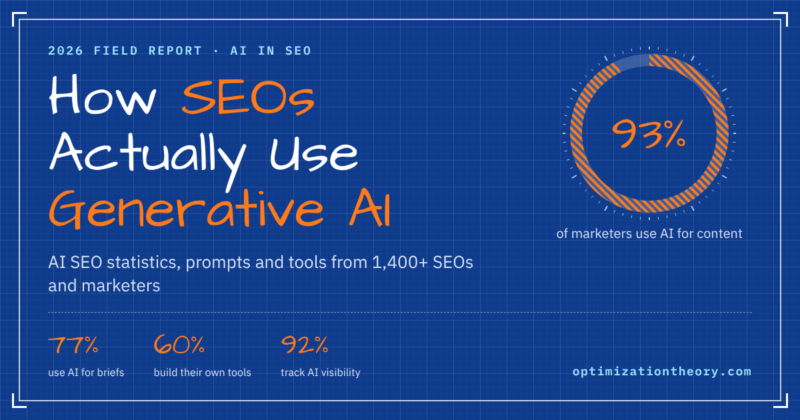
If AI can't find you, understand you and trust you, it won't recommend you.
Keywords tell you what they typed. Intent tells you what they meant. Fan-out tells you what they'll ask next.
Be a thing, not a string. AI remembers entities, not keywords.
The click isn't dead. It just has to be earned twice.
Schema is the business card you hand to every machine that reads your site.
If Googlebot can't reach it and AI can't parse it, it doesn't exist.
Good SEO grows quietly. Then all at once.

