

We pulled millions of rows of Google data to learn what Americans really want to know. The answer, mostly: the weather, whether the dog can have a banana, and where YouTube went.
By Jourdan Rombough · Data from DataForSEO, collected October 26, 2026 · U.S. Google, English
Every keyword and search volume behind this article: 5,116 keywords, 22,018 monthly data points and every search shown in this article. Free to view, filter and copy in Google Sheets.
Every day, millions of Americans walk up to the most powerful information machine ever built. It has indexed hundreds of billions of pages. It can translate Finnish, solve calculus and tell you the boiling point of tungsten.
And they type “weather.”
I'm not here to judge. I'm here to report. The judging is a separate, optional service, included at no extra charge.
For this piece we pulled monthly search volumes going back to 2020, thousands of autocomplete suggestions, Google Trends data for all 50 states, more than 1,100 live search results pages, answers from three AI chatbots and speed tests on 324 top-ranking pages. What follows is the country's search history, charted and lightly cross-examined.
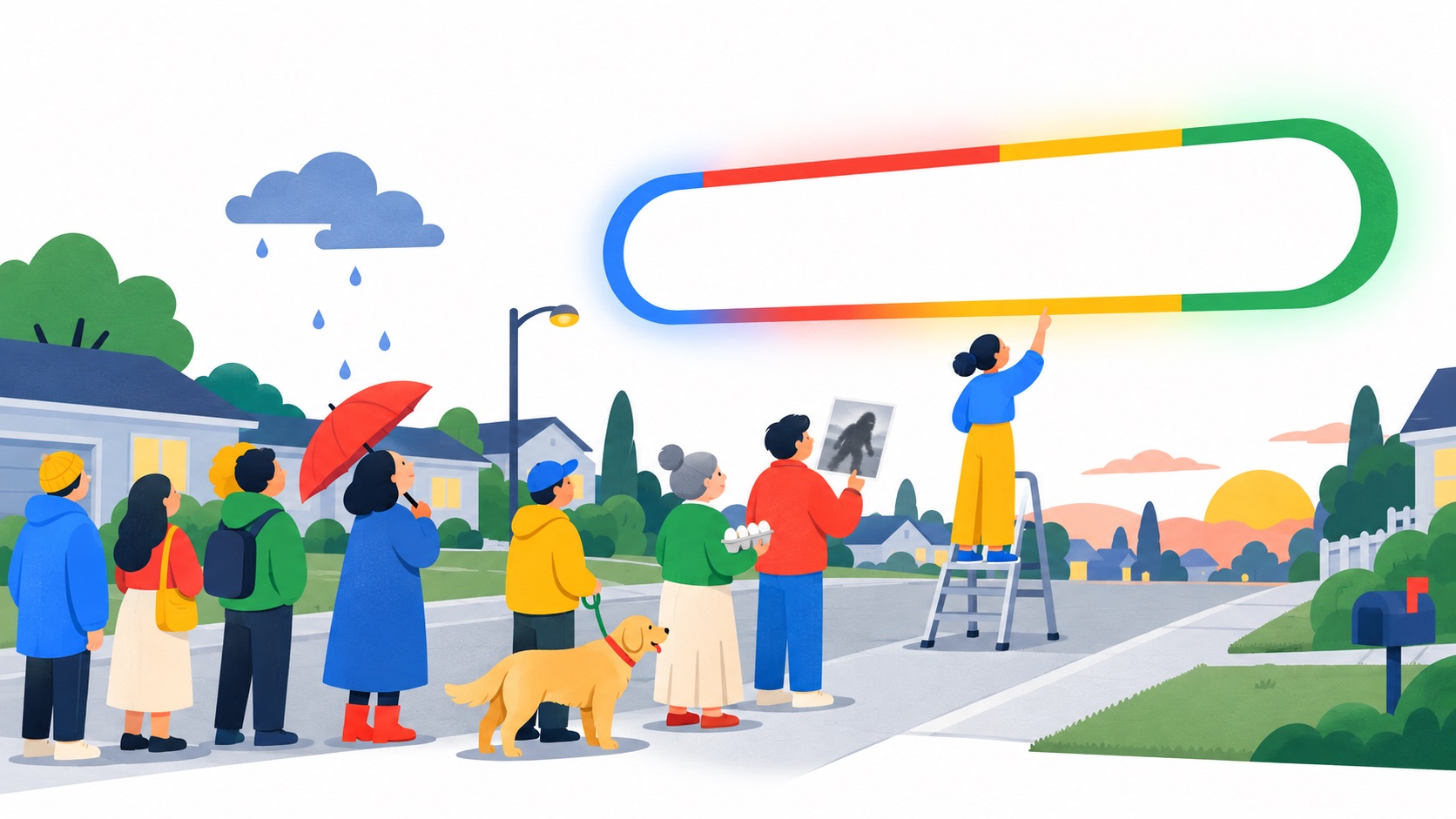
Pushing our luck in every direction at once
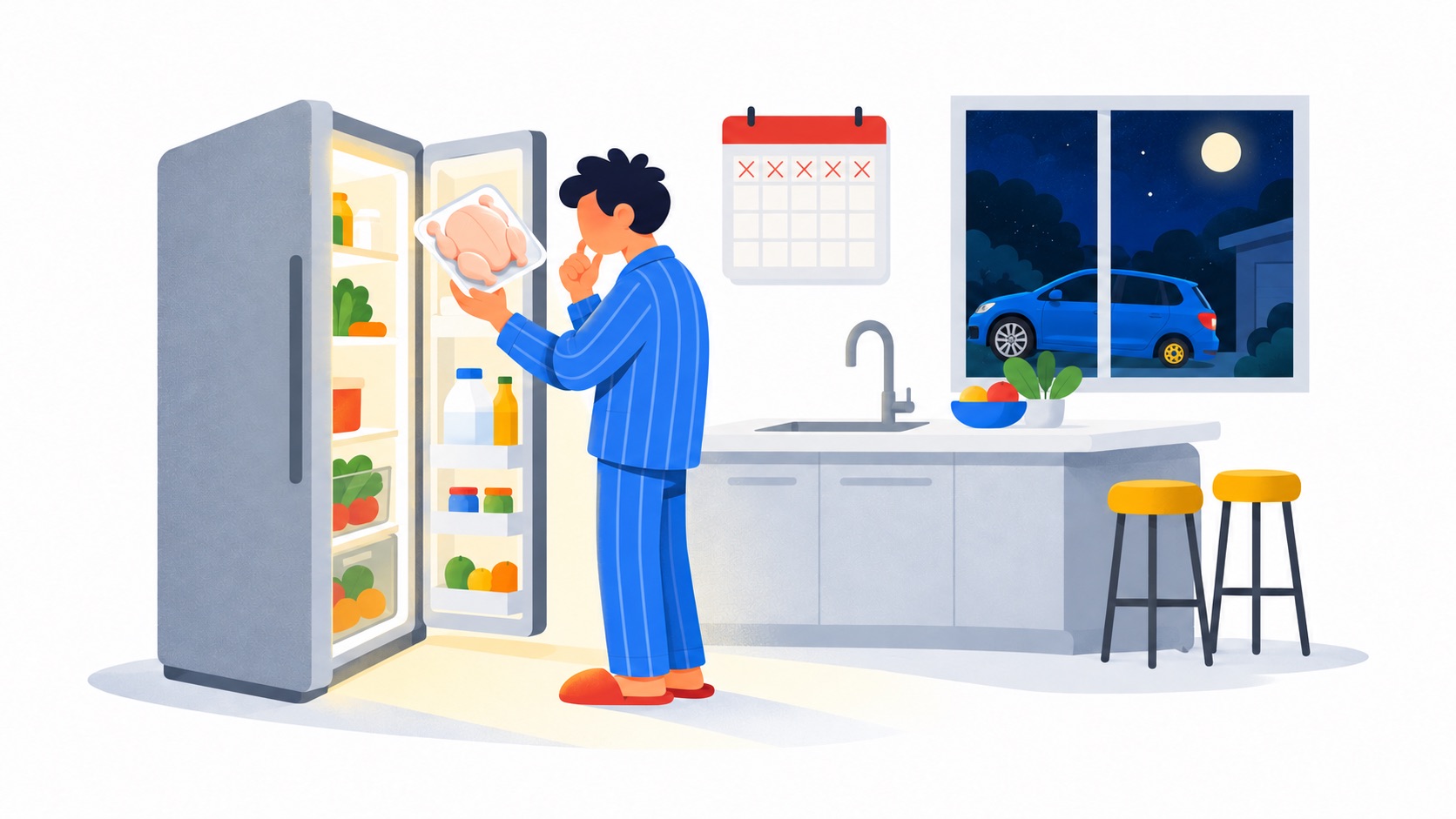
Autocomplete is the closest thing we have to a national diary. Start typing “how long can I” and Google finishes your sentence based on what everyone else has asked. Four of the top five are about the fridge. The fifth is about driving on a spare tire. These are people negotiating with consequences.
Then there's the social surveillance genre. Nearly 10,000 people a month want to know if someone can see that they screenshotted an Instagram story. Google's AI Overview says no, Instagram doesn't notify anyone. Google also surfaces the follow-up question “Will Instagram notify people if I screenshot their story in 2026?” So the anxiety renews every year, like a car registration.
And finally, the quiet ones. “Is it weird to go to a bar alone” gets about 1,000 searches a month. Concerts, movies and restaurants follow. No, it isn't weird. Yes, someone will look at you. That person is also alone.
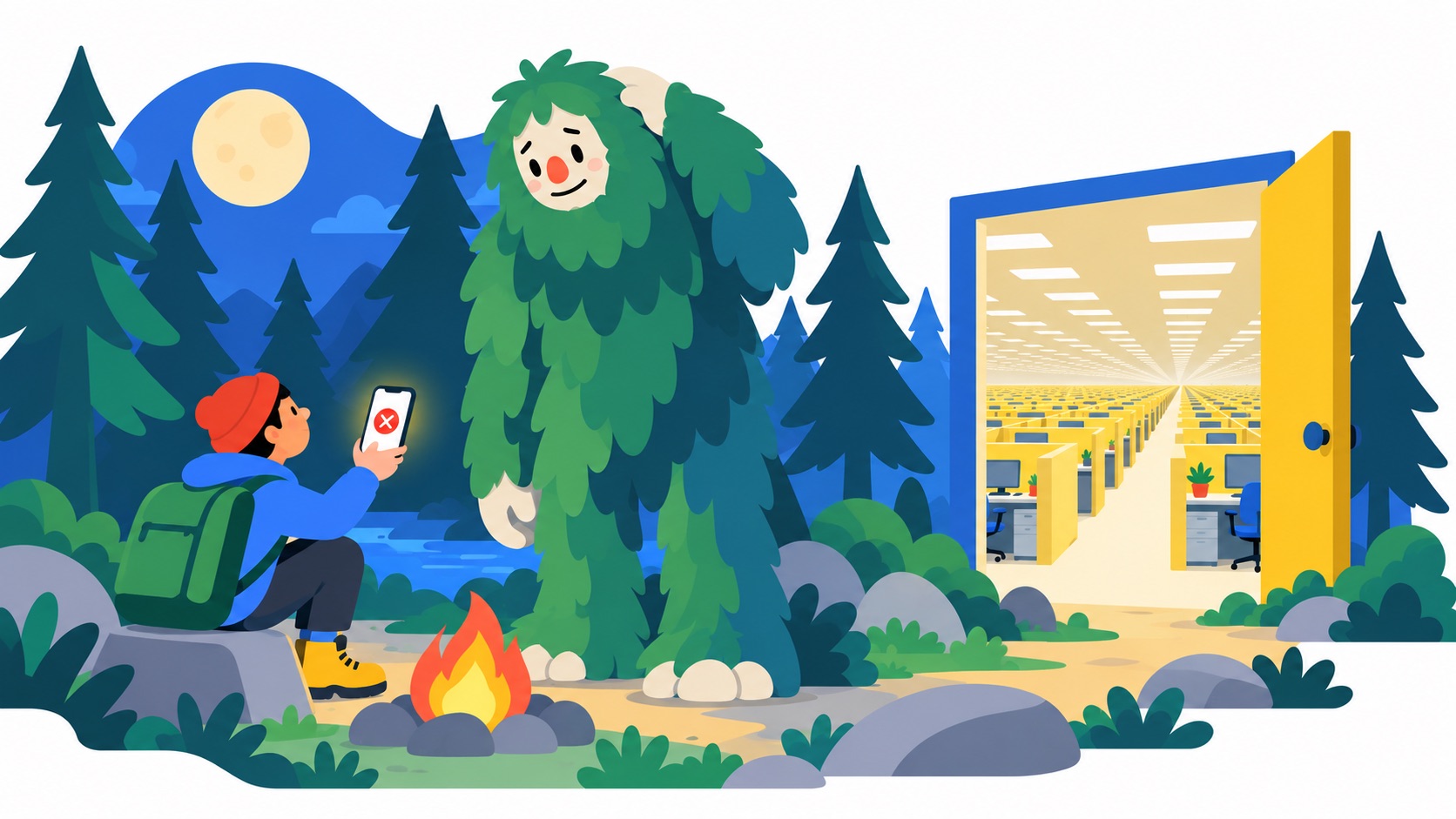
Bigfoot is still not real. Please stop checking.
About 49,500 times a month, someone asks Google whether Bigfoot is real. Google now answers with an AI Overview whose first word is “No.” This has not slowed anyone down. Searches are up 31% from a year ago.
Aliens lead the field at 135,000 a month, up 56%. Skinwalkers and ghosts tie at 60,500. Vampires, werewolves and wendigos are all slipping, which is the first good news the wendigos have had in a while.
No, there is no scientific proof that Bigfoot is real. No bones, bodies, or verified DNA samples have ever been discovered.
“Is it real?” Estimated monthly U.S. searches
The biggest jump belongs to the Backrooms, an internet horror legend about endless yellow office rooms. Searches for “is the Backrooms real” rose 157% in a year. That sounds like a movement. It was a movie. A24's Backrooms opened May 29, 2026. Searches peaked the next month and fell 76% by September.
“Is the Backrooms real,” monthly searches
Sep 25Dec 25Mar 26Jun 26Sep 26
Two more findings, because you've come this far. Mothman searches run at 2x a normal month every October. And when you map the questions by state, West Virginia ranks first for both Mothman and skinwalkers, third for Bigfoot and top ten for aliens and ghosts. West Virginia is not afraid of the unknown. It's just doing its homework.
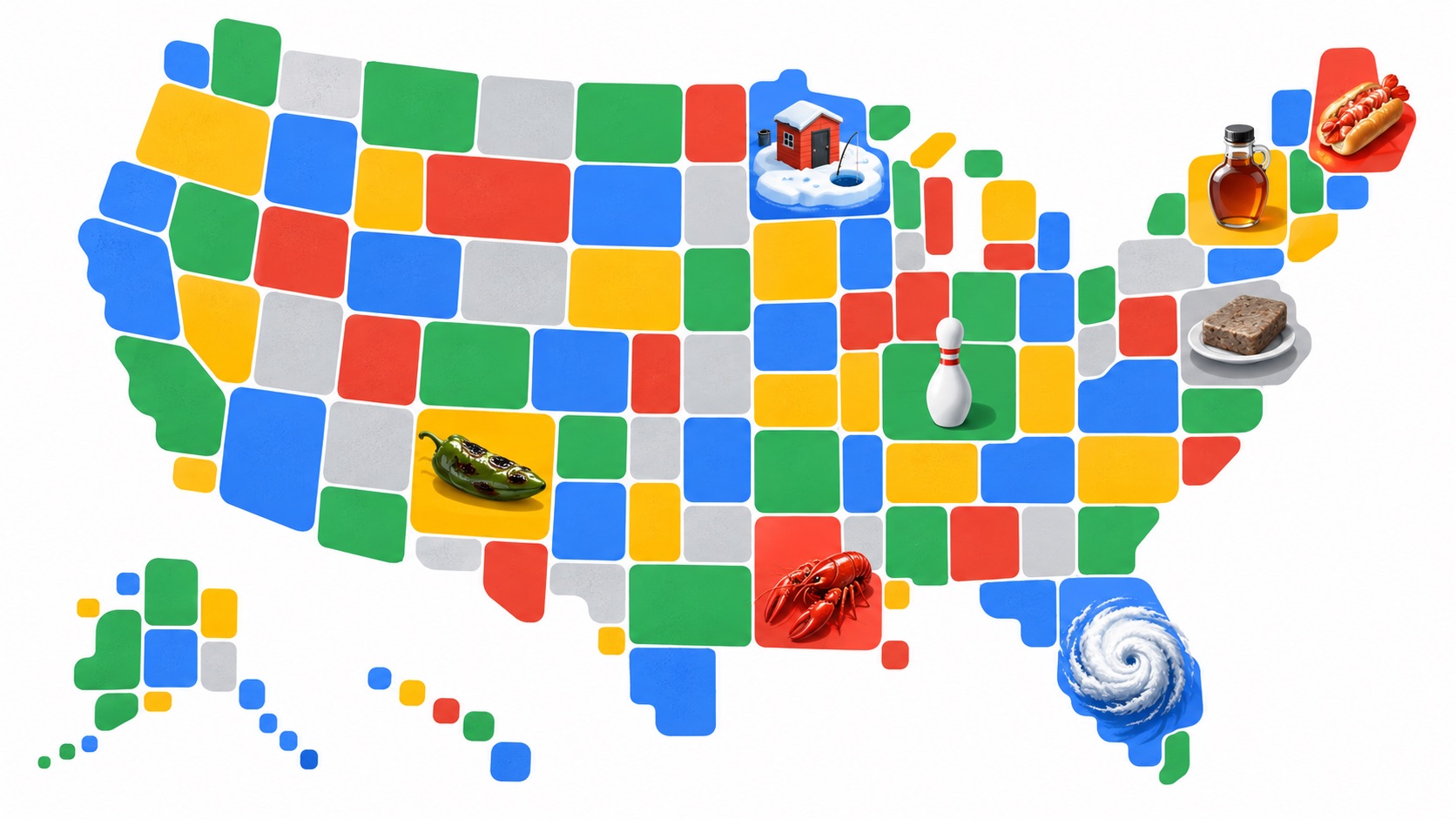
Every state has one search it can't stop making
We ran 70 everyday phrases through Google Trends, state by state, and found each state's most distinctive search: the thing it looks up far more than the typical state does.
Delaware searches “scrapple” at 33 times the national median. Louisiana searches “Mardi Gras” at 33 times. New Mexico searches “green chile” at 25 times, which seems low. Hawaii searches “hurricane tracker” at 25 times. Minnesota checks on ice fishing at 14 times, presumably from the ice.
Utah's most distinctive search is “church near me.” Kentucky's is “bowling,” and I'd like to believe that's the city of Bowling Green and not a lifestyle. I can't prove either.
Each state's most distinctive search
America's dog owners are afraid of fruit
We pulled every autocomplete suggestion for “can my dog eat” and “can dogs eat,” from A to Z. That's 512 different foods people are nervous about.
The most feared foods are bananas and strawberries, at 246,000 searches a month each. Bananas. The fruit that comes in its own packaging. Grapes, which can actually hurt a dog, get 110,000. The dog, for its part, would like you to know it once ate a sock and was fine.
“Can dogs eat…?” Top 21 foods by monthly searches
Google showed an AI Overview on all 30 of the top dog questions, and the answers lined up with standard vet guidance. The sources are telling. The American Kennel Club was cited in 22 of them, Purina in 18 and PetMD in 13. So a dog food company is now the authority on whether your dog can eat food that isn't dog food. That's either a conflict of interest or very good marketing. Probably both.

We stopped asking about egg prices. I have a theory why.
In 2021, “egg prices” got about 3,600 searches a month. Then came two shocks. In January 2023 it hit 550,000. In February 2025 it hit 823,000. A country that had never once thought about the price of an egg suddenly thought of nothing else.
“Why are eggs so expensive” peaked at 673,000 in January 2023. Last month it got 320. Either eggs got cheaper or we gave up. The data can't tell you which. I can, but I won't.
“Egg prices,” monthly searches
Jan 21Dec 22Oct 24Sep 26
“Tariffs,” monthly searches
Jan 21Dec 22Oct 24Sep 26
The word “tariffs” went from around 50,000 searches a month to 5 million in April 2025. Beef had its turn in late 2025, when “beef prices” hit 40,500 in October. And the strangest one: “why is RAM so expensive now” went from about 10 searches a month to 74,000 in December 2025. Computer memory now costs enough that regular people noticed, which is a sentence I never expected to type.

Is this real? Ask the AI.
In 2022, about ten people a month needed to type “is this AI” into Google. Last month, 201,000 did, an all-time high. They typed it into a search engine that now answers questions with AI. Nobody involved seems to have noticed the problem.
The rest of the AI mood board isn't sunny either. “AI slop” went from a few dozen searches to 74,000 a month. “AI bubble” peaked at 165,000 in November 2025. And “how to turn off AI overview” hit a record 22,200 last month, which is 22,200 people asking Google how to make Google stop.
Four searches that only exist because of AI
Jan 23Nov 24Sep 26
May 23Jan 25Aug 26
Jan 23Nov 24Sep 26
Jun 24Aug 25Sep 26
One more: “is AI dangerous” jumped from 3,600 searches in August 2026 to 27,100 in September. I don't know what happened. I'm not going to ask the AI.

We google websites we are already on
Here's the most searched term in the United States for every year from 2021 to 2025: “youtube.” Not a question. Not a problem to solve. Just the name of a website, typed into a different website, by a person who was already on the internet.
In 2025 alone, Americans searched for it an estimated 2.5 billion times. Facebook and Amazon fill out the podium most years. And in 2025, people searched Google for the word “google” roughly 1.5 billion times. I've thought about this for a while and I don't have anything to add. It's Google all the way down.
Strip out the brand names and one word wins every single year: weather. More than a billion searches a year, from a nation that owns windows.
America's #1 searches, by year
| Year | #1 overall | #1 without brands | #2 without brands | #3 without brands |
|---|---|---|---|---|
| 2021 | youtube | weather | translate | food near me |
| 2022 | youtube | weather | wordle | hotels |
| 2023 | youtube | weather | wordle | hotels |
| 2024 | youtube | weather | restaurants near me | food near me |
| 2025 | youtube | weather | restaurants near me | food near me |
The real mover is “restaurants near me.” It went from about 308 million searches in 2021 to nearly 1.2 billion in 2025. Americans have stopped deciding where to eat. We hand the decision to a phone, then argue with the phone.
“Restaurants near me,” estimated searches per year

Google now adds “reddit” for you
For years, people typed “reddit” at the end of their searches to find real humans instead of SEO content. Google noticed. It now does that part for you.
We checked live results for 1,095 everyday queries across 11 categories. Reddit appeared in the top 10 for 65% of them, the top 3 for 47%, and the #1 spot for 13%. YouTube and Facebook were also everywhere, which tells you something about where Google thinks the answers live now.
Queries with Reddit in Google's top 10, by category
Product reviews top the list at 85%, then gaming at 84%. Health comes last at 35%. So Google will let strangers on the internet pick your headphones, but not your blood pressure medication. That's fair. It may be the most reasonable decision on this entire page.
AI Overviews showed up on 95% of these queries, and about a third of those cited Reddit. The robot is reading Reddit too. Let's hope it's reading the good threads.

Three chatbots walk into a product review
More people now skip Google and ask a chatbot. So we asked ChatGPT, Perplexity and Gemini the same 50 questions: “What are the 5 best [thing] to buy in 2026?”
They named the same #1 brand 23 times out of 50. At least two of them agreed on #1 in 43 cases. On average, three of the five brands showed up on all three lists. Perfect agreement came on standing desks, home security, smartwatches and 4K TVs.
Then we asked for the best streaming service, and they didn't share a single brand. ChatGPT said Netflix. Perplexity said HBO. Gemini said Apple. That's roughly how this question goes in every household in America, so in a sense, the AI has achieved human-level intelligence.
Did all three chatbots pick the same #1?

Almost everyone lost. Some lost harder.
When the search engine answers the question itself, fewer people click. It's like a librarian who reads you the whole book out loud so you never check it out.
We tracked estimated Google traffic for 48 major websites from October 2025 to October 2026. The typical site fell 28.5%. Home, health and recipe publishers took the worst of it: bhg.com fell 66%, verywellhealth.com 63% and thespruce.com 55%. The winners were Facebook, up 56%, and, oddly, the recipe site Serious Eats, up 84%. Someone over there knows something.
Change in estimated Google traffic, Oct 2025 to Oct 2026

The #1 result is usually the slow one
Everything above is about what people search. This part is about what they get when they click. For a decade, website owners have been told page speed is a ranking factor, and an entire industry exists to shave milliseconds off load times.
So we ran Google's own speed test, Lighthouse, on the top 10 results for 50 of the queries above. 324 pages finished the test. The pages ranked #1 had the lowest median performance score of any group: 46 out of 100. Pages in spots 4 to 6 scored 57. Only about 1 in 20 of the #1 pages loaded their main content within Google's own 2.5-second target.
Median Lighthouse performance score, by Google ranking
For what it's worth, about 50 people a month ask Google whether page speed affects SEO. Everyone else just installs a plugin.
Speed still matters to the human being waiting for your page to load. That person has feelings, or at least a back button. But in this sample, being fast clearly isn't what puts a page on top.
A baseball town in July, and a sky full of drones
Search data gets more fun when you zoom in. Take Cooperstown, New York, population roughly “one Main Street.” Searches for Cooperstown Dreams Park, the youth baseball complex, are about 10 times higher in June than in December. The Hall of Fame and local lodging both peak in July. The whole town's internet presence follows a Little League schedule.
Cooperstown searches by month, indexed to each topic's peak
Oct 25Dec 25Feb 26May 26Jul 26Sep 26
Now drones. In a normal month, about 30 Americans search for “drone sightings.” In December 2024, when New Jersey residents started reporting mysterious drones overhead, that number hit 450,000. “Can I shoot down a drone” went from about 110 searches to 2,400 that month. The answer is no. Drones count as aircraft under federal law. Please put the shotgun down and go back inside.
“Drone sightings,” monthly searches
Jan 24Sep 24May 25Jan 26Sep 26

The search bar never lies. It just doesn't flatter.
- We use Google as a front door. YouTube, Facebook, Amazon and even “google” top the charts every year.
- Spikes aren't trends. The Backrooms, egg prices and drone sightings all exploded and faded within months. Always check the monthly curve.
- Google is answering more and sending less. AI Overviews appeared on 95% of everyday queries, and the median big site lost about 28% of its estimated traffic in a year.
- Forums won. Reddit is in the top 10 for about two thirds of everyday questions, everywhere except health.
- The chatbots mostly agree, until you ask about TV.
- Fast doesn't mean first. The #1 pages in our sample were the slowest group.
Google can answer almost anything. We mostly use it to find YouTube, check the weather and confirm Bigfoot is still not real.

Open the full data set: every keyword, every monthly estimate, every search result we checked and every chatbot answer. Free to use with credit.
Methodology
- Source: DataForSEO APIs, collected October 26, 2026. United States, English. About $18 in API credits.
- Search volume: modeled monthly averages from Google Ads and DataForSEO Labs data, not counts of people. Close spelling variants often share one estimate, so we never add variants together.
- Most searched by year: top 2,000 U.S. keywords plus 90 event terms, with yearly totals summed from monthly history. Brands, misspellings and adult terms were sorted by hand.
- States: Google Trends, past 12 months, 70 phrases, one request each. Values are relative share (0 to 100), compared with each phrase's median across states.
- Dogs, Reddit and AI Overviews: live Google autocomplete and results pages captured once on Oct 26, 2026. Results change daily.
- Traffic winners and losers: DataForSEO historical rank overview for 48 domains. Estimated traffic is a model based on rankings, not real analytics.
- Chatbots: one response per model per question, with web search on where supported. Answers vary from run to run.
- Speed: mobile Lighthouse performance runs on 324 of 414 top-10 URLs. Lab results, not real-user data.
- Searches aren't beliefs. A search shows curiosity, worry or homework, not what anyone thinks is true.
More Writing & Research by Jourdan Rombough
View all research


If AI can't find you, understand you and trust you, it won't recommend you.
Keywords tell you what they typed. Intent tells you what they meant. Fan-out tells you what they'll ask next.
Be a thing, not a string. AI remembers entities, not keywords.
The click isn't dead. It just has to be earned twice.
Schema is the business card you hand to every machine that reads your site.
If Googlebot can't reach it and AI can't parse it, it doesn't exist.
Good SEO grows quietly. Then all at once.
