

I ran 2,300 political keywords through Google's own data: all 45 presidents, a few hundred pundits and politicians, and the questions America asks when it thinks nobody is looking. Google declined to share the number for the sitting president. I got it anyway.
By Jourdan Rombough · Search volume from DataForSEO, collected November 13, 2026 · U.S. Google, English
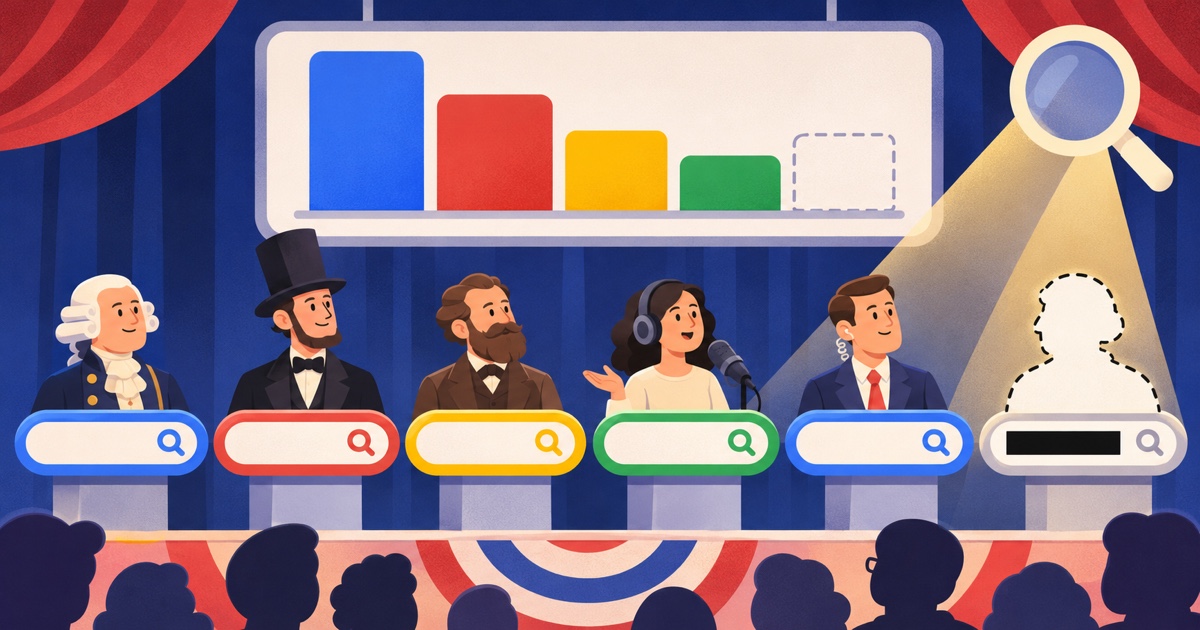
Millard Fillmore was the 13th president of the United States. He signed the Compromise of 1850, was denied his own party's nomination two years later, and has spent the 152 years since his death as the punchline to every joke about forgettable presidents. And yet, each month, roughly 42,000 Americans sit down at a search bar and type his name. On purpose. Nobody is making them do this.
I find that oddly comforting. It suggests that somewhere under all the shouting, the country still has a quiet, steady interest in its own history. Or it suggests that a great many eighth graders have a worksheet due. The data, as we'll see, leans toward the worksheet.
This is a report on what Americans type into Google when the subject is politics. I pulled search volume for all 45 presidents, about 150 commentators and anchors, about 120 politicians and their relatives, 100 news outlets and shows, and a few hundred questions people ask about how their own government works. Roughly 2,300 keywords in all.
Some of what came back is funny. Some of it is a little bleak. And one part of it is missing, because Google would rather not say. We'll start there, because I am still annoyed about it.

- Google's keyword tool returns nothing at all for the names of Trump, Biden, Obama and most sitting politicians. Misspell the name and it hands over the number.
- Trump's name draws about 3.1 million searches a month, one in four of all searches for any president.
- Charlie Kirk's name was searched 124 million times in the month he was killed. Nothing else in the data comes close.
- A Netflix series made James Garfield the second most searched president in America for one month.
- The audience split that shows up in the data is cable versus online, not left versus right.
- "Political compass test" gets 110,000 searches a month. "Who is my congressman" gets 9,900.
Google will not tell you how many people search for the president
Here is how keyword research normally works. You type a phrase into Google's Keyword Planner, or into one of the many tools that buy the same data, and Google tells you how many people search for it each month. It will do this for almost anything. It will do it for "why does my cat stare at me." It will do it for "millard fillmore."
It will not do it for "donald trump."
I don't mean it returns a low number, or a zero. It returns nothing. An empty cell where the most searched name in American politics ought to be. The same goes for Joe Biden and Barack Obama, for Kamala Harris and JD Vance, for Bernie Sanders, Nancy Pelosi, Ted Cruz, and nearly every sitting senator, representative and governor I tried. Of the 456 names and outlets on my main list, 89 came back blank.
89 of 456 political keywords came back blank
The pattern is not random, but it isn't exactly tidy either. Forty-two of the 45 presidents report normally. The three most recent do not. Appointed officials are fine: Kristi Noem, Pam Bondi, Marco Rubio and Pete Hegseth all return numbers. So does nearly every pundit, and so do former officeholders like Hillary Clinton and Mitt Romney. The blank cells belong almost entirely to people who hold elected office right now, people running for it, and their families. Barron Trump is blank. So are Michelle Obama and Hunter Biden.
Even that rule has holes in it. Maxwell Frost, a sitting congressman from Florida, reports normally. I assume this is an oversight and not a comment on Maxwell Frost.

The blackout runs past names, too. "How to register to vote" is blank. So are "election results," "electoral college" and "what is maga." And in a twist I did not see coming, so was every search I tried that ended in the word "kids." Forty-four names, from Abraham Lincoln to Joe Rogan, and not one returned a number. Google has apparently decided that nobody needs to know how often we look up other people's children. For once, Google and I are in agreement.
Google has not, as far as I can find, published a list of what it withholds or why. DataForSEO's documentation says only that Google's advertising policies restrict data on certain topics, political content among them. So we are left with a search engine that knows precisely how many people look up the president every month, and a keyword tool that politely pretends it has never heard of the man.

That would be the end of the story, except for one thing. Google's keyword tool has a soft spot for bad spellers.
The typo that talks
When you misspell something in a Google search, it quietly assumes you meant the real thing. Did you mean: donald trump. The keyword tool appears to do the same. It groups a misspelling with the query it thinks you intended and reports one number for the whole group.
The blocklist, however, seems to check only the correct spelling. You can probably see where this is going.
I had a script generate about ten misspellings for each blanked name. Drop a letter, double a letter, swap two. Then I asked Google about those instead. For "donald trump," seven of the eleven typos came back with the identical figure: 3,350,000 searches a month. The rest came back with next to nothing, or nothing. It was all or nothing every time, which is what makes the result so easy to read.
The same trick worked on Joe Biden (nine typos out of nine agreed on 550,000), Barack Obama (550,000), JD Vance (823,000), Gavin Newsom (550,000) and Kamala Harris (301,000). In all, misspellings recovered 46 of the 89 blanked names before the budget for this project ran dry. The other 43 are filled in with a statistical estimate, and I've marked those wherever they appear.
What Google hides, recovered one typo at a time

Is the typo number real? I think so, for three reasons.
First, when you run the same test on names Google does report, the typo returns the same figure as the correct spelling. "Candace owen" and "candace owens" both come back at 823,000. "Cash patel" and "kash patel" both come back at 673,000.
Second, I built a simple model that predicts Google volume from Bing volume and third-party clickstream data, trained it only on names Google reports, and then pointed it at the blanked ones. It landed within 2x of the typo figure for 38 of 39 names, with a median miss of 18%.
Third, the recovered numbers behave like real ones. Here is Trump's monthly search volume going back to late 2022, reconstructed entirely from people who cannot spell his name.
The line Google will not show you
The quiet months sit between 1.5 and 5 million. The three tallest bars land on the Butler shooting, the 2024 election and the inauguration. If that's a coincidence, it is an extremely well-informed one.
For the SEO crowd: the validation chart
Two methods, one answer
I should be honest about the limits. This is a quirk, not a feature, and Google could close it tomorrow. If you're reading this in a future where "donald tump" also returns an empty cell, you're welcome, and I'm sorry.

All 45 presidents, ranked by how often we look them up
With the missing numbers restored, we can finally do something nobody asked for: rank every president in American history by monthly Google searches.
The search primary: all 45 presidents, ranked
Donald Trump wins, which will surprise no one, including Donald Trump. His name draws about 3.1 million searches a month. That is one in four of all searches for any president's name, and nearly as many as the next five presidents combined. (Google's own rounded figure for him is the 3.35 million from the last section. Averaging its twelve monthly numbers gives 3.1 million, and I use that method for everyone so the comparison is fair.)
After him the list gets more interesting. John F. Kennedy is second. George Washington is third and Abraham Lincoln is fourth, which seems about right for two men who are on the money. Bill Clinton and Joe Biden are separated by a rounding error, with Barack Obama just behind them.
Then there is the bottom of the table, where the real drama is. George H. W. Bush, the 41st president, ranks 41st, a coincidence I enjoyed more than I should have. Below him sit Rutherford B. Hayes, John Tyler, and our friend Millard Fillmore at 44th. And in dead last, with 33,000 searches a month, is Benjamin Harrison.
I want to be fair to Benjamin Harrison. He signed the Sherman Antitrust Act. He was the grandson of a president. He was, by most accounts, a perfectly competent administrator. None of it has helped. He is being out-searched by Millard Fillmore, and there is no coming back from that.
He is being out-searched by Millard Fillmore, and there is no coming back from that.
A few other things in that table deserve a moment:
- The biggest month for any president not named Trump belongs to Jimmy Carter: 16.6 million searches in January 2025, the month of his state funeral.
- Grover Cleveland had a moment. His best month was November 2024, at 550,000 searches, when America went looking for the only other president to win two non-consecutive terms. For a few weeks he was relevant again. I hope he enjoyed it.
- We mostly want to know how tall they were. "Abraham lincoln height" and "george washington height" each get 14,800 searches a month. That's more than either man's "wife" or "net worth." Of all the things one might wonder about the man who held the Union together, we have settled on his measurements. (Six foot four. You're welcome.)
- The audience is young. A median 31% of the people searching a president's name are between 18 and 24. For the news anchors in this study it's 7%. This is the homework effect I mentioned, and it means Fillmore's 42,000 monthly searches are less a sign of civic health than of something due Friday.
The Garfield effect
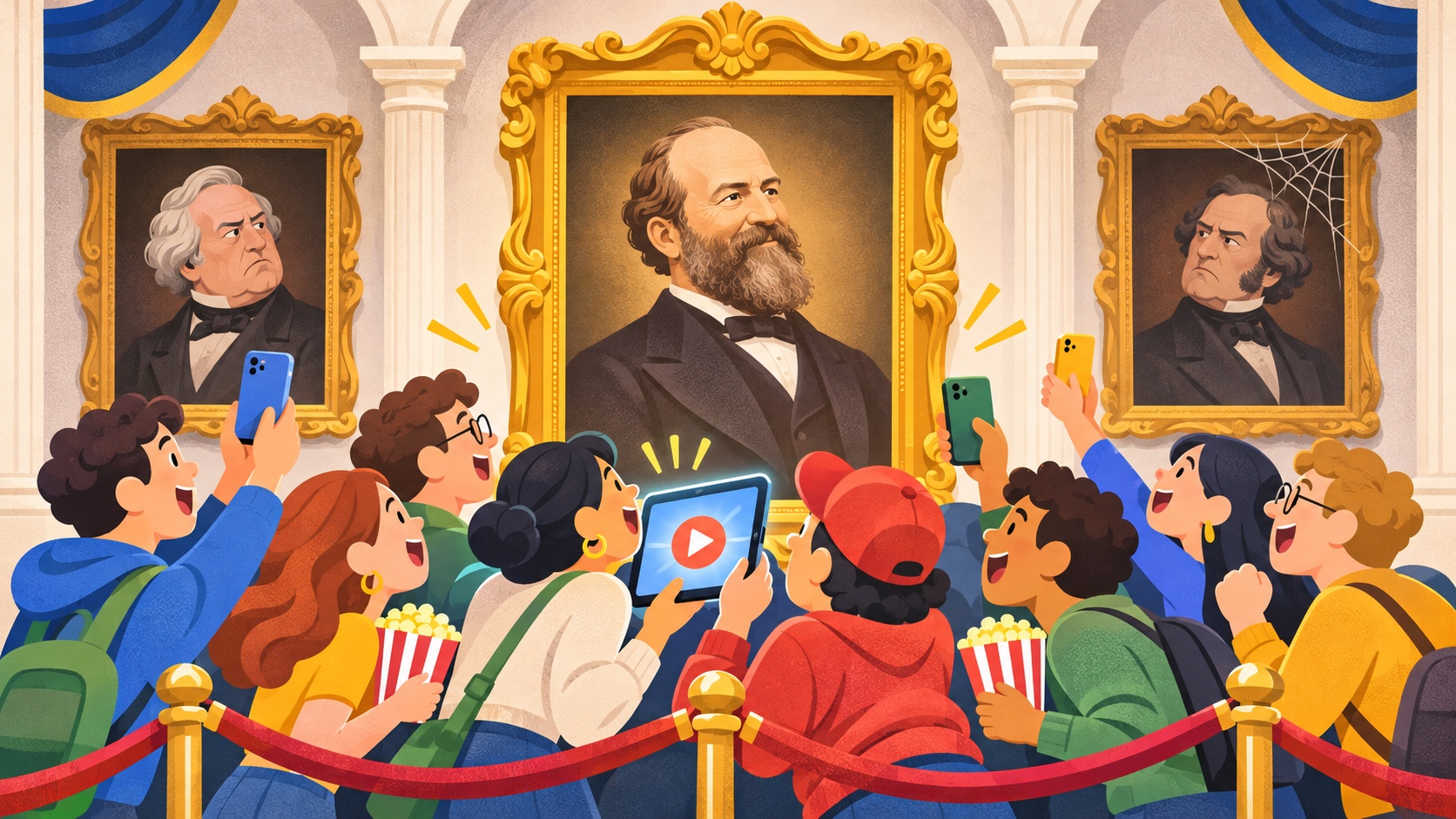
James A. Garfield was president for six and a half months. He was shot by a disappointed office seeker in July 1881, lingered for eleven weeks while his doctors made things considerably worse, and died that September. For the next 144 years, his search volume reflected this.
Before November 2025, Garfield drew somewhere between 30,000 and 90,000 searches a month. Respectable, for a 19th-century president. Roughly Franklin Pierce numbers.
Then Netflix released Death by Lightning, a limited series about his assassination, and Garfield's name was searched 2.24 million times in a single month. For November 2025 he was the second most searched president in the United States, behind only the one currently in office. He beat Lincoln. He beat Washington. He beat Kennedy and Clinton.
The Garfield effect
His vice president came along for the ride. Chester A. Arthur, who is a supporting character in the series and, in fairness, a supporting character in most accounts of Chester A. Arthur, jumped to 823,000 searches.
The spike faded, as spikes do. By October 2026 Garfield was back down to 74,000 searches a month. But that is still about 49% above where he sat two years earlier, and averaged over the past twelve months he ranks 11th of 45, ahead of Franklin Roosevelt. A place in the national memory, it turns out, can be had for the price of one prestige miniseries. Somewhere, the estate of Benjamin Harrison should be taking meetings.
Pundit power rankings
Presidents get searched because they were assigned. Pundits get searched because someone, somewhere, is upset. So I pulled the numbers for about 100 commentators, sorted them by how they are commonly described, and lined the two sides up.
A word on the labels before the emails start. "Left-leaning" and "right-leaning" follow how each person is usually characterized in the press. Late-night hosts and daytime panelists are entertainers, and they're here because people search for them in a political context. You will disagree with at least one placement. I'd be worried about you if you didn't.
Pundit power rankings
The top ten right-leaning names draw a combined 5.8 million searches a month. The top ten left-leaning names draw 2.8 million. Before anyone takes a victory lap, look at where that gap comes from.
Take two names out and the gap mostly closes
Charlie Kirk was assassinated on September 10, 2025. In the year since, searches for his name and for his widow, Erika Kirk, who succeeded him at the head of Turning Point USA, have averaged 2.7 million a month between them. Set those two names aside and the right's lead shrinks to 3.4 million against 2.8 million. Still a lead. Not the blowout the first number implies.
A few observations, offered without enthusiasm for either team:
- Search follows events, not audience size. The most searched names on both lists got there through a death, a firing, a suspension or an arrest. Hosting a successful show for twenty years gets you to the middle of the table.
- The left's list is mostly television. Five of its top six are current or former TV hosts. On the right, four of the top six built their audiences online.
- Sitting politicians mostly trail the pundits. JD Vance, the vice president of the United States, would rank third on the right-leaning list. Gavin Newsom would rank second on the left.
- Matt Walsh ranks 18th on the right, at 114,792 searches a month, a hair behind Dan Bongino and a hair ahead of Milo Yiannopoulos. His best months, at 673,000 each, were April 2023 and September 2024, the second arriving with his film Am I Racist? The single most searched thing about him is his Twitter account. I mention all this because the dry, faintly exasperated register of this article owes him an obvious debt, and it seemed only fair to check on how he's doing. He's doing fine.
The unaligned
The anchors
Then there are the people who refuse to be sorted. Elon Musk leads that group with just under a million searches a month, followed by Joe Rogan at 365,000. The most searched news anchor in the country, Kaitlan Collins, would place sixth among them. The anchors are paid specifically to be recognizable, and they are being out-searched by a comedian from Louisiana with a mullet.
One more thing. People search for hosts. They do not search for shows.
People search hosts, not shows
Joe Rogan's name gets 365,000 searches a month. "Joe rogan experience," which is the actual name of the thing he makes, gets 8,225. "The ben shapiro show" gets 1,125. "The tucker carlson show" gets 997. Media companies spend real money naming and branding these programs, and the audience has responded by typing the guy's name.
The exceptions are the old network franchises. "Jimmy kimmel live" and "the late show with stephen colbert" still draw tens of thousands of searches on their own. Television built brands. The internet builds people.

124 million
Most of this report deals in monthly averages. Averages are calm. They hide the fact that political search does not flow like a river. It sits there like a pond until something terrible happens, and then it floods.
The largest single month for any name in this data is September 2025, when Charlie Kirk was shot and killed at a campus event in Utah. His name was searched 124 million times that month.
I don't have a joke for that number, and I don't think there should be one. All I can offer is scale. It is more than three times Donald Trump's best month, which was the month he won the presidency. It is nearly six times every search for Kirk's name in the six and a half years before it, combined. At the current pace it would take Trump's name more than three years to be searched that many times.

The spike hall of fame
| # | Name | Month | Searches | What happened |
|---|---|---|---|---|
| 1 | Charlie Kirk | Sep 2025 | 124,000,000 | Assassinated September 10 |
| 2 | Donald Trump* | Nov 2024 | 37,200,000 | Won the election |
| 3 | Jimmy Carter | Jan 2025 | 16,600,000 | State funeral, after his death on December 29 |
| 4 | Mitch McConnell* | Jul 2026 | 16,600,000 | Hospitalized after a fall, then weeks of silence |
| 5 | Donald Trump* | Jul 2024 | 16,600,000 | Butler shooting, then the convention |
| 6 | Lindsey Graham* | Jul 2026 | 13,600,000 | Died July 11 |
| 7 | Jimmy Kimmel | Sep 2025 | 13,600,000 | Suspended by ABC after remarks about the Kirk shooting |
| 8 | Kristi Noem | Mar 2026 | 7,480,000 | Fired as Homeland Security secretary |
| 9 | Elon Musk | Feb 2025 | 7,480,000 | DOGE's first full month |
| 10 | Erika Kirk | Sep 2025 | 6,120,000 | Widow of Charlie Kirk. Up from about 5,000 a month |
| 11 | Pete Hegseth | Nov 2024 | 5,000,000 | Nominated for Defense secretary |
| 12 | Don Lemon | Jan 2026 | 3,350,000 | Arrested by federal agents after a church protest |
| 13 | Pam Bondi | Apr 2026 | 3,350,000 | Fired as attorney general |
| 14 | Stephen Colbert | Jul 2025 | 2,740,000 | CBS announced the end of The Late Show |
| 15 | James A. Garfield | Nov 2025 | 2,240,000 | Netflix released Death by Lightning |
| 16 | Maria Bartiromo | Sep 2026 | 1,220,000 | Left Fox Business after 12 years |
Read down the "what happened" column and a pattern shows up quickly. Of the sixteen largest spikes, four trace to a death, one is a health scare, and six are somebody being fired, suspended, cancelled, arrested or shown the door. Nobody on this list got here by doing the job quietly and well. That is not how you get 16 million people to type your name.
Lindsey Graham and Mitch McConnell both land on the list in July 2026, for reasons nobody would choose. Graham died on July 11 after what his office called a brief and sudden illness. McConnell had been hospitalized after a fall in mid-June and went nearly four weeks without a detailed public statement, during which time the country did what it does, and searched.
What happens after the spike is its own story.
Who fades, and who keeps a new baseline
Jimmy Kimmel went from 13.6 million searches to 823,000 in a single month. Don Lemon held 20% of his peak for one month and about 3% after that. Erika Kirk is the exception. Seven months on she still drew 16% of her peak, because she did not go back to being a private person. She took over a national organization.
And Charlie Kirk's own line drops to 1% of its peak, which sounds like forgetting until you do the arithmetic. One percent of 124 million is about 1.2 million searches a month. That is more than Tucker Carlson, Ben Shapiro and Megyn Kelly draw put together.

Who is Googling whom
DataForSEO also buys clickstream data, which is a polite term for a panel of people who have agreed to let software watch what they type. It comes with rough age and gender splits. They are estimates, they stop at age 64, and I would not bet the house on any single figure. But the overall shape is hard to miss.
I expected the audiences to split left and right. They don't. They split by screen.
The real divide is the screen, not the party
On that chart, every square is someone who built an audience on television or radio, and every ring is someone who built it online. Red is right-leaning and blue is left-leaning. Notice that the colors are thoroughly mixed and the shapes are not. The squares drift to the upper right: older searchers, and far more of them on Bing. The rings pool in the lower left.
Sean Hannity and Rachel Maddow agree on almost nothing, but their search audiences are nearly the same age. Seventy-two percent of the people searching Hannity are 45 or older. For Maddow it's 70%. Meanwhile, 46% of the people searching Charlie Kirk are between 18 and 24.
How old are the people typing these names?

The Bing detail deserves its own paragraph, partly because it's useful and partly because nobody ever gives Bing its own paragraph.
Bing is cable news country
For a typical cable host on the right, Bing delivers about 14 searches for every 100 on Google. For a typical online creator it's about 7. Maria Bartiromo is the outlier among outliers: her Bing volume is 30% of her Google volume. Glenn Beck is at 23%. Charlie Kirk is at 4.5%.
My working theory is not complicated. Bing is the default search engine on Windows computers, and the people least likely to change a default are the people who have been using the same desktop since the Bush administration. I say this with affection. But if your audience watches cable news, Bing matters about twice as much as you've been assuming.
Also, Bing blanks nothing. Ask it about "donald trump" and it reports 311,980 monthly searches without any fuss whatsoever. I'm not saying Bing is braver than Google. I'm saying Bing has less to lose.

As for gender, politics search skews male nearly everywhere: a median 57% for right-leaning names, 54% for left-leaning ones and 58% for the unaligned. The exceptions are the late-night hosts and the historian Heather Cox Richardson, whose searchers are 64% women.
Husbands, heights and net worths
So far we've looked at how often people search a name. The more revealing question is what they type after it.
I took 44 of the biggest names and paired each one with 15 common add-ons: net worth, age, wife, husband, height and so on. I was hoping to learn what the public wants to know about its political class. I regret to report that I found out.
What America wants to know about them
| husband | wife | net worth | age | height | young | podcast | ||
|---|---|---|---|---|---|---|---|---|
| Kristi Noem | 301K | · | 27.1K | 22.2K | 6.6K | 12.1K | 1K | · |
| Karoline Leavitt | 135K | · | 8.1K | 27.1K | 2.4K | 1.6K | · | · |
| Charlie Kirk | · | 60.5K | 33.1K | 14.8K | 18.1K | 3.6K | 2.4K | 4.4K |
| Candace Owens | 60.5K | · | 22.2K | 5.4K | 1.3K | 880 | 49.5K | 18.1K |
| Joe Rogan | · | 40.5K | 33.1K | 9.9K | 18.1K | 9.9K | 1K | 60.5K |
| Jimmy Kimmel | · | 14.8K | 33.1K | 5.4K | 2.4K | 1.9K | 260 | 170 |
| Tucker Carlson | · | 14.8K | 18.1K | 2.9K | 1.6K | 1.9K | 9.9K | 6.6K |
| Megyn Kelly | 9.9K | · | 6.6K | 3.6K | 1K | 3.6K | 9.9K | 18.1K |
| Ben Shapiro | · | 12.1K | 6.6K | 1.9K | 5.4K | 480 | 14.8K | 6.6K |
| Matt Walsh | · | 4.4K | 1K | 720 | 320 | 210 | 33.1K | 1.9K |
| Stephen Colbert | · | 12.1K | 12.1K | 3.6K | 1.9K | 2.4K | 170 | 720 |
| Don Lemon | 18.1K | 2.4K | 9.9K | 1.6K | 480 | 320 | 390 | 880 |
| Hasan Piker | · | 5.4K | 8.1K | 4.4K | 6.6K | 590 | 3.6K | 880 |
| Bill Maher | · | 4.4K | 8.1K | 2.9K | 2.4K | 1.9K | 720 | 3.6K |
| Rachel Maddow | · | 1.9K | 1.9K | 880 | 480 | 2.4K | 110 | 5.4K |
| Marco Rubio | · | 22.2K | 18.1K | 8.1K | 9.9K | 2.4K | 1K | · |
| Pete Hegseth | · | 18.1K | 12.1K | 5.4K | 3.6K | 2.9K | 1.6K | · |
| Bill Clinton | · | 2.9K | 8.1K | 40.5K | 2.9K | 22.2K | 880 | 110 |
| JFK | · | 18.1K | 720 | 2.4K | 3.6K | 18.1K | · | 140 |
| Abraham Lincoln | · | 5.4K | 390 | 1.6K | 14.8K | 5.4K | · | · |
| George Washington | · | 8.1K | 1.3K | 2.4K | 14.8K | 14.8K | · | · |
It's spouses. Then money. Then height. Policy was not on my list of add-ons, and judging by these results I don't think it was missed.
The single biggest query in the grid is "kristi noem husband," at 301,000 searches a month. To put that in context, it outdraws the name "Ben Shapiro." It outdraws "Rachel Maddow" nearly three to one. It outdraws the names of 33 of the 45 presidents. "Karoline leavitt husband" is next at 135,000.
Across the whole grid, and setting aside Elon Musk's net worth, which at 673,000 searches a month is its own weather system, "husband" and "wife" together draw 839,000 monthly searches. "Net worth" draws 308,000. We are a nation that will listen to a person talk for three hours and come away with exactly one question, which is who they go home to.

Other findings, in no particular order:
- We are looking for the show. The most searched thing about Matt Walsh and Ben Shapiro is their Twitter. For Joe Rogan, Megyn Kelly and Rachel Maddow it's their podcast. These are people trying to find the program, typing the only part of its name they can remember.
- We want to see them young. "Bill clinton young" gets 22,200 searches a month. "Jfk young" gets 18,100. I have chosen not to look into why.
- We are fixated on height. "Charlie kirk height" and "joe rogan height" each get 18,100 searches. "Nick fuentes height" gets 14,800. The country that cannot name its congressman is deeply curious about how tall everyone is.
- The blackout reaches here too. "Donald trump net worth," "joe biden age" and "barack obama height" all come back blank. I assume the typo trick works on those as well. That is a project for a month with more budget in it.

The civics confessional
If the last section was about what we want to know about them, this one is about what we don't know about ourselves.
Start with the dictionary. Americans argue about fascism and socialism more or less constantly. They are also, in very large numbers, quietly looking up what those words mean.
- fascism meaning301,000
- gaslighting meaning246,000
- socialism meaning201,000
- grifter meaning110,000
- dei meaning110,000
- tds meaning74,000
- nepotism meaning74,000
- incumbent meaning74,000
- woke meaning60,500
- sedition meaning60,500
- who is on the 10 dollar bill33,100
- who is on the 20 dollar bill33,100
- who is on the 50 dollar bill27,100
- who is on the 100 dollar bill27,100
- who is on the 2 dollar bill22,200
- who is on the dime22,200
- who is on the 5 dollar bill14,800
- who is on the nickel14,800
"Fascism meaning" gets 301,000 searches a month. "Socialism meaning" gets 201,000. I would like to believe these searches happen before the argument and not in the middle of it, under the table, with one hand. I would like to believe a lot of things.
"Gaslighting meaning" sits between them at 246,000, and "grifter meaning" gets 110,000, which tells you something about the tone of the national conversation. "Sedition meaning" normally gets around 40,000 searches a month. In November 2025 it got 450,000.
The -isms, ranked by how often we look them up
Then there is the money. Every month, tens of thousands of people ask Google who is on the bills in their own wallet. They could look. The bill is right there. They ask anyway.
Which leads naturally to my favorite number in the entire report. "Was benjamin franklin a president" gets 14,800 searches a month. He was not. He is on the hundred, which is confusing, I grant you, but he was not. "Was alexander hamilton a president" gets another 6,600. Also no. Between the two of them that's more than 250,000 searches a year from people who looked at American currency and drew a reasonable but incorrect conclusion.

- youngest president33,100
- was benjamin franklin a president14,800
- oldest president12,100
- tallest president8,100
- shortest president8,100
- was alexander hamilton a president6,600
- president stuck in bathtub880
- which president had a pet alligator590
- doomscrolling27,100
- how to move to canada4,400
- how to stop doomscrolling1,900
- how to stop caring about politics20
- how to talk to family about politics10
A few more from the confessional:
- "Youngest president" gets 33,100 searches a month and "oldest president" gets 12,100. "Tallest president" and "shortest president" are tied at 8,100, because of course they are. Height again.
- "Is fox news biased," "is cnn biased" and "is npr biased" each get exactly 1,600 searches a month. A perfect three-way tie. It may be the only bipartisan consensus we have left.
- "How to move to canada" averages 4,400 searches a month. In November 2024 it hit 90,500. It came back down. It always comes back down.
- "President stuck in bathtub" gets 880 searches a month. The story is probably a myth. William Howard Taft has been dead for 96 years, and this is what we've done with his memory.
And now the part I find a little bleak.
Finding yourself beats finding your representative, eleven to one
"Political compass test," an online quiz that tells you which corner of a chart your opinions belong in, gets 110,000 searches a month. "Who is my congressman" gets 9,900. We are eleven times more interested in finding out what we are than in finding out who represents us. We want the label. We'll skip the phone call.
Which brings us to the very bottom of the list. "Doomscrolling" gets 27,100 searches a month. "How to stop doomscrolling" gets 1,900. "How to stop caring about politics" gets 20. And "how to talk to family about politics" gets 10.
Ten. In a country of 340 million people, ten a month ask the internet how to have the conversation. The rest of us are apparently planning to wing it. Good luck at Thanksgiving.

Fox, CNN and the rebrand nobody Googles
I also pulled the outlets themselves, mostly to confirm what everyone already suspects.
Fox News alone is 46% of the map
"Fox news" gets 33.9 million searches a month. That's about twice "cnn" and roughly 16 times "msnbc" and its new name put together. Before anyone frames that and hangs it in a lobby: these are navigational searches. People type "fox news" into Google to get to Fox News, the same way they type "facebook" to get to Facebook. It measures habit, and possibly an unfamiliarity with bookmarks. It does not measure ratings.
The Drudge Report, a website that has looked more or less the same since the late 1990s, still draws 2.3 million searches a month, slightly more than "new york times." I have no notes.
The more useful story, for anyone in marketing, is MSNBC. In November 2025 the network renamed itself MS NOW. A year later, here is how that's going in the search bar.
The rebrand nobody Googles
Over the past twelve months "msnbc" has averaged 1.7 million searches a month. "Ms now" has averaged 395,000. The old name is still beating the new one by more than four to one, a full year in. And while searches for the old name have fallen from 2.7 million to 1 million, the new name has picked up only a small fraction of the difference.
Audiences do not rename things because a press release asked them to. If you are planning a rebrand, budget for at least a year of people searching for the company you used to be.
What SEOs should steal from this
If you do this for a living, here is the part with practical value. Everyone else is excused, with my thanks.
What Google puts on a person's results page
Start with the results page. On a search for a person's name, Google's knowledge panel appears 98% of the time. People Also Ask appears 77% of the time. An AI Overview appears 3% of the time. Whatever Google is doing with AI answers elsewhere, it is keeping them well away from the names of real people, which is probably wise.
New fame means soft results pages
- Test typos on blank keywords. If Keyword Planner returns nothing for a term that obviously has volume, try five to ten misspellings. Several typos returning the same large number is the real number. I would expect this to work well beyond politics, in health, finance and anywhere else Google restricts data.
- Check Bing when the audience is older. Cable-news names run about twice the Bing share of online creators. If your customer is 60 and watches television, you are undercounting Bing.
- New fame means soft results pages. Laura Loomer draws 392,000 searches a month at a keyword difficulty of 10. Pam Bondi draws 939,000 at 13. When a name blows up faster than the link graph can catch up, page one is wide open.
- People search hosts, not shows. Build the page around the person's name. The show title is for the logo.
- Brand search lags a rebrand by a year or more. Keep ranking for the old name. MSNBC's audience is still typing it.
- A blank cell is not a zero. The most searched name in American politics shows up in Google's own tool as nothing at all. Missing data is not the same as missing demand.
The Search Bar Confessional digs into how America really searches when politics is not involved: the weather, Bigfoot, and whether the dog can have a banana.
Frequently asked questions
Who is the most searched president on Google?
Donald Trump, at about 3.1 million U.S. searches a month for his name, which is one in four of all searches for any president. John F. Kennedy is second at 851,583, George Washington third at 717,250 and Abraham Lincoln fourth at 581,167. Google's Keyword Planner returns no data for Trump's name, so his figure was recovered from misspellings.
Who is the least searched president?
Benjamin Harrison, with about 33,000 U.S. searches a month. Millard Fillmore is second to last at 42,167, and John Tyler is third to last at 49,608.
Why does Google Keyword Planner show no search volume for Donald Trump?
Google withholds keyword data on certain topics under its advertising policies, and political content is one of them. In this study 89 of 456 political names and outlets returned no data at all, including Trump, Biden, Obama and most sitting members of Congress. Misspellings of the same names are not blocked and return the hidden figure.
How many people search for Donald Trump each month?
About 3.1 million U.S. Google searches a month for the exact name "donald trump" over the past year, based on the figure Google returns for misspellings. The peak was 37.2 million in November 2024, the month of the election.
Who is the most searched political commentator?
Charlie Kirk, whose name has averaged 1.8 million U.S. searches a month in the year since his assassination in September 2025. Among left-leaning names, Jimmy Kimmel leads at 515,417, followed by Hasan Piker at 420,583. Among independents, Elon Musk leads at 973,750, followed by Joe Rogan at 365,333.
What was the biggest political search spike?
Searches for Charlie Kirk in September 2025: 124 million in one month in the United States. That is more than three times the searches for Donald Trump in November 2024, the month he won the election.
Is Fox News searched more than CNN?
Yes. "Fox news" draws about 33.9 million U.S. Google searches a month and "cnn" about 17.6 million. Most of those searches are navigational, meaning people are using Google to reach the site, so the figures measure habit and not ratings.
Methodology
- Source: DataForSEO APIs, collected November 13, 2026. United States, English. About 2,300 keywords.
- Main number: average monthly Google searches for the exact keyword, November 2025 to October 2026, calculated as the mean of Google's twelve monthly figures. Google groups close variants and rounds volumes into buckets, so ties are common.
- Exact names only: "trump tariffs" and "trump news" are separate keywords and are not counted in "donald trump." Total interest in any person is larger than the figure for their name.
- Recovered figures (marked *): Google returned no data for the correct spelling, so the figure is the one Google returned for misspellings of it. 46 names were recovered this way.
- Estimates (marked ~): 43 blanked names were not typo-tested. Their figures come from a regression on Bing volume and clickstream volume, trained on the 367 keywords Google reports. Against the typo-recovered names the model's median miss was 18%.
- History: monthly volumes back to 2019 from DataForSEO Labs. Recovered names have twelve months of history, except Trump, whose misspelling "donald trumph" has data back to October 2022.
- Labels: left-leaning, right-leaning and independent follow how each person is commonly described. Late-night hosts and daytime panelists are entertainers who are searched in a political context. Names shared with other well-known people were removed.
- Age and gender: DataForSEO's clickstream panel, ages 18 to 64 only. Treat as directional.
- Events: dates for 2026 news events were checked against reporting published by OPB, WBTV, the Carolina Political Review and NewscastStudio.
Keep searching · More from the series
Read the rest of the Funny Google Searches series
More Writing & Research by Jourdan Rombough
View all research




If AI can't find you, understand you and trust you, it won't recommend you.
Keywords tell you what they typed. Intent tells you what they meant. Fan-out tells you what they'll ask next.
Be a thing, not a string. AI remembers entities, not keywords.
The click isn't dead. It just has to be earned twice.
Schema is the business card you hand to every machine that reads your site.
If Googlebot can't reach it and AI can't parse it, it doesn't exist.
Good SEO grows quietly. Then all at once.
