SEO Split Test Calculator
SEO Split Test Calculator
Estimate ratio-adjusted lift and difference-in-differences against matched control pages, with a pre-trend check.
Whether an SEO change moved traffic on treated pages relative to matched control pages, and whether the evidence supports reading the estimate.
- Excel workbook (.xlsx), opens in Google Sheets
- PDF field guide, 9 to 11 pages
- Blank and worked CSV templates
- DataForSEO import script
Free, no email required. Version 3.0, updated November 2026.
=IF(J13="","",IF(J13<>"Ready","n.a.",IF(G13=1,"Review estimate with design","Pretrend evidence missing")))The formula above is the real one from cell O13. Scroll it sideways to read the whole rule.
Connected to the DataForSEO API
This template is designed around one DataForSEO endpoint. Pull the data, convert it with one command, and the workbook does the rest.
DataForSEO Labs: Ranked KeywordsEvery keyword a domain ranks for, with its ranking URL, position and volumedataforseo_labs/google/ranked_keywords/live
Save the JSON responseThe full API response, kept as your source of truth.response.json
Run the import scriptOffline. No API calls, no credentials.dataforseo_import.py import --template 33
Paste at A13Dashboard, checks and action list update instantly.SEO Split Test Calculator.xlsx
Column map for this template:Filled by the APIAudit trail (automatic)You add
What the SEO split test calculator decides
SEO changes don't happen in a vacuum. Between before and after, Google updates, seasons turn and competitors publish. The only fair way to estimate a change's impact is against pages that didn't get the change but would have moved the same way otherwise.
This SEO split testing template compares treatment and control groups before and after a change. It calculates each group's change, a ratio-adjusted lift and an additive difference-in-differences estimate, and only marks an experiment Review estimate with design when you've confirmed the groups trended in parallel beforehand.
Who it's for
- SEOs running template or sitewide experiments
- Ecommerce teams testing category or product page changes
- Analysts who need defensible test reporting
- Teams without an SEO testing platform
Where it fits in your workflow
The SEO split test calculator answers one question. These three templates answer the questions around it:
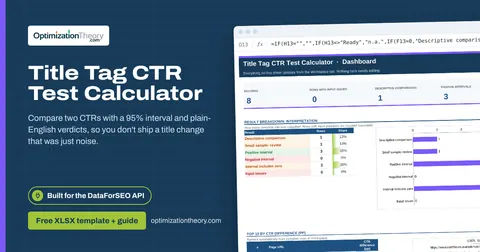
- Title Tag CTR Test Calculator: whether a title or snippet change produced a CTR difference that's distinguishable from noise, with honest labels for small samples and non-randomized comparisons.
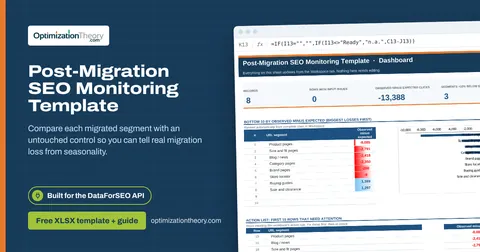
- Post-Migration SEO Monitoring Template: whether each migrated section is performing above or below what you'd expect after adjusting for market-wide changes, measured against a control segment that didn't move.
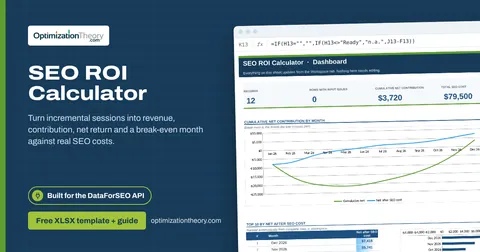
- SEO ROI Calculator: whether SEO is paying back, by month and cumulatively, after real costs, and when it broke even.
What's inside the download
One ZIP with the workbook, a 9-column input template (blank and filled), the PDF field guide and an offline script that converts saved DataForSEO responses into the input CSV. The workbook has five tabs.
How the SEO A/B testing calculation works
Treatment change = after ÷ before − 1, same for control. Ratio-adjusted lift = (T after ÷ T before) ÷ (C after ÷ C before) − 1. Difference-in-differences = (T after − T before) − (C after − C before).
The key formula, exactly as it appears in the workbook
=IF(J13="","",IF(J13<>"Ready","n.a.",IF(G13=1,"Review estimate with design","Pretrend evidence missing")))
| Result column | Plain-English formula | What it tells you |
|---|---|---|
| Treatment change | Treatment after ÷ Treatment before-1 | Relative change in the treatment group. |
| Control change | Control after ÷ Control before-1 | Relative change in the control group. |
| Ratio-adjusted lift | (Treatment after ÷ Treatment before) ÷ (Control after ÷ Control before)-1 | Treatment ratio divided by control ratio, minus one. |
| Additive difference-in-differences | (Treatment after-Treatment before)-(Control after-Control before) | Additive normalized outcome change net of control change. |
| Evidence review | IF(Pretrend reviewed=1,"Review estimate with design","Pretrend evidence missing") | Study-design reminder. No statistical significance is inferred. |
The results you will see
Review estimate with designPretrend evidence missing
Green meets the checks, red needs fixing first, amber needs a human decision and blue marks an opportunity. Rows with missing or out-of-range inputs are held back in the Input check column until they're fixed, so a half-filled row never sneaks into a total.
How to use the SEO split test calculator
- Split comparable pagesRandomly assign similar pages to treatment and control. Hundreds of pages per group is ideal.
- Check the pre-periodChart both groups for 6 to 8 weeks before the change. Mark parallel trends = 1 only if they moved together.
- Ship the change to treatment onlyLeave control untouched for the test window.
- Read lift with the design in mindReport the ratio-adjusted lift, note the evidence, and don't over-read small effects.
The worked example in the Workspace tab. Clear the lime input cells, paste your CSV at A13 (values only) and every result recalculates.
Fill the SEO split test calculator with DataForSEO
Every template in this library is built to run on DataForSEO data. This one uses DataForSEO Labs: Ranked Keywords: every keyword a domain ranks for, with its ranking URL, position and volume.
DataForSEO supplies the URL or query list and the audit trail; you add the measurements listed below.
- Request the dataSend this request with your DataForSEO API login (HTTP Basic auth).
POST https://api.dataforseo.com/v3/dataforseo_labs/google/ranked_keywords/live [ { "target": "yourdomain.com", "location_code": 2840, "language_code": "en", "limit": 1000 } ]
- Save the full JSON responseSave the complete response, not just the task ID, next to the template folder.
- Convert it with the included scriptIt runs offline, makes no API calls and never sees your credentials.
python3 Automation/dataforseo_import.py import --template 33 --input response.json --output my-inputs.csv
- Add what the API can't knowExperiment ID, Treatment before, Treatment after, Control before, Control after, Hypothesis, Pretrend reviewed, Evidence
- Paste at A13Clear the demo rows, paste the CSV values at Workspace cell A13 and the dashboard updates.
| Fills automatically from DataForSEO | You add |
|---|---|
| Source reference (audit trail) | Experiment ID, Treatment before, Treatment after, Control before, Control after, Hypothesis, Pretrend reviewed, Evidence |
Source reference fills automatically with the task ID, endpoint, location, language, device and snapshot time, so every row is traceable. Before a big pull, estimate the cost with the DataForSEO pricing calculator. The same steps, plus an example request file, are in the download's Automation folder.
Worked example: Northbeam Outdoor
Every template ships filled with data from Northbeam Outdoor, a fictional outdoor-gear retailer that appears across all 40 workbooks, so you can see what useful output looks like before you add your own. This workbook has 6 example rows.
The comparison-table experiment shows a solid lift with a checked pre-trend. Two experiments are flagged because no pre-period evidence was recorded, so their estimates shouldn't be reported yet.
Top 10 by ratio-adjusted lift
| # | Experiment ID | Ratio-adjusted lift |
|---|---|---|
| 1 | EXP-05 | 17.7% |
| 2 | EXP-03 | 15.2% |
| 3 | EXP-01 | 11.8% |
| 4 | EXP-02 | -0.1% |
| 5 | EXP-06 | -5.3% |
Input fields
Keep the columns in this order when you prepare a CSV. A missing observation stays blank; use 0 only for a measured zero or a verified No. Fields marked DataForSEO can be filled automatically by the included script.
| CSV field | Column | Meaning and rule | Source |
|---|---|---|---|
| experiment_id | Experiment ID | One hypothesis, treatment definition and fixed analysis window. | Your records |
| treatment_before | Treatment before | Clicks per URL per day, or another fixed normalized metric, before release. | Your records |
| treatment_after | Treatment after | Same normalized measure after release. | Your records |
| control_before | Control before | Same normalized measure for the matched control before release. | Your records |
| control_after | Control after | Same normalized measure for the matched control after release. | Your records |
| hypothesis | Hypothesis | Specific change and predicted mechanism. | Your records |
| parallel_trends | Pretrend reviewed | 1 after checking whether pre-release trajectories are plausibly comparable. 1 = Yes, 0 = No. | Your records |
| evidence | Evidence | Link to a dated crawl, screenshot, ticket or source that another reviewer can inspect. | Your records |
| source_ref | Source reference | Task ID, export filename and observation scope. Retain the untouched source response separately. Optional. | DataForSEO: source_ref |
Reading the result honestly
A positive estimate needs a credible control and enough stable observations. The workbook does not estimate a p-value.
Limits. Seasonality, spillovers and cohort changes can invalidate interpretation. Keywords and ranks help explain the result but do not establish causality.
SEO A/B testing mistakes to avoid
Tips from practice
- Use the title CTR test for snippet-only experiments.
- Run tests long enough to cover weekly cycles, usually four weeks minimum.
- Log every experiment here, including the ones that didn't work.
Frequently asked questions
What is SEO split testing?
Applying a change to a random group of similar pages and comparing their organic performance with an unchanged control group.
What is difference-in-differences?
A method that estimates impact as the change in the treatment group minus the change in the control group over the same period.
How many pages do I need for an SEO test?
Enough that random noise averages out, typically hundreds of pages with steady traffic per group.
Can I A/B test SEO on one page?
Not as a controlled test. Use before-and-after comparisons and label them descriptive.
Use it with these templates
Each template answers one decision. These are the ones that feed into, or follow from, the SEO split test calculator.
24Title Tag CTR Test CalculatorOn-Page API
Compare two CTRs with a 95% interval and plain-English verdicts, so you don't ship a title change that was just noise.
10Post-Migration SEO Monitoring TemplateLabs: Ranked Keywords
Compare each migrated segment with an untouched control so you can tell real migration loss from seasonality.
32SEO ROI CalculatorLabs: Ranked Keywords
Turn incremental sessions into revenue, contribution, net return and a break-even month against real SEO costs.
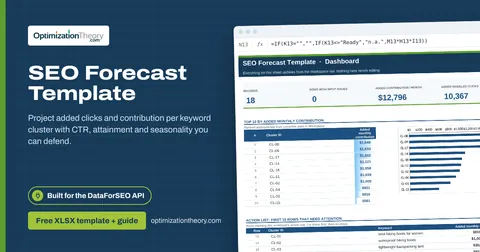
31SEO Forecast TemplateLabs: Keyword Overview
Project added clicks and contribution per keyword cluster with CTR, attainment and seasonality you can defend.
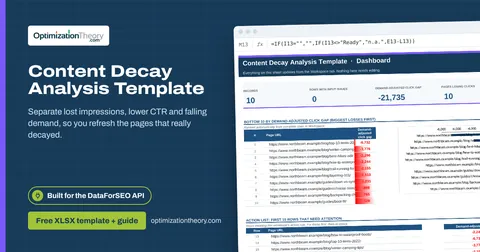
21Content Decay Analysis TemplateLabs: Ranked Keywords
Separate lost impressions, lower CTR and falling demand, so you refresh the pages that really decayed.
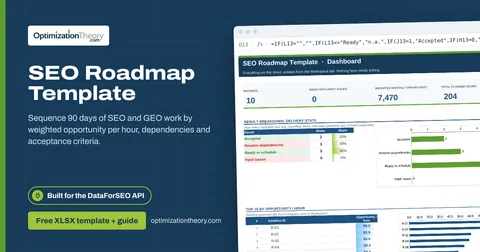
40SEO Roadmap TemplateOn-Page API
Sequence 90 days of SEO and GEO work by weighted opportunity per hour, dependencies and acceptance criteria.
Part of the SEO Business & Delivery Toolkit
Get all 10 SEO Business & Delivery templates in one ZIP, or the complete set of 40 SEO and GEO templates with the 401-page field handbook.
Further reading on Optimization Theory

Built by Jourdan Rombough, technical SEO and GEO consultant with 15+ years in search. About Jourdan or get an SEO plan.
More on digital marketing in our blog
See all posts