Technical SEO Prioritization Template
Technical SEO Prioritization Template
Turn a technical SEO audit into a ranked fix queue by recovered clicks, profit and profit per hour of dev time.
Which technical issues to fix first, ranked by an explicit estimate of recoverable clicks and monthly profit per hour of effort.
- Excel workbook (.xlsx), opens in Google Sheets
- PDF field guide, 9 to 11 pages
- Blank and worked CSV templates
- DataForSEO import script
Free, no email required. Version 3.0, updated November 2026.
=IF(K13="","",IF(K13<>"Ready","n.a.",M13/H13))The formula above is the real one from cell N13. Scroll it sideways to read the whole rule.
Connected to the DataForSEO API
This template is designed around one DataForSEO endpoint. Pull the data, convert it with one command, and the workbook does the rest.
DataForSEO On-Page APIA crawl of your site: URLs, status codes, canonicals, inlinks and sitemap membershipon_page/task_post
Save the JSON responseThe full API response, kept as your source of truth.response.json
Run the import scriptOffline. No API calls, no credentials.dataforseo_import.py import --template 13
Paste at A13Dashboard, checks and action list update instantly.Technical SEO Prioritization Template.xlsx
Column map for this template:Filled by the APIAudit trail (automatic)You add
What the technical SEO prioritization template decides
A technical SEO audit tool will happily give you 400 issues. A development team will give you about 20 hours a sprint. The gap between those two numbers is where most technical SEO programs stall, because 'high priority' labels from a crawler don't translate into business cases.
This technical SEO audit template converts each issue into a planning estimate. You enter the monthly clicks on affected pages, what share is affected, how much is recoverable, your confidence, conversion rate, value and hours. It calculates recoverable clicks, monthly profit opportunity and profit per hour, and ranks the queue so the dev team works on what matters.
Who it's for
- Technical SEOs presenting audit findings to developers
- Product managers allocating sprint capacity
- In-house SEOs justifying engineering time
- Agencies turning an audit into a statement of work
Where it fits in your workflow
The technical SEO prioritization template answers one question. These three templates answer the questions around it:
- Crawl Budget Analysis Template: which URL patterns soak up crawl requests without returning value, how much crawl activity each wastes, and what to do about it.
- Core Web Vitals Tracker: which pages and devices pass all three Core Web Vitals at the 75th percentile, and which metrics are failing where.
- Internal Linking Opportunity Template: which internal links to add first, based on the source page's traffic, the expected link click-through and the value of the destination.
What's inside the download
One ZIP with the workbook, a 10-column input template (blank and filled), the PDF field guide and an offline script that converts saved DataForSEO responses into the input CSV. The workbook has five tabs.
How the technical SEO audit template calculation works
Planned recovered clicks = monthly clicks × affected share × recoverable share × confidence. Monthly profit = recovered clicks × conversion rate × value per conversion. Profit per hour = monthly profit ÷ effort hours.
The key formula, exactly as it appears in the workbook
=IF(K13="","",IF(K13<>"Ready","n.a.",M13/H13))
| Result column | Plain-English formula | What it tells you |
|---|---|---|
| Planned recovered clicks | Segment monthly clicks × Affected share × Recoverable click share × Confidence factor | Conditional estimate under the recorded impact assumptions. |
| Monthly profit opportunity | Planned recovered clicks × Conversion rate × Value per conversion | Modeled recovered contribution per month. |
| Monthly profit / hour | Monthly profit opportunity ÷ Work hours | Comparable planning metric for the listed fixes. |
How to use the technical SEO prioritization template
- List issues, not symptomsGroup crawler warnings into fixable issues with one owner each (e.g. 'faceted URLs indexable on category pages').
- Size the affected trafficEnter monthly clicks for the affected page group and the share actually affected.
- Be explicit about uncertaintyRecoverable share is how much you could win back; confidence is how sure you are. Both are editable and visible.
- Rank and hand offSort by profit per hour. Give the top items to dev with the Owner column filled in.
The worked example in the Workspace tab. Clear the lime input cells, paste your CSV at A13 (values only) and every result recalculates.
Fill the technical SEO prioritization template with DataForSEO
Every template in this library is built to run on DataForSEO data. This one uses DataForSEO On-Page API: a crawl of your site: URLs, status codes, canonicals, inlinks and sitemap membership.
DataForSEO supplies the URL or query list and the audit trail; you add the measurements listed below.
- Request the dataSend this request with your DataForSEO API login (HTTP Basic auth).
POST https://api.dataforseo.com/v3/on_page/task_post [ { "target": "yourdomain.com", "max_crawl_pages": 1000 } ]
Post the crawl task, wait for it to finish, then request on_page/pages with {"id": "<task id>", "limit": 1000} and save that response.
- Save the full JSON responseSave the complete response, not just the task ID, next to the template folder.
- Convert it with the included scriptIt runs offline, makes no API calls and never sees your credentials.
python3 Automation/dataforseo_import.py import --template 13 --input response.json --output my-inputs.csv
- Add what the API can't knowIssue, Segment monthly clicks, Affected share, Recoverable click share, Confidence factor, Conversion rate, Value per conversion, Work hours, Owner
- Paste at A13Clear the demo rows, paste the CSV values at Workspace cell A13 and the dashboard updates.
| Fills automatically from DataForSEO | You add |
|---|---|
| Source reference (audit trail) | Issue, Segment monthly clicks, Affected share, Recoverable click share, Confidence factor, Conversion rate, Value per conversion, Work hours, Owner |
Source reference fills automatically with the task ID, endpoint, location, language, device and snapshot time, so every row is traceable. Before a big pull, estimate the cost with the DataForSEO pricing calculator. The same steps, plus an example request file, are in the download's Automation folder.
Worked example: Northbeam Outdoor
Every template ships filled with data from Northbeam Outdoor, a fictional outdoor-gear retailer that appears across all 40 workbooks, so you can see what useful output looks like before you add your own. This workbook has 12 example rows.
The biggest issue by traffic, slow LCP on mobile category pages, lands near the bottom because it's a 40-hour job with a small recoverable share. Fixing broken internal links after a template change is the clear first sprint item at roughly $386 a month per hour.
Top 10 by monthly profit / hour
| # | Issue | Monthly profit / hour |
|---|---|---|
| 1 | Broken internal links after template change | $386.05 |
| 2 | Faceted URLs indexable on category pages | $169.09 |
| 3 | Soft 404s on out-of-stock products | $132.13 |
| 4 | Missing Product schema price and availability | $120.44 |
| 5 | Hreflang return tags missing on DE site | $92.31 |
Input fields
Keep the columns in this order when you prepare a CSV. A missing observation stays blank; use 0 only for a measured zero or a verified No. Fields marked DataForSEO can be filled automatically by the included script.
| CSV field | Column | Meaning and rule | Source |
|---|---|---|---|
| issue | Issue | Specific observed problem and affected template. | Your records |
| monthly_clicks | Segment monthly clicks | Observed monthly organic clicks for the affected segment. | Your records |
| affected_share | Affected share | Share of that segment exposed to the issue. Decimal: 0.08 = 8%. | Your records |
| recoverable_share | Recoverable click share | Hypothesized fraction of exposed clicks recoverable by the fix. Decimal: 0.08 = 8%. | Your records |
| confidence | Confidence factor | Analyst planning haircut from 0 to 1, not a statistical confidence interval. Decimal: 0.08 = 8%. | Your records |
| conversion_rate | Conversion rate | Conversions divided by eligible organic sessions for the same segment. This is an assumption. Decimal: 0.08 = 8%. | Your records |
| value_per_conversion | Value per conversion | USD contribution profit per conversion or expected lead profit. Use one value basis. | Your records |
| effort_hours | Work hours | Estimated implementation hours, greater than zero. | Your records |
| owner | Owner | Person accountable for the next action. | Your records |
| source_ref | Source reference | Task ID, export filename and observation scope. Retain the untouched source response separately. Optional. | DataForSEO: source_ref |
Reading the result honestly
The calculation makes assumptions inspectable. It does not convert a crawl issue count directly into a ranking forecast.
Limits. Different issues can overlap the same clicks. Do not sum overlapping opportunities without deduplication.
Technical SEO audit template mistakes to avoid
Tips from practice
- Feed issues from the crawl waste, indexability and CWV templates into this one.
- Revisit confidence after each fix ships; you'll calibrate quickly.
- Export the top 10 as tickets with the profit estimate in the description.
Frequently asked questions
How do I prioritize technical SEO issues?
Estimate the traffic each issue affects, how much you could recover, the value of that traffic and the effort to fix. Rank by value per hour of effort.
What should a technical SEO audit template include?
The issue, affected pages and traffic, impact assumptions, owner, effort, evidence and a calculated priority. This template adds the profit math and a ranked dashboard.
Is this an impact vs effort matrix?
Yes, in numeric form. Instead of placing issues on a 2x2 grid, it calculates impact in profit and divides by effort.
What if an issue has no measurable traffic?
Enter zero clicks and it will rank at the bottom. Handle compliance, security or hygiene items separately; they don't need an SEO business case.
Use it with these templates
Each template answers one decision. These are the ones that feed into, or follow from, the technical SEO prioritization template.
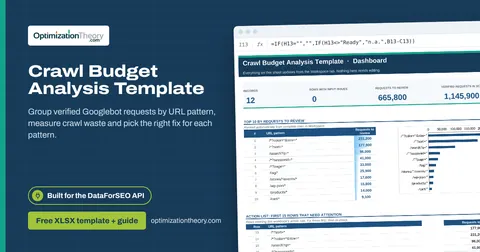
14Crawl Budget Analysis TemplateOn-Page API
Group verified Googlebot requests by URL pattern, measure crawl waste and pick the right fix for each pattern.
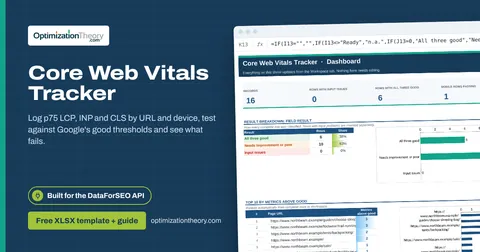
15Core Web Vitals TrackerOn-Page API
Log p75 LCP, INP and CLS by URL and device, test against Google's good thresholds and see what fails.
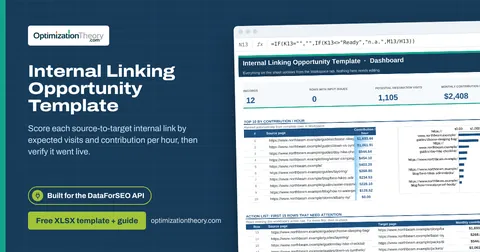
16Internal Linking Opportunity TemplateOn-Page API
Score each source-to-target internal link by expected visits and contribution per hour, then verify it went live.
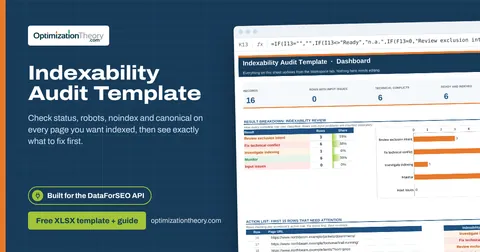
11Indexability Audit TemplateOn-Page API
Check status, robots, noindex and canonical on every page you want indexed, then see exactly what to fix first.
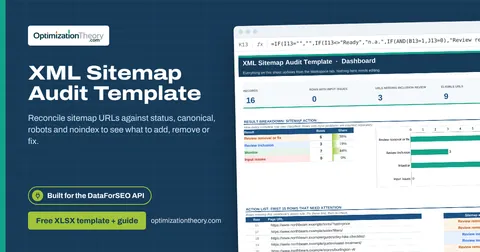
17XML Sitemap Audit TemplateOn-Page API
Reconcile sitemap URLs against status, canonical, robots and noindex to see what to add, remove or fix.
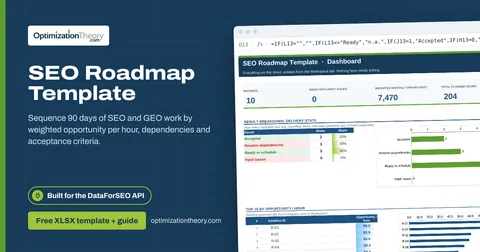
40SEO Roadmap TemplateOn-Page API
Sequence 90 days of SEO and GEO work by weighted opportunity per hour, dependencies and acceptance criteria.
Part of the Technical SEO Toolkit
Get all 6 Technical SEO templates in one ZIP, or the complete set of 40 SEO and GEO templates with the 401-page field handbook.
Further reading on Optimization Theory

Built by Jourdan Rombough, technical SEO and GEO consultant with 15+ years in search. About Jourdan or get an SEO plan.
More on digital marketing in our blog
See all posts