Content Audit Template
Content Audit Template
Score every URL by lost clicks, conversions and links, choose keep, refresh, merge or retire, and catch the risky calls.
What to do with each existing page (keep, refresh, merge or retire) and which decisions would throw away conversions, links or a merge destination.
- Excel workbook (.xlsx), opens in Google Sheets
- PDF field guide, 9 to 11 pages
- Blank and worked CSV templates
- DataForSEO import script
Free, no email required. Version 3.0, updated November 2026.
=IF(J13="","",IF(J13<>"Ready","n.a.",IF(AND(F13="Retire",OR(D13>0,E13>0)),"Review retained value",IF(AND(F13="Merge",G13="N/A"),"Set merge destination","Review intent and quality"))))The formula above is the real one from cell M13. Scroll it sideways to read the whole rule.
Connected to the DataForSEO API
This template is designed around one DataForSEO endpoint. Pull the data, convert it with one command, and the workbook does the rest.
DataForSEO On-Page APIA crawl of your site: URLs, status codes, canonicals, inlinks and sitemap membershipon_page/task_post
Save the JSON responseThe full API response, kept as your source of truth.response.json
Run the import scriptOffline. No API calls, no credentials.dataforseo_import.py import --template 20
Paste at A13Dashboard, checks and action list update instantly.Content Audit Template.xlsx
Column map for this template:Filled by the APIAudit trail (automatic)You add
What the content audit template decides
Content audits end in one of two places: a beautifully scored spreadsheet nobody acts on, or a mass deletion that takes good pages down with the bad. The difference is decision rules that protect value.
This content audit template records clicks before and now, conversions, referring domains, your chosen disposition and destination, and the hours to act. It calculates observed lost clicks and lost clicks per work hour, then reviews each decision: retiring a page with conversions or links is flagged Review retained value, a merge without a destination is flagged Set merge destination.
Who it's for
- Content teams pruning or refreshing a blog
- SEOs recovering from a helpful content or core update
- Ecommerce sites cleaning up old collections and guides
- Teams planning a migration who want to cut dead weight first
Where it fits in your workflow
The content audit template answers one question. These three templates answer the questions around it:
- Content Decay Analysis Template: whether a page lost clicks because it lost rankings, lost CTR or the market lost interest, and how big the demand-adjusted gap is.
- Keyword Cannibalization Checker Template: which query and URL pairs are true cannibalization worth consolidating, which are distinct intents to leave alone, and which page should win.
- Redirect Mapping Template: whether each planned redirect actually reaches the approved destination in one permanent hop, on an indexable page whose canonical agrees, with a human sign-off.
What's inside the download
One ZIP with the workbook, a 9-column input template (blank and filled), the PDF field guide and an offline script that converts saved DataForSEO responses into the input CSV. The workbook has five tabs.
How the content audit template calculation works
Observed lost clicks = clicks before − clicks now (never negative). Lost clicks per hour = lost clicks ÷ effort. Disposition review flags Retire with conversions or links, and Merge with destination N/A.
The key formula, exactly as it appears in the workbook
=IF(J13="","",IF(J13<>"Ready","n.a.",IF(AND(F13="Retire",OR(D13>0,E13>0)),"Review retained value",IF(AND(F13="Merge",G13="N/A"),"Set merge destination","Review intent and quality"))))
| Result column | Plain-English formula | What it tells you |
|---|---|---|
| Observed lost clicks | MAX(0,Earlier clicks-Current clicks) | Positive loss only. Gains display zero lost clicks. |
| Lost clicks / work hour | Observed lost clicks ÷ Work hours | Triage of historical loss relative to estimated effort. |
| Disposition review | IF(AND(Disposition="Retire",OR(Current conversions>0,Referring domains>0)),"Review retained value",IF(AND(Disposition="Merge",Merge destination="N ÷ A"),"Set merge destination","Review intent and quality")) | Protects observed conversion/link value and requires a merge destination. |
The results you will see
Review retained valueSet merge destinationReview intent and quality
Green meets the checks, red needs fixing first, amber needs a human decision and blue marks an opportunity. Rows with missing or out-of-range inputs are held back in the Input check column until they're fixed, so a half-filled row never sneaks into a total.
How to use the content audit template
- Build the inventoryExport every content URL with clicks for two comparable periods (e.g. this year vs last year), conversions and referring domains.
- Pick a dispositionKeep, Refresh, Merge or Retire from the dropdown. Merges need a destination URL.
- Estimate effortHours to refresh, merge or redirect. This ranks refresh work by lost clicks per hour.
- Clear the review flagsWork the Dashboard action list before deleting anything. Then send merges and retirements to the redirect map.
The worked example in the Workspace tab. Clear the lime input cells, paste your CSV at A13 (values only) and every result recalculates.
Fill the content audit template with DataForSEO
Every template in this library is built to run on DataForSEO data. This one uses DataForSEO On-Page API: a crawl of your site: URLs, status codes, canonicals, inlinks and sitemap membership.
Most of the data columns fill automatically. Add the business inputs listed below, then paste.
- Request the dataSend this request with your DataForSEO API login (HTTP Basic auth).
POST https://api.dataforseo.com/v3/on_page/task_post [ { "target": "yourdomain.com", "max_crawl_pages": 1000 } ]
Post the crawl task, wait for it to finish, then request on_page/pages with {"id": "<task id>", "limit": 1000} and save that response.
- Save the full JSON responseSave the complete response, not just the task ID, next to the template folder.
- Convert it with the included scriptIt runs offline, makes no API calls and never sees your credentials.
python3 Automation/dataforseo_import.py import --template 20 --input response.json --output my-inputs.csv
- Add what the API can't knowEarlier clicks, Current clicks, Current conversions, Referring domains, Disposition, Merge destination, Work hours
- Paste at A13Clear the demo rows, paste the CSV values at Workspace cell A13 and the dashboard updates.
| Fills automatically from DataForSEO | You add |
|---|---|
| Page URL | Earlier clicks, Current clicks, Current conversions, Referring domains, Disposition, Merge destination, Work hours |
Source reference fills automatically with the task ID, endpoint, location, language, device and snapshot time, so every row is traceable. Before a big pull, estimate the cost with the DataForSEO pricing calculator. The same steps, plus an example request file, are in the download's Automation folder.
Worked example: Northbeam Outdoor
Every template ships filled with data from Northbeam Outdoor, a fictional outdoor-gear retailer that appears across all 40 workbooks, so you can see what useful output looks like before you add your own. This workbook has 14 example rows.
The example's biggest loss is an old 'top tents of 2022' post that dropped 7,500 clicks and is a straightforward refresh. Three retirements are flagged because the pages still have conversions or links, and one merge has no destination yet.
Top 10 by lost clicks / work hour
| # | Page URL | Lost clicks / work hour |
|---|---|---|
| 1 | https://www.northbeam.example/blog/2019-gift-guide/ | 780.0 |
| 2 | https://www.northbeam.example/blog/best-hikes-adirondacks/ | 700.0 |
| 3 | https://www.northbeam.example/blog/top-10-tents-2022/ | 625.0 |
| 4 | https://www.northbeam.example/guides/choose-sleeping-bag/ | 600.0 |
| 5 | https://www.northbeam.example/blog/layering-101/ | 600.0 |
Input fields
Keep the columns in this order when you prepare a CSV. A missing observation stays blank; use 0 only for a measured zero or a verified No. Fields marked DataForSEO can be filled automatically by the included script.
| CSV field | Column | Meaning and rule | Source |
|---|---|---|---|
| url | Page URL | Exact absolute URL. Keep case and query parameters unless a documented normalization rule applies. | DataForSEO: url |
| clicks_before | Earlier clicks | GSC clicks in a complete comparable window. | Your records |
| clicks_now | Current clicks | GSC clicks in the matching current window. | Your records |
| conversions | Current conversions | Observed conversions for the same current period. | Your records |
| referring_domains | Referring domains | Unique URL-level referring domains. | Your records |
| disposition | Disposition | Keep, Refresh, Merge or Retire after manual quality and relevance review. | Your records |
| destination | Merge destination | Required when merging. Otherwise enter N/A. | Your records |
| effort_hours | Work hours | Estimated implementation hours, greater than zero. | Your records |
| source_ref | Source reference | Task ID, export filename and observation scope. Retain the untouched source response separately. Optional. | DataForSEO: source_ref |
Reading the result honestly
Low traffic alone is insufficient evidence for deletion. Some pages serve conversions, support or legal needs.
Limits. Traffic changes can reflect demand or SERP shifts. Use resource 21 before attributing loss to content age.
Content audit template mistakes to avoid
Tips from practice
- Run the content decay template on Refresh candidates to understand why they declined.
- Use the cannibalization checker to find merge pairs.
- Schedule refreshes in the content calendar so the audit turns into work.
Frequently asked questions
What is a content audit?
A systematic review of existing content to decide what to keep, update, merge or remove, based on performance, quality and business value.
When should I delete content?
When a page has no traffic, no links, no conversions and no strategic purpose. Otherwise merge or redirect it.
How often should I run a content audit?
Annually for most sites, with quarterly checks on high-value pages.
What's the difference between refresh and merge?
Refresh improves a page in place. Merge combines overlapping pages into one stronger page and redirects the rest.
Use it with these templates
Each template answers one decision. These are the ones that feed into, or follow from, the content audit template.
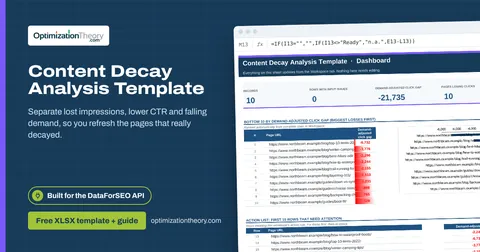
21Content Decay Analysis TemplateLabs: Ranked Keywords
Separate lost impressions, lower CTR and falling demand, so you refresh the pages that really decayed.
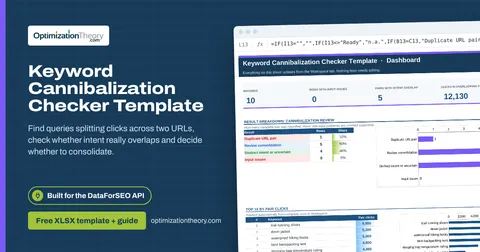
22Keyword Cannibalization Checker TemplateLabs: Ranked Keywords
Find queries splitting clicks across two URLs, check whether intent really overlaps and decide whether to consolidate.
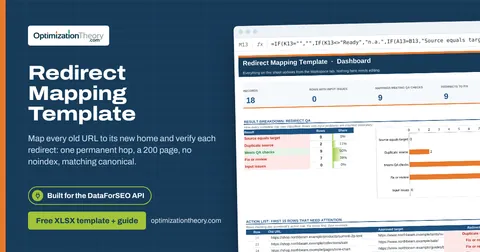
08Redirect Mapping TemplateOn-Page API
Map every old URL to its new home and verify each redirect: one permanent hop, a 200 page, no noindex, matching canonical.
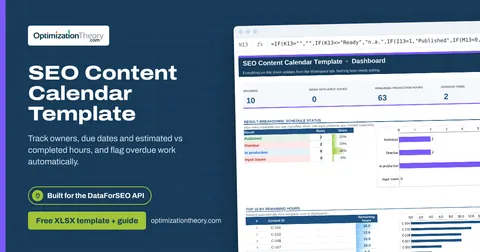
23SEO Content Calendar TemplateLabs: Keyword Overview
Track owners, due dates and estimated vs completed hours, and flag overdue work automatically.

19SEO Content Brief TemplateLabs: Keyword Overview
A content brief built for Google and AI answers: real questions, original evidence, sources and a three-step approval workflow.
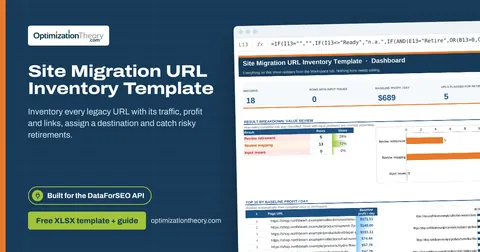
07Site Migration URL Inventory TemplateOn-Page API
Inventory every legacy URL with its traffic, profit and links, assign a destination and catch risky retirements.
Part of the Content SEO Toolkit
Get all 6 Content SEO templates in one ZIP, or the complete set of 40 SEO and GEO templates with the 401-page field handbook.
Further reading on Optimization Theory

Built by Jourdan Rombough, technical SEO and GEO consultant with 15+ years in search. About Jourdan or get an SEO plan.
More on digital marketing in our blog
See all posts