Brand Entity Consistency Audit
Brand Entity Consistency Audit
Compare your official brand facts with Wikidata, LinkedIn, GBP, Yelp and more, and log every correction request.
Which third-party profiles state your brand facts incorrectly, and which corrections to request and from whom.
- Excel workbook (.xlsx), opens in Google Sheets
- PDF field guide, 9 to 11 pages
- Blank and worked CSV templates
- DataForSEO import script
Free, no email required. Version 3.0, updated November 2026.
=IF(J13="","",IF(J13<>"Ready","n.a.",IF(OR(K13=1,F13=1),"Consistent on review","Request factual correction")))The formula above is the real one from cell L13. Scroll it sideways to read the whole rule.
Connected to the DataForSEO API
This template is designed around one DataForSEO endpoint. Pull the data, convert it with one command, and the workbook does the rest.
DataForSEO AI Optimization: LLM MentionsAI answers (ChatGPT or Google AI Overviews) that mention a domain or keyword, with their cited sourcesai_optimization/llm_mentions/search_mentions/live
Save the JSON responseThe full API response, kept as your source of truth.response.json
Run the import scriptOffline. No API calls, no credentials.dataforseo_import.py import --template 29 --csv
Paste at A13Dashboard, checks and action list update instantly.Brand Entity Consistency Audit.xlsx
Column map for this template:Filled by the APIAudit trail (automatic)You add
What the brand entity consistency audit decides
Search engines and AI systems build their picture of your brand from many sources at once: your site, Google Business Profile, Wikidata, LinkedIn, Crunchbase, review sites, directories. When those sources disagree on your founding year, phone number or return policy, AI answers can repeat the wrong one with confidence.
This entity SEO audit template records the official value for each entity attribute and the value observed on each third-party source. It checks for an exact text match, lets a reviewer confirm semantic matches (Albany, NY vs Albany, New York), and flags everything else as Request factual correction, with an owner and review date.
Who it's for
- Brand and SEO teams managing knowledge panels and AI answers
- Local businesses keeping NAP data consistent
- Companies after a rebrand, move or policy change
- Agencies running entity audits for clients
Where it fits in your workflow
The brand entity consistency audit answers one question. These three templates answer the questions around it:
- Schema Markup Audit Template: which pages and schema types are ready to release, and which fail on syntax, required properties, content mismatch or policy.
- Answer Evidence Audit Template: which claims on a page are verified, original, clear and current, and what each unfinished claim needs next.
- AI Citation Tracker: how often AI answers cite your site, on which platforms and prompts, measured over an explicit set of valid, observed answers.
What's inside the download
One ZIP with the workbook, a 9-column input template (blank and filled), the PDF field guide and an offline script that converts saved DataForSEO responses into the input CSV. The workbook has five tabs.
How the entity SEO calculation works
Exact text match = 1 when the official and observed values are identical (case-sensitive). The action is Consistent on review when there's an exact or confirmed semantic match, otherwise Request factual correction.
The key formula, exactly as it appears in the workbook
=IF(J13="","",IF(J13<>"Ready","n.a.",IF(OR(K13=1,F13=1),"Consistent on review","Request factual correction")))
| Result column | Plain-English formula | What it tells you |
|---|---|---|
| Exact text match | IF(EXACT(Official value,Observed value),1,0) | Case-sensitive text comparison. |
| Entity correction action | IF(OR(Exact text match=1,Human semantic match=1),"Consistent on review","Request factual correction") | Uses human semantic review before treating text differences as contradictions. |
The results you will see
Consistent on reviewRequest factual correction
Green meets the checks, red needs fixing first, amber needs a human decision and blue marks an opportunity. Rows with missing or out-of-range inputs are held back in the Input check column until they're fixed, so a half-filled row never sneaks into a total.
How to use the brand entity consistency audit
- Write the official factsList each entity (company, locations, people) and attribute with the authoritative value.
- Collect observed valuesCheck each source: Google Business Profile, Apple, Bing, Wikidata, Wikipedia, LinkedIn, Crunchbase, Yelp, BBB, industry directories.
- Confirm semantic matchesMark 1 where the wording differs but the fact is the same.
- Request correctionsWork the action list. Log the request, the owner and the date; recheck later.
The worked example in the Workspace tab. Clear the lime input cells, paste your CSV at A13 (values only) and every result recalculates.
Fill the brand entity consistency audit with DataForSEO
Every template in this library is built to run on DataForSEO data. This one uses DataForSEO AI Optimization: LLM Mentions: AI answers (ChatGPT or Google AI Overviews) that mention a domain or keyword, with their cited sources.
This is a sign-off workflow. DataForSEO responses are the evidence you attach; the human checks stay manual by design.
- Request the dataSend this request with your DataForSEO API login (HTTP Basic auth).
POST https://api.dataforseo.com/v3/ai_optimization/llm_mentions/search_mentions/live [ { "target": [ { "domain": "yourdomain.com" } ], "platform": "chat_gpt", "location_code": 2840, "language_code": "en", "limit": 100 } ]
- Save the full JSON responseSave the complete response, not just the task ID, next to the template folder.
- Convert it with the included scriptIt runs offline, makes no API calls and never sees your credentials.
python3 Automation/dataforseo_import.py import --template 29 --csv --input my-filled.csv --output my-inputs.csv
- Add what the API can't knowEntity name, Attribute, Official value, Observed value, Human semantic match, Owner, Review date
- Paste at A13Clear the demo rows, paste the CSV values at Workspace cell A13 and the dashboard updates.
| Fills automatically from DataForSEO | You add |
|---|---|
| Observed source URL | Entity name, Attribute, Official value, Observed value, Human semantic match, Owner, Review date |
Source reference fills automatically with the task ID, endpoint, location, language, device and snapshot time, so every row is traceable. Before a big pull, estimate the cost with the DataForSEO pricing calculator. The same steps, plus an example request file, are in the download's Automation folder.
Worked example: Northbeam Outdoor
Every template ships filled with data from Northbeam Outdoor, a fictional outdoor-gear retailer that appears across all 40 workbooks, so you can see what useful output looks like before you add your own. This workbook has 12 example rows.
Five example corrections are needed, including a store Bing still shows as permanently closed and a 30-day return policy quoted on BBB when the real policy is 60 days, which is exactly what an AI answer about returns would repeat.
Result breakdown
| Result | Rows | Share |
|---|---|---|
| Consistent on review | 7 | 58% |
| Request factual correction | 5 | 42% |
| Input issues | 0 | 0% |
Input fields
Keep the columns in this order when you prepare a CSV. A missing observation stays blank; use 0 only for a measured zero or a verified No. Fields marked DataForSEO can be filled automatically by the included script.
| CSV field | Column | Meaning and rule | Source |
|---|---|---|---|
| entity | Entity name | Exact organization, person or product being audited. | Your records |
| attribute | Attribute | One field such as official name, address, product name or service area. | Your records |
| official_value | Official value | Verified value from the authoritative record. | Your records |
| observed_value | Observed value | Value found in the cited profile or answer. | Your records |
| source_url | Observed source URL | URL of the profile or source being audited. | DataForSEO: url |
| semantic_match | Human semantic match | 1 only after checking whether harmless formatting differences preserve meaning. 1 = Yes, 0 = No. | Your records |
| owner | Owner | Person accountable for the next action. | Your records |
| review_date | Review date | Date the claim was checked. | Your records |
| source_ref | Source reference | Task ID, export filename and observation scope. Retain the untouched source response separately. Optional. | DataForSEO: source_ref |
Reading the result honestly
Fix actual contradictions before polishing harmless name or URL formatting variations.
Limits. Mention discovery does not establish truth. Official records, product data and authorized business owners supply authoritative facts.
Entity SEO mistakes to avoid
Tips from practice
- Add Organization and LocalBusiness schema with sameAs links to verified profiles.
- Ask AI platforms about your brand facts in the citation tracker to see which errors surface.
- Re-run after any change to hours, address, policies or leadership.
Frequently asked questions
What is entity SEO?
Optimizing how search engines and AI systems understand your brand as an entity: its attributes, relationships and the sources that describe it.
What is NAP consistency?
Keeping your business name, address and phone number identical across listings. It's part of a wider entity consistency audit.
Why does AI give wrong facts about my company?
Often because third-party sources disagree or are outdated. Fixing those sources is the most reliable correction.
Which sources matter most?
Your own site, Google Business Profile, Wikidata and Wikipedia where applicable, LinkedIn, major directories and review sites in your industry.
Use it with these templates
Each template answers one decision. These are the ones that feed into, or follow from, the brand entity consistency audit.
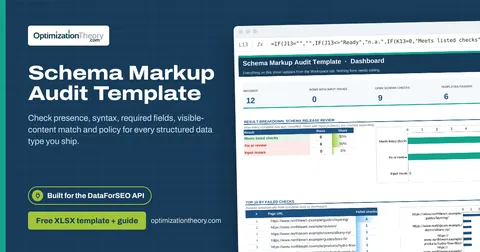
18Schema Markup Audit TemplateOn-Page API
Check presence, syntax, required fields, visible-content match and policy for every structured data type you ship.
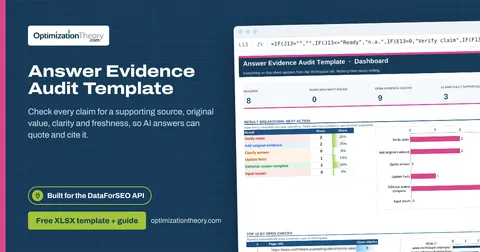
28Answer Evidence Audit TemplateOn-Page API
Check every claim for a supporting source, original value, clarity and freshness, so AI answers can quote and cite it.
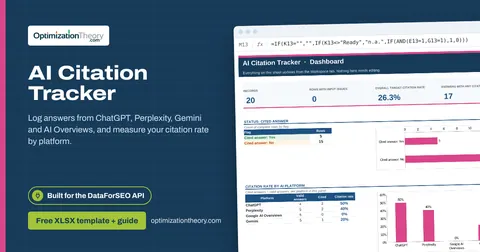
26AI Citation TrackerAI Optimization: LLM Mentions
Log answers from ChatGPT, Perplexity, Gemini and AI Overviews, and measure your citation rate by platform.
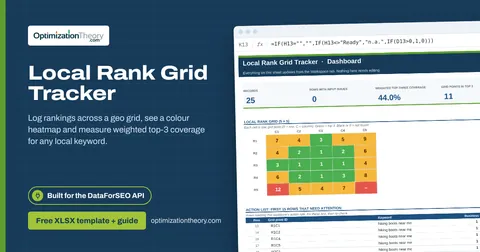
35Local Rank Grid TrackerSERP API: Google Maps
Log rankings across a geo grid, see a colour heatmap and measure weighted top-3 coverage for any local keyword.
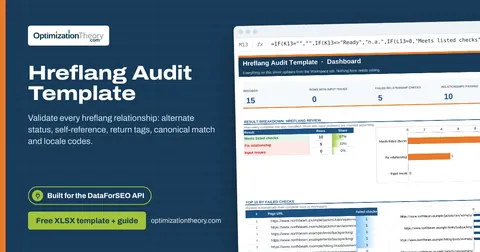
12Hreflang Audit TemplateOn-Page API
Validate every hreflang relationship: alternate status, self-reference, return tags, canonical match and locale codes.
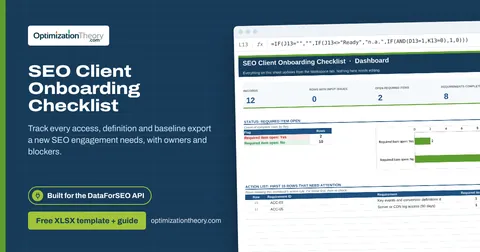
39SEO Client Onboarding ChecklistOn-Page API
Track every access, definition and baseline export a new SEO engagement needs, with owners and blockers.
Part of the AI Visibility & GEO Toolkit
Get all 6 AI Visibility & GEO templates in one ZIP, or the complete set of 40 SEO and GEO templates with the 401-page field handbook.
Further reading on Optimization Theory

Built by Jourdan Rombough, technical SEO and GEO consultant with 15+ years in search. About Jourdan or get an SEO plan.
More on digital marketing in our blog
See all posts