

- October 28, 2026
- Artificial Intelligence, GEO & AEO, How To, SEO
What Is the Agentic Web? The Complete Guide to AI Agents, Agentic Commerce and Agent-Ready SEO
The web was built for people who click. The agentic web is being built for AI agents that act. Here's what the agentic web is, how it works under the hood, what the expert studies say, and exactly how to make your website ready for the AI agents already showing up in your logs.

The agentic web in 30 seconds
- The agentic web is the next phase of the internet, where AI agents browse, compare, decide and transact on behalf of people, and increasingly talk to other agents directly.
- It runs on new open protocols: MCP, A2A, WebMCP and NLWeb for actions and data, plus ACP, AP2 and UCP for agentic checkout and agentic payments.
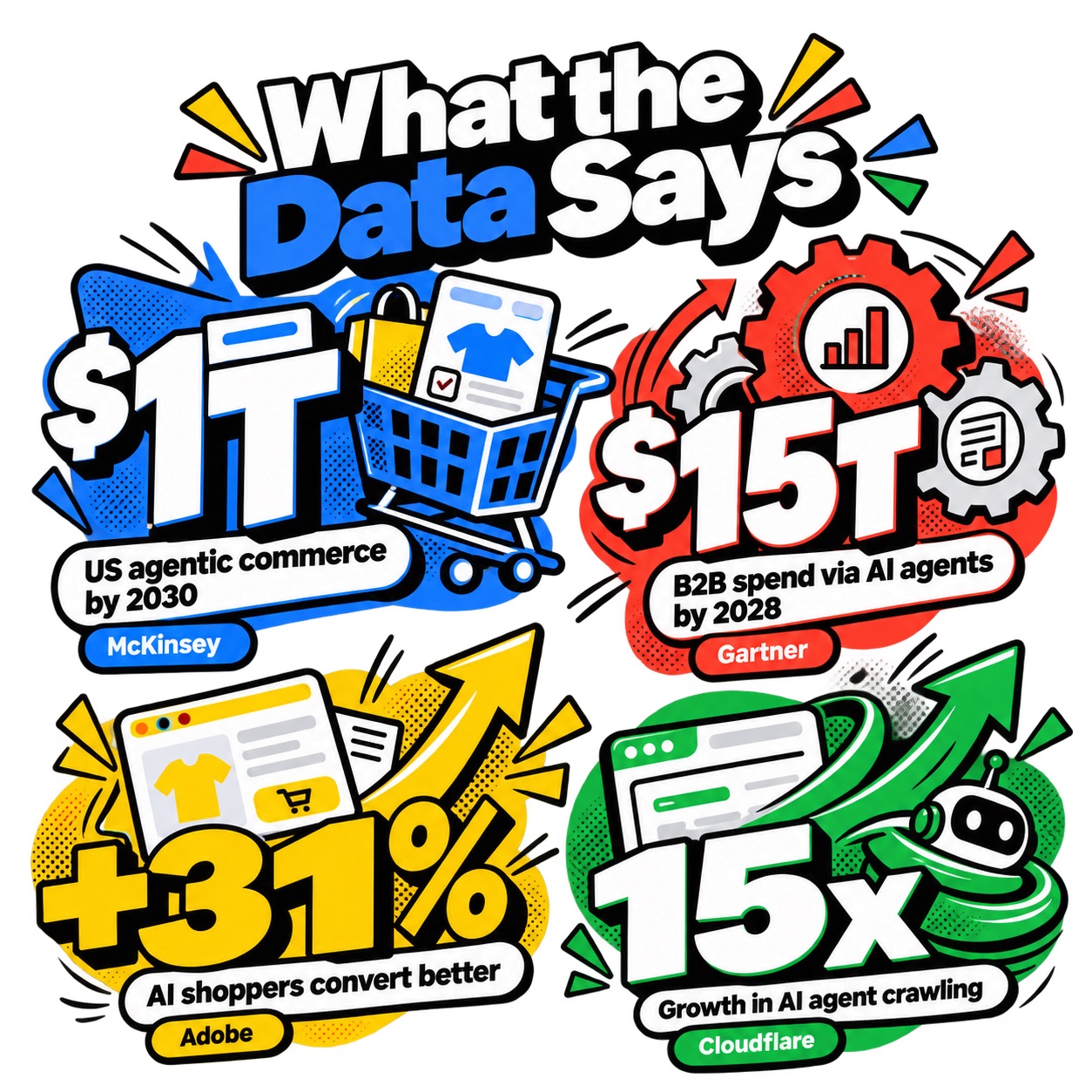
- The money is real: McKinsey projects up to $1 trillion in US agentic commerce by 2030, and Gartner expects AI agents to intermediate $15 trillion in B2B spend by 2028.
- AI-referred shoppers already convert 31% better than other traffic (Adobe, 2025 holiday season), and user-driven AI agent crawling grew 15x in 2025 (Cloudflare).
- For SEOs, the job is expanding from "rank and get cited" to "be usable by an agent." That's agentic SEO, and the checklist is below.
What is the agentic web?
The agentic web is a version of the internet where AI agents, not just people, are the main users. Agents read pages, call tools, compare options and complete tasks like booking, buying and filing forms on a person's behalf, and they coordinate with other agents through shared protocols.
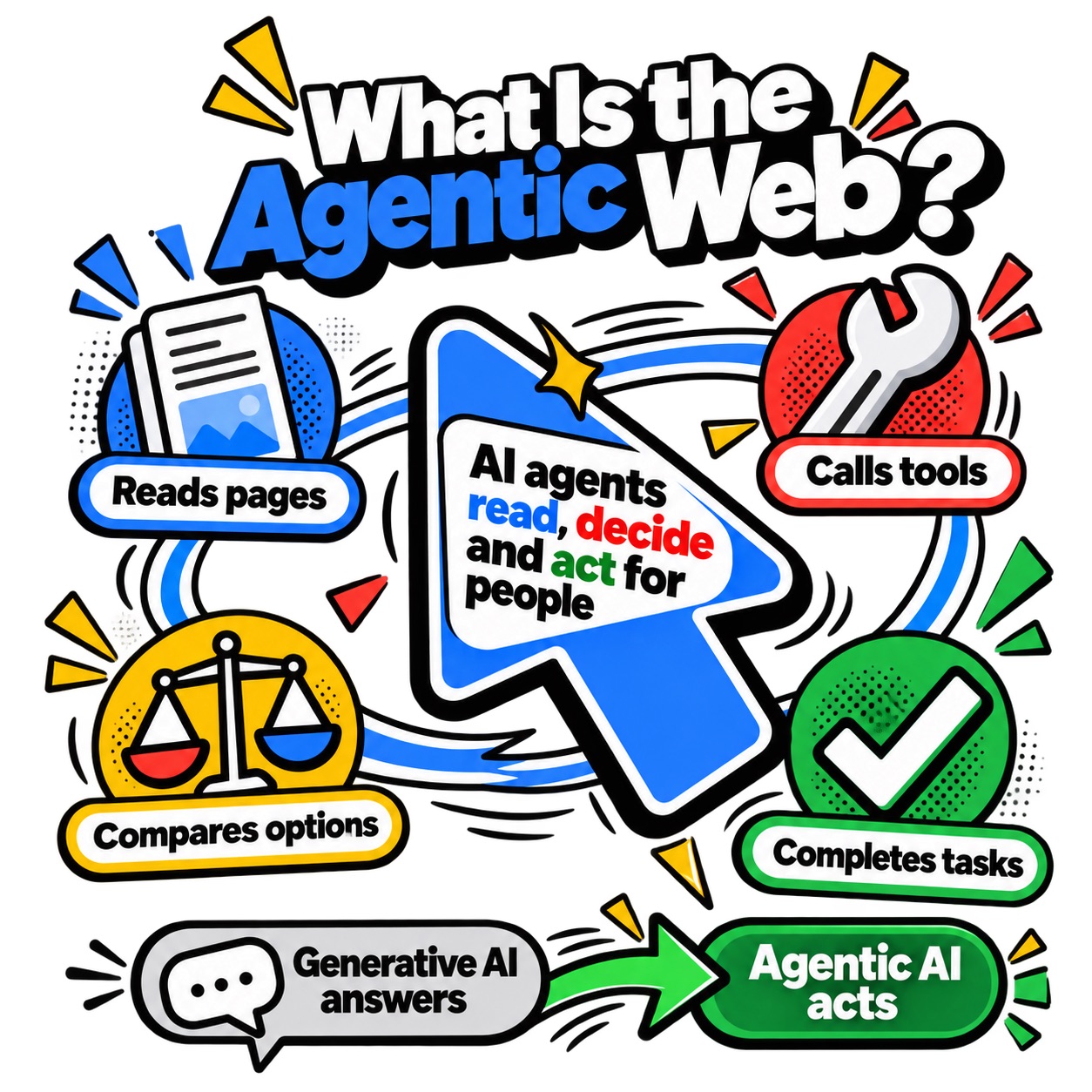
On the traditional web, a human types a query, scans ten blue links, opens tabs and does the work. On the agentic web, the human states a goal ("find me a carry-on under $200 that fits United's size rules and order it") and an AI agent does the browsing, the comparing and the checkout. The person approves the result. The agent does the clicking.
The term picked up momentum in 2025. Microsoft built its Build 2025 keynote around what Satya Nadella called the open agentic web, and Microsoft defines it as "AI agents that make decisions and perform tasks on behalf of users or organizations." A few months later, researchers published "Agentic Web: Weaving the Next Web with AI Agents" on arXiv, describing the agentic internet as a shift from human-driven browsing to machine-to-machine interaction, where agents "plan, coordinate, and carry out complex tasks for users."
So you'll see a few names for the same idea: the agentic web, the agentic internet, the open agentic web, the agent-driven web or simply the AI agent web. They all describe one change: your website's most important visitor is starting to be software that acts, not a person who reads.
Agentic AI vs. generative AI: why the distinction matters
Generative AI writes an answer. Agentic AI takes an action. ChatGPT summarizing the best running shoes is generative. ChatGPT agent opening three retailer sites, checking your size, applying a coupon and placing the order is agentic. The agentic web is the infrastructure that lets agentic AI work across sites it doesn't own, which is why it touches SEO, UX, development, payments and security all at once.
From the search web to the agentic web
The clearest way to understand the agentic web is to see where it sits in the history of search. Each era changed who the "user" is and what a website has to do to win.
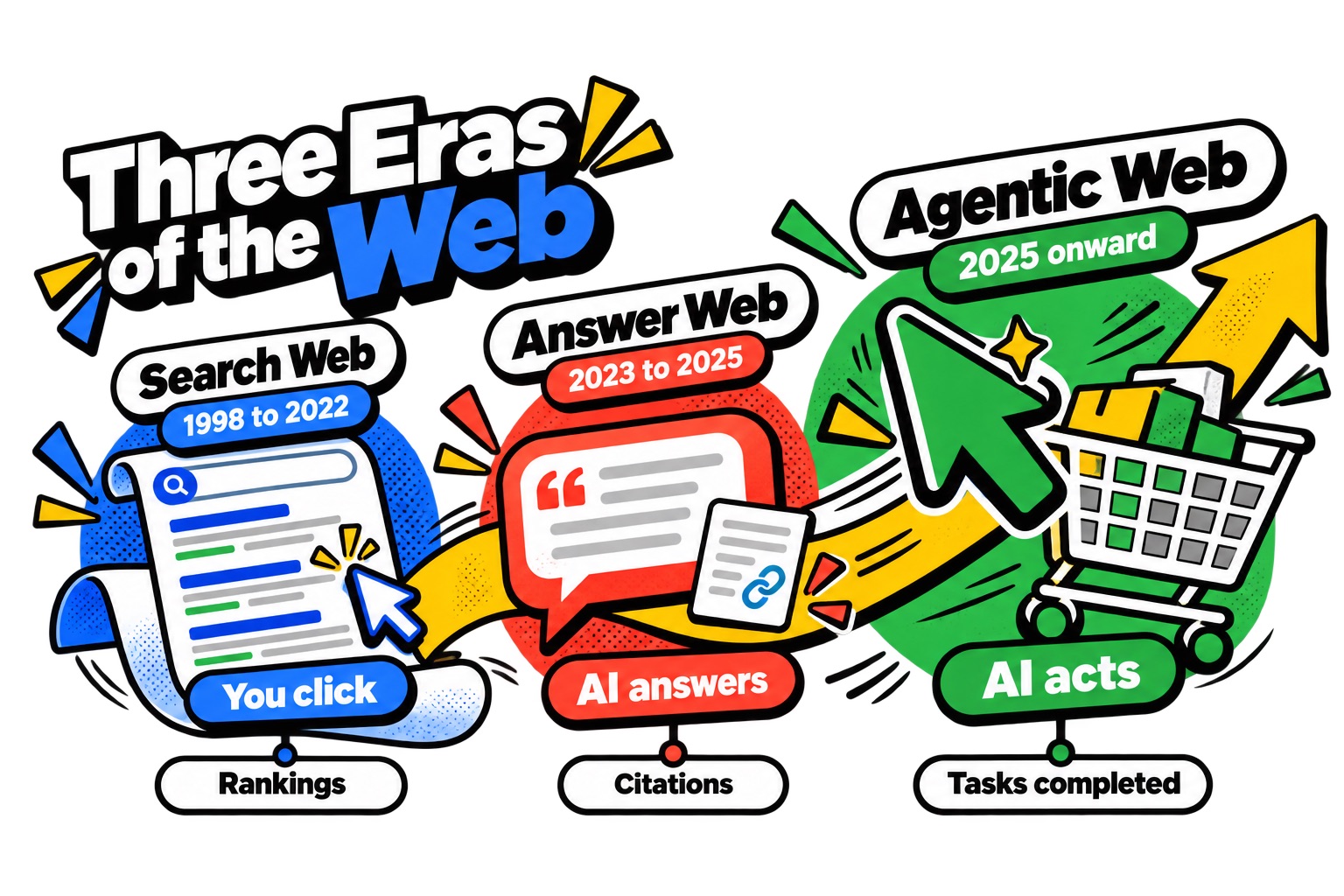
| Era | Who does the work | How you win | Main metric |
|---|---|---|---|
| Search web 1998 to 2022 |
The person searches, clicks and compares | Rank in the top 10 blue links | Rankings, clicks, CTR |
| Answer web 2023 to 2025 |
AI search reads pages and writes the answer | Get cited and mentioned in AI answers (GEO) | Citations, share of voice |
| Agentic web 2025 onward |
AI agents read, decide and act for the person | Be usable by agents: readable data, callable actions, agent checkout | Agent task completion, agent-driven revenue |
Notice that each era stacks on the last one. Agents still use search indexes to find candidates, and they still prefer brands the models already trust. Agentic web optimization doesn't replace SEO or generative engine optimization. It adds a new layer on top.
How the agentic web works
Under the hood, every agentic web interaction runs through the same layers. If you understand this stack, you understand where your website can win or lose.
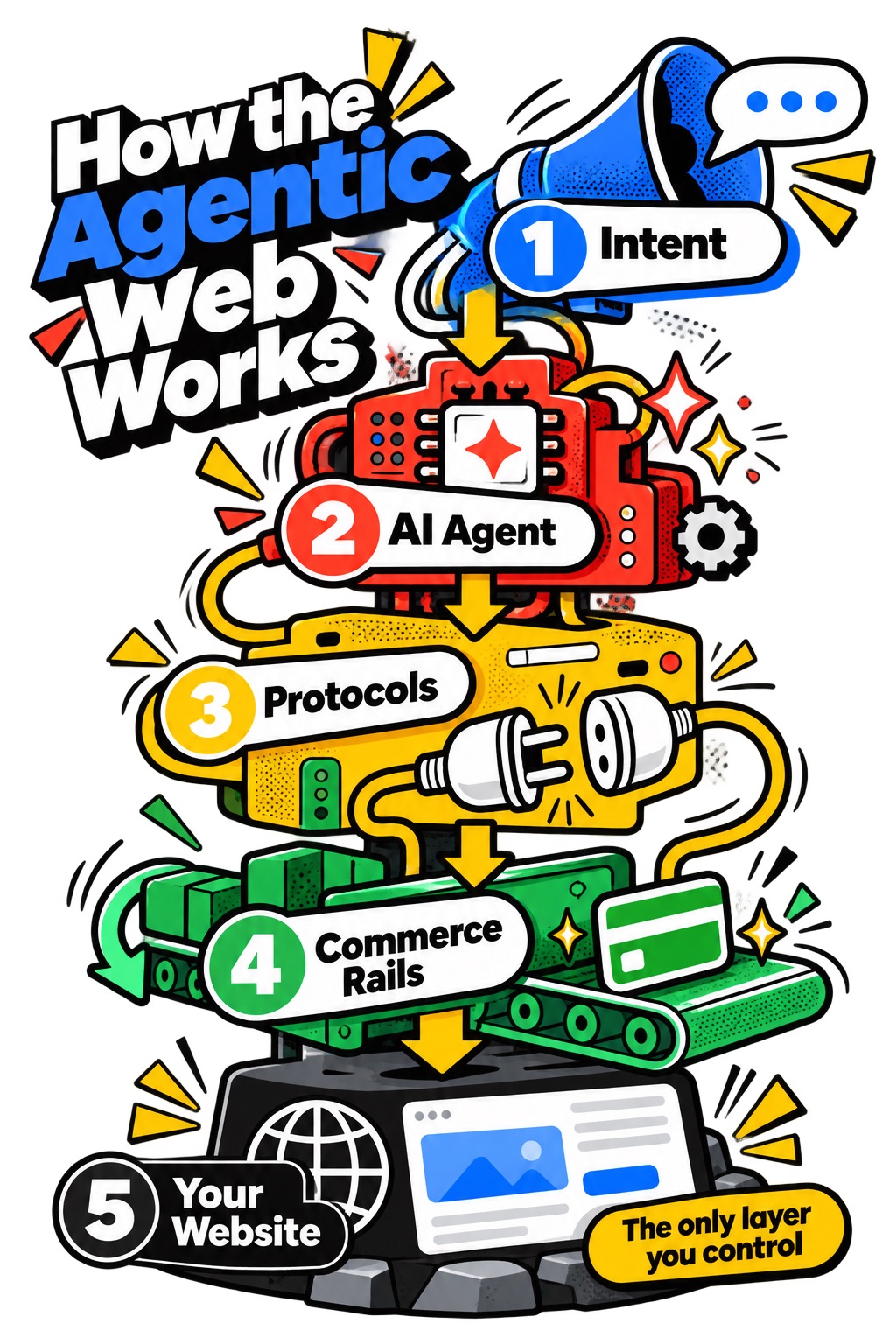
A person gives a goal in plain language: "Book a table for four near Times Square at 7pm Friday."
An LLM-powered agent (ChatGPT agent, Gemini, Claude, Perplexity Comet, Copilot) breaks the goal into steps and plans the work. This is the same query fan-out you see in AI search, but followed by actions.
The agent reaches tools and data through standards like MCP, A2A, WebMCP and NLWeb, or falls back to reading and clicking your HTML like a person would.
To pay, it uses agentic checkout and agentic payments standards (ACP, UCP, AP2) and network programs like Visa Intelligent Commerce and Mastercard Agent Pay.
Your HTML, structured data, product feeds, APIs and checkout. This is the only layer you control, and it decides whether the agent finishes the task with you or with a competitor.
The five steps of an agentic task
Discover
The agent searches and fans out sub-queries to build a shortlist.
Read
It fetches pages and pulls facts: price, specs, stock, policies.
Evaluate
It compares options against the person's constraints and trusted sources.
Act
It fills forms, adds to cart or calls a site tool through a protocol.
Pay & confirm
It checks out with a delegated payment token and reports back.
Steps 1 to 3 are where traditional SEO and GEO live. Steps 4 and 5 are new. A site can win the citation and still lose the sale if the agent can't read the price (because it loads with JavaScript), can't find the size selector (because it's an unlabeled div), or gets stopped by a CAPTCHA at checkout.
Agentic browsers and agentic search
Two product categories make the agentic web visible to everyday users. Agentic browsers like Perplexity Comet, ChatGPT Atlas, Opera Neon and Chrome with Gemini put an agent inside the browser that can see the page, click, type and move between tabs. Agentic search goes past the classic retrieval-augmented generation model: instead of retrieving once and answering, the AI runs multiple rounds of searching, reading and reasoning until it can complete the task. If RAG is "look it up, then answer," agentic search is "keep investigating until the job is done."
The protocols powering the agentic web
The biggest technical story of the agentic web is standardization. In under two years the industry went from every agent scraping every site its own way to a set of shared protocols. McKinsey's agentic commerce research specifically calls out MCP, A2A, AP2 and ACP as the emerging standards to watch. Here's the full map.
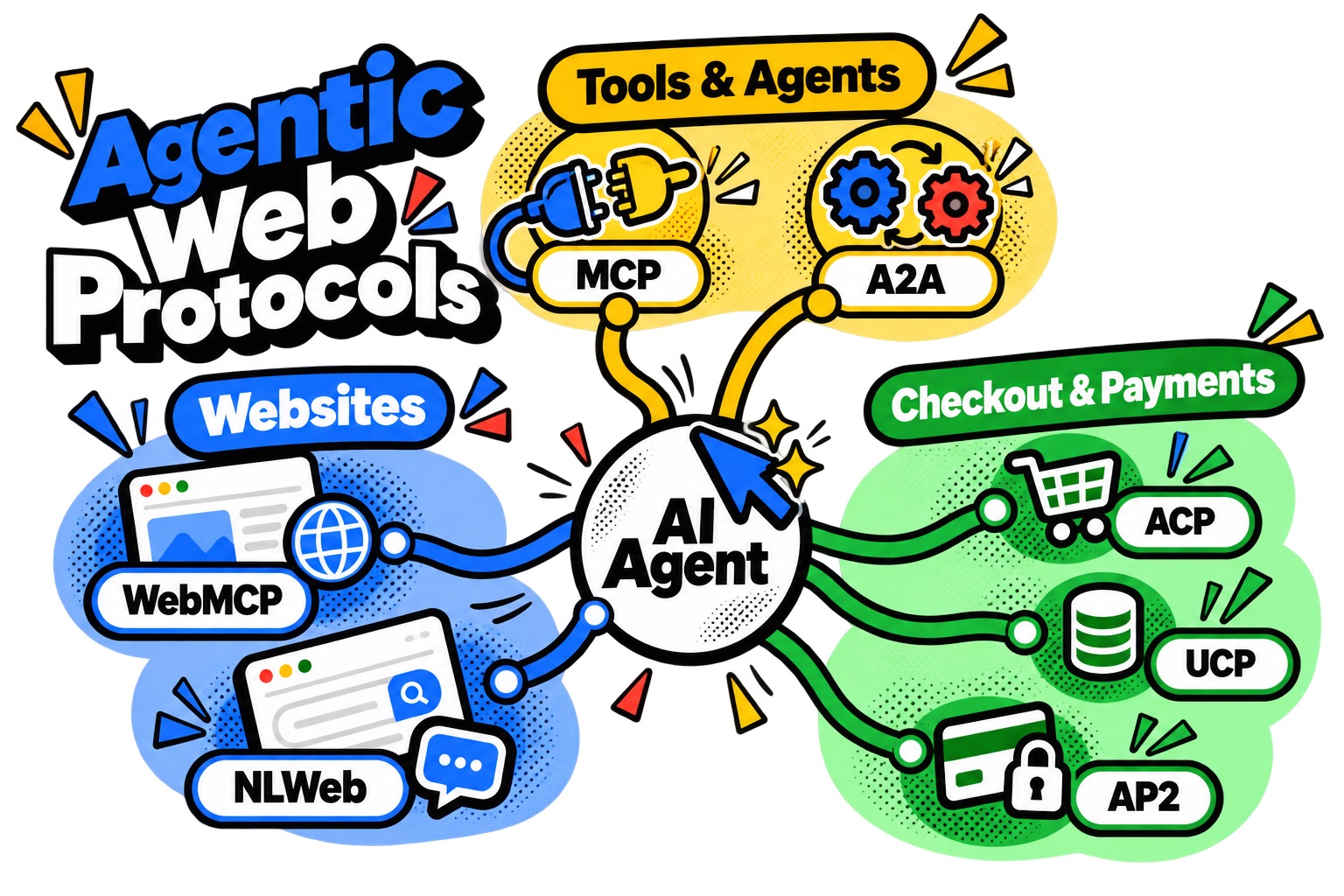
| Protocol | Backed by | What it does | Layer |
|---|---|---|---|
| MCP Model Context Protocol |
Anthropic, now industry-wide | A universal way for AI models to connect to tools and data sources. "USB-C for AI." | Tools & data |
| A2A Agent2Agent |
Google, now Linux Foundation | Lets agents from different vendors discover each other and hand off tasks. | Agent to agent |
| WebMCP | Google & Microsoft editors, W3C Community Group | Lets a web page register its own tools (search, add to cart, book) for in-browser agents via navigator.modelContext. |
Website actions |
| NLWeb | Microsoft (R.V. Guha) | Turns a site into a natural-language endpoint that people and agents can query, built on MCP. | Website data |
| ACP Agentic Commerce Protocol |
OpenAI & Stripe | Powers Instant Checkout inside ChatGPT so users can buy from merchants without leaving the chat. | Checkout |
| UCP Universal Commerce Protocol |
Google with Shopify, Etsy, Wayfair, Target, Walmart | A common language for agents, merchants and payment providers across the whole shopping journey. Powers checkout in AI Mode and Gemini. | Checkout |
| AP2 Agent Payments Protocol |
Google & payments partners | Verifiable "mandates" that prove a person authorized an agent to pay, and for how much. | Payments |
| llms.txt | Community proposal | A markdown map of a site's key pages for LLMs. Unproven for citations, more useful for docs and coding agents. | Proposed |
Reality check on WebMCP: as of spring 2026, WebMCP is a W3C Community Group draft, not an official standard. Chrome 146 shipped an implementation in March 2026, but it's behind a testing flag and off by default. It's worth prototyping now, but don't rebuild your stack around it yet.
Agentic web examples you can use today
The agentic web isn't a 2030 prediction. These agentic AI examples are live, and each one changes what "optimized" means for a website.
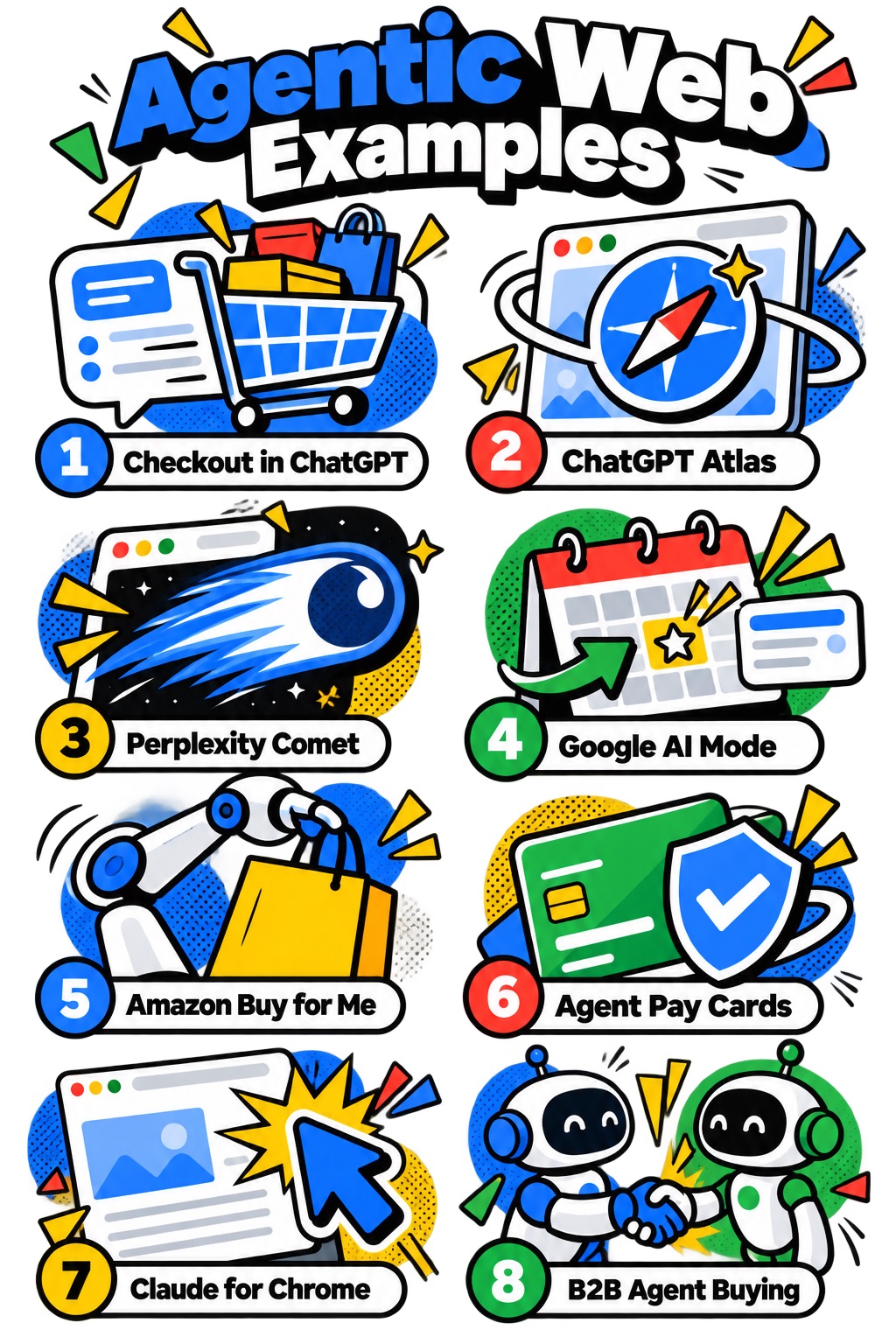
ChatGPT Instant Checkout
Buy straight from a ChatGPT conversation through the Agentic Commerce Protocol. It launched with US Etsy sellers first, with Shopify merchants announced next. As an Etsy seller myself, this one got my attention fast.
ChatGPT agent & Atlas
OpenAI's agent and its Atlas browser navigate real sites, fill forms and complete multi-step tasks while the user watches or walks away.
Perplexity Comet
An agentic browser that researches, compares and acts across tabs. "Perplexity Comet" now draws nearly 10,000 US searches a month.
Google AI Mode & Gemini
Agentic restaurant reservations through partners like OpenTable and Resy, AI calling to check local store prices and stock, and UCP-powered checkout on eligible product listings.
Amazon "Buy for Me"
Amazon's agent purchases products from other brands' websites on the shopper's behalf, inside the Amazon app.
Visa & Mastercard agent programs
Visa Intelligent Commerce and Mastercard Agent Pay give agents tokenized, permissioned cards so they can pay without ever seeing the real card number.
Claude for Chrome
Anthropic's browser extension lets Claude read the page you're on, click and complete tasks across sites.
Agent-to-agent B2B buying
Procurement agents that request quotes, compare vendor terms and negotiate with supplier agents over A2A. This is where Gartner's $15 trillion forecast comes from.
What the expert studies say about the agentic web
Forecasts are forecasts, but the direction across every major source is the same. Here's what the research actually says, with the scope of each number spelled out so nobody compares apples to oranges.
McKinsey: agentic commerce could match the web and mobile revolutions
McKinsey's report "The agentic commerce opportunity" projects up to $1 trillion in orchestrated US retail revenue and $3 trillion to $5 trillion globally by 2030. Their key argument is speed: agentic commerce can scale faster than the mobile shift because agents run on top of commerce infrastructure that already exists. They describe shopping moving from separate steps to "a continuous, intent-driven flow."
Gartner: B2B goes agent-first
At its 2025 IT Symposium, Gartner predicted that AI agents will intermediate more than $15 trillion in B2B spending by 2028, and that 90% of B2B purchases will be handled by AI agents within three years. Gartner also expects 20% of monetary transactions to be programmable by 2030. If you do B2B SEO, the "buyer" reading your pricing page is increasingly a procurement agent.
Adobe: AI shoppers convert better, and the gap is widening
Adobe Analytics found generative AI referrals to US retail sites grew 693% year over year in November and December 2025. More important for the business case, AI-referred shoppers converted 31% more often than other traffic, a gap that doubled from 2024. Revenue per visit from AI traffic jumped 254% year over year, and those visitors were 33% less likely to bounce and spent 45% more time on site.
AI-referred shoppers vs. other traffic
US retail, 2025 holiday season. How much better AI-referred visits performed.
Source: Adobe Analytics, 2025 holiday season, via Digital Commerce 360. Bars scaled to value.
Cloudflare: agents are crawling a lot more than they're sending back
Cloudflare's 2025 data shows crawling triggered directly by user requests (agents like ChatGPT-User fetching a page because someone asked) grew more than 15x during 2025, the fastest growth of any AI bot category. Cloudflare also tracks a "crawl-to-refer" ratio: how many pages a platform crawls for every visitor it sends back. Search engines sit near the low end. Some AI platforms sit in the tens of thousands.
Pages crawled per visitor sent back
Cloudflare crawl-to-refer ratios, 2025 (log scale). Lower is better for publishers.
Source: Cloudflare Radar 2025 Year in Review, via MediaNama, and Cloudflare. Ratios are volatile, and native apps don't send referrers, so AI ratios may be overstated.
Imperva: humans are already the minority
Imperva's 2025 Bad Bot Report found automated traffic made up 51% of all web traffic in 2024, the first time in a decade bots outnumbered humans. Malicious bots alone were 37%. That's the security backdrop of the agentic web: your site has to welcome the good AI agents while stopping the bad bots that look a lot like them.
Who's actually visiting the web
Humans · about 49%
Malicious bots · 37%
Good bots · about 14%
Good bots include search crawlers and legitimate AI agents. The human and good-bot shares are derived from Imperva's 51% and 37% figures.
Source: Imperva 2025 Bad Bot Report (2024 data), via Intelligent CIO.
The academic view: an "agent attention economy"
The arXiv paper by Yang et al. frames the agentic web in three dimensions: intelligence (how agents reason and decide), interaction (how agents communicate and coordinate) and economics (the money flows of agent-driven activity). Its most useful idea for marketers is the agent attention economy. On the human web, brands compete for eyeballs. On the agentic web, services compete to be selected and invoked by agents. That's a different game, and it rewards clean data, reliable tools and trusted reputation over flashy design.
A timeline of the agentic web
Agentic commerce, agentic checkout and agentic payments
What is agentic commerce? Agentic commerce is shopping where an AI shopping agent does some or all of the buying journey for a person: discovery, comparison, cart building, checkout and even returns. It's the part of the agentic web with the clearest revenue, which is why "agentic commerce" pulls about 5,400 US searches a month, the most of any agentic web term I tracked.
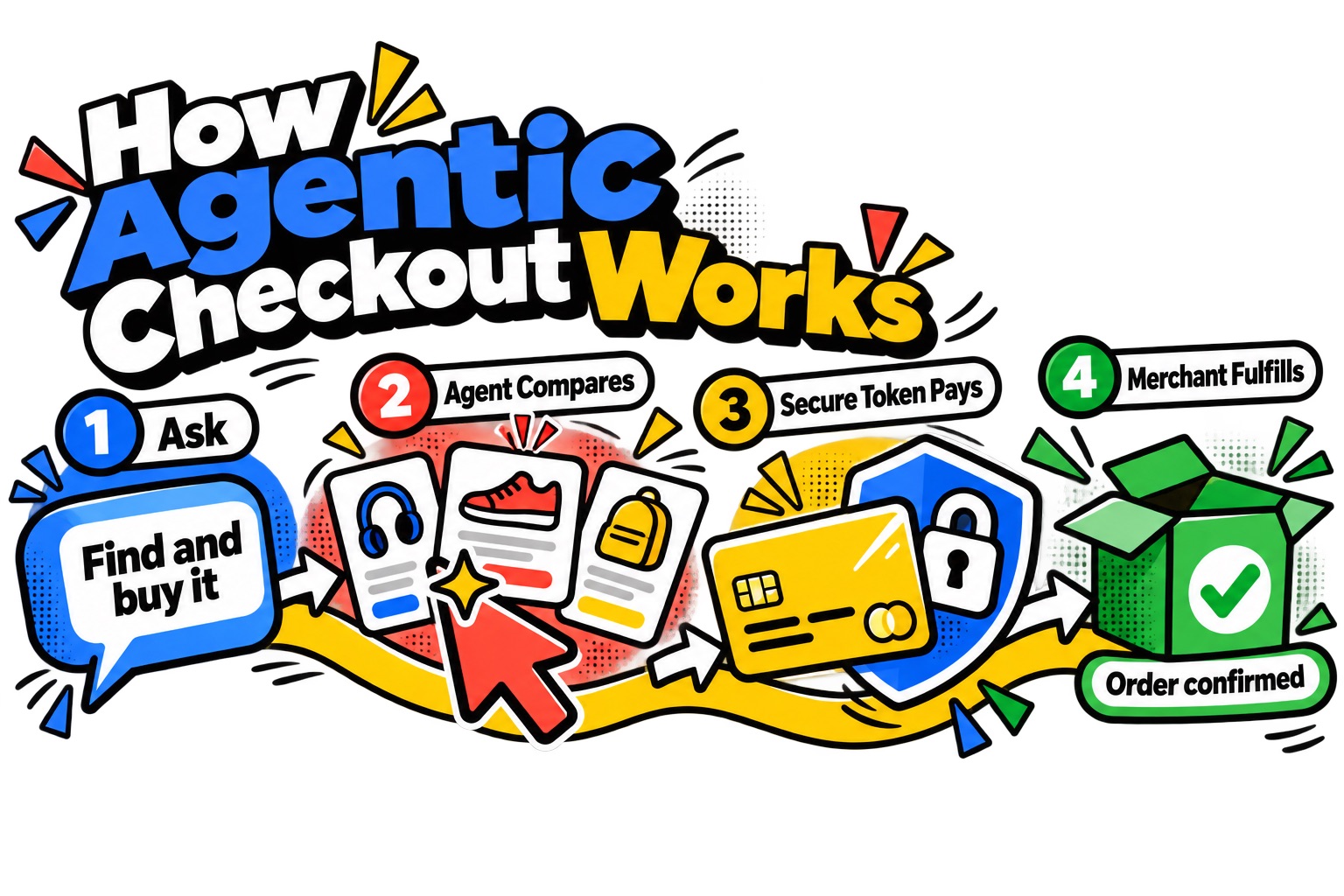
How agentic checkout works
Agentic checkout is the moment an agent completes a purchase. In ChatGPT, that runs through ACP. In Google AI Mode and Gemini, it runs through UCP, with payment from Google Pay. Either way the pattern is the same: the merchant shares a structured product feed, the agent shows the options inside the chat, and the merchant stays the merchant of record, processing the order on its own systems.
How agentic payments stay safe
Agentic payments solve the obvious fear: "I'm not giving a robot my credit card." Instead of a raw card number, the agent gets a scoped, tokenized credential. Google's AP2 adds signed "mandates," cryptographic proof that a person authorized this agent to buy this thing up to this amount. Visa and Mastercard's agent programs do the same at the network level. For merchants, that means fewer chargebacks from "my agent did it" disputes, as long as you accept those credentials.
For ecommerce and agentic ecommerce teams: your product feed is now a ranking factor for agents. Complete GTINs, accurate prices, live inventory, clear return policies and real shipping times are what an AI shopping agent uses to pick you over the next store.
Agentic SEO: how to optimize your website for AI agents
Agentic SEO (some people call it agent experience, or AX, the agent version of UX) is the practice of making your site easy for AI agents to find, read, trust and act on. Search volume for "agentic SEO" is still tiny, which tells you how early this is. Here's how I break it down after 15+ years in technical SEO.
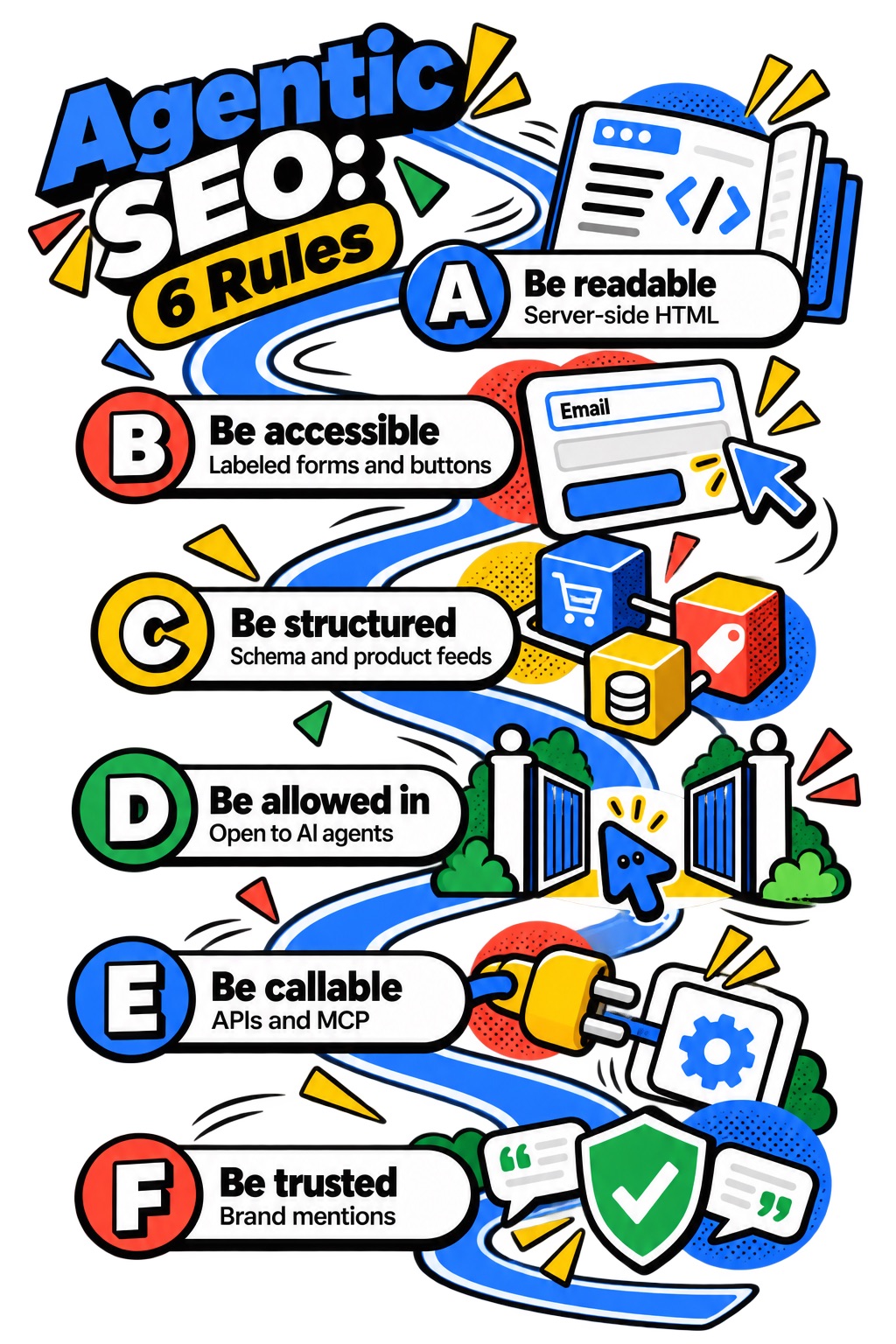
Be readable
Put prices, specs, availability and policies in server-rendered HTML. Most AI crawlers don't execute JavaScript, so content that loads client-side often doesn't exist to them. Use server-side rendering for money pages.
Be accessible
Agentic browsers lean on the same accessibility tree that screen readers use. Labeled form fields, real buttons, semantic headings and ARIA where needed make your site usable by agents. Good accessibility is good agentic web optimization.
Be structured
Product, Offer, Organization, FAQ and LocalBusiness schema help agents read entities and facts. Schema isn't the switch that gets you cited, but it reduces mistakes when an agent pulls your price or hours.
Be allowed in
Audit robots.txt and your CDN or WAF. Many sites block agent user agents like ChatGPT-User, OAI-SearchBot, Claude-User or PerplexityBot by accident while trying to block training bots like GPTBot or ClaudeBot. Block training if you want, but keep search and user agents open.
Be callable
Expose key actions (search, check stock, book, add to cart) as clean APIs or MCP servers. Start prototyping WebMCP tools now so you're ready when browsers turn it on by default.
Be trusted
Agents shortlist brands the models already know. Earned mentions on the sources AI engines cite (Reddit, reviews, publishers, YouTube) still drive selection. Brand is the agentic web's strongest ranking signal.
Measuring agentic web traffic
You can't optimize what you can't see. Start in your server logs: segment user agents like ChatGPT-User, OAI-SearchBot, Claude-User, Claude-SearchBot and PerplexityBot from training crawlers, and track which URLs they hit. In GA4, build a custom channel group for AI referrers (chatgpt.com, perplexity.ai, gemini.google.com, copilot.microsoft.com, claude.ai). ChatGPT also appends utm_source=chatgpt.com to many outbound links. Expect these numbers to undercount, because a lot of agentic activity never sends a referrer.
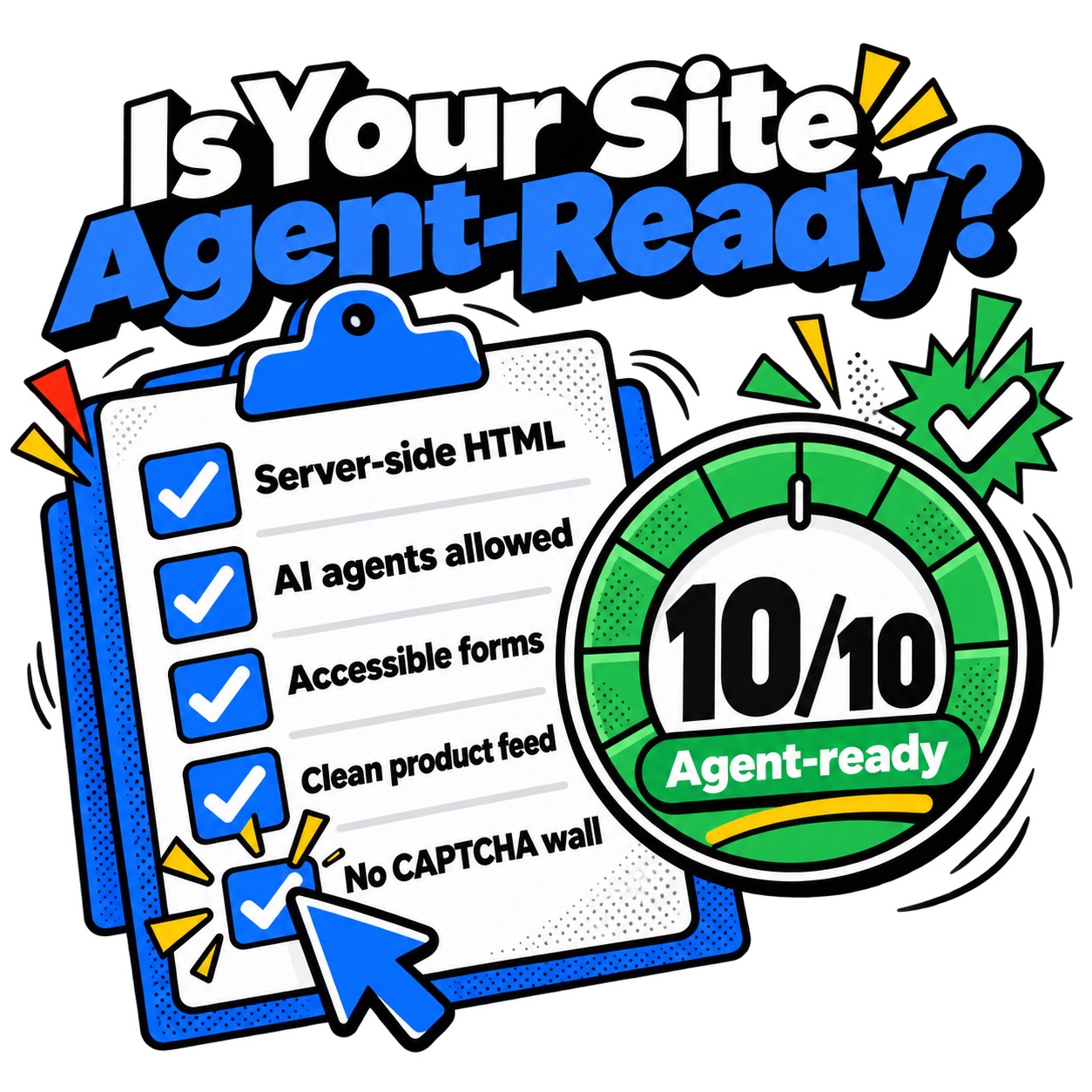
Agent-ready website checklist
Check off what your site already does to see your agentic web readiness score.
Risks and open problems on the agentic web
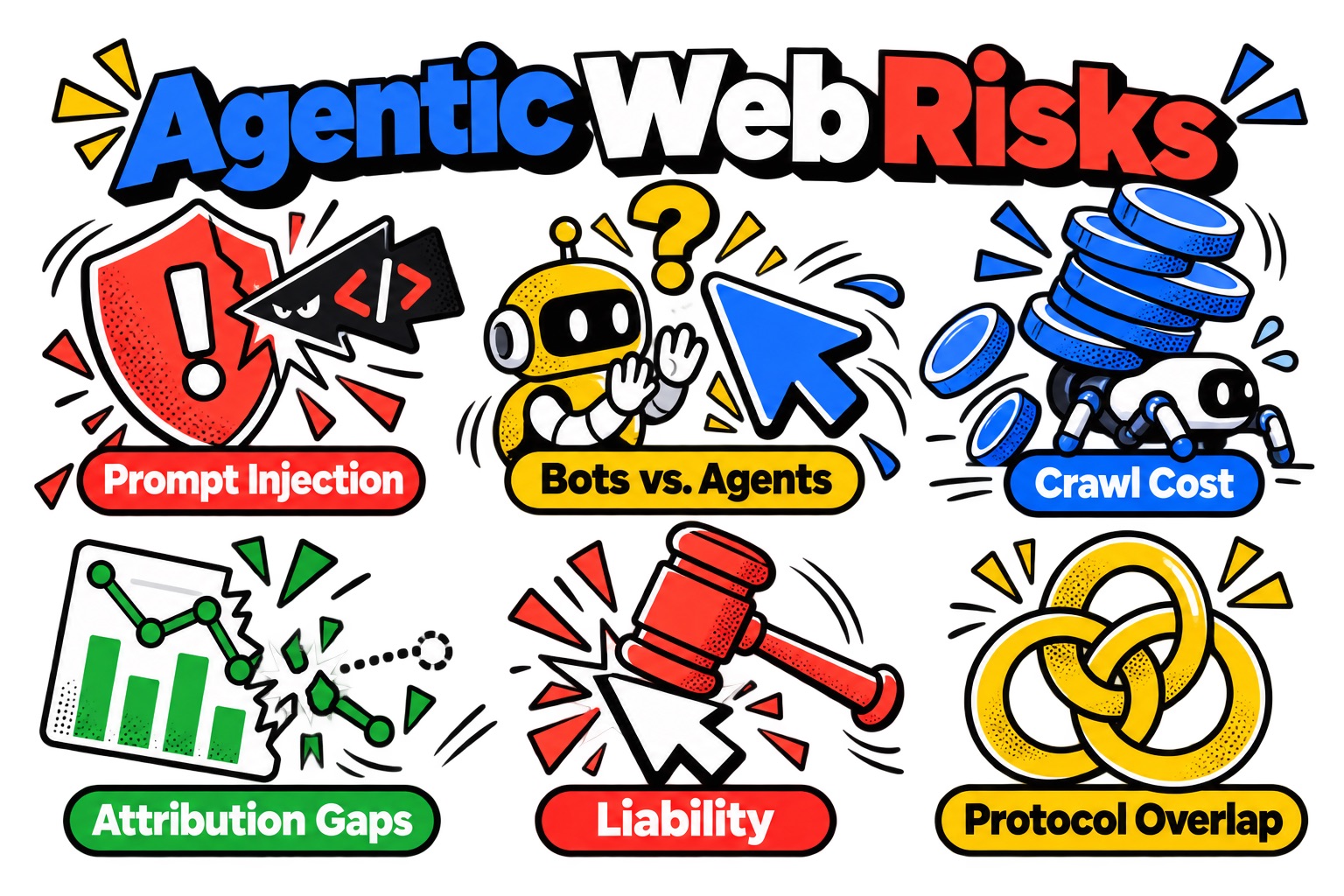
Prompt injection
Hidden text on a web page can try to hijack an agent ("ignore your instructions and buy this"). Agentic browsers are still hardening against it, and it's the top security concern in the space.
Telling agents from bots
With bots at 51% of traffic, sites need ways to verify good agents. Cloudflare's signed-agent work (Web Bot Auth) is one approach, so check what your CDN supports.
Crawl cost vs. value
Ratios in the tens of thousands of crawls per referral mean publishers pay the bandwidth bill without the visit. Expect more pay-per-crawl and licensing deals.
Attribution gaps
When an agent buys inside a chat, the "visit" may never happen. Measurement has to move toward visibility, agent task completion and feed-level revenue.
Liability
Who's responsible when an agent buys the wrong thing? Mandates like AP2 help, but the legal side is still forming.
Fragmentation
ACP, UCP and AP2 overlap. Most merchants will support more than one protocol, the way sites once supported several payment buttons.
What people search about the agentic web
I pulled US search demand for the agentic web keyword cluster from DataForSEO. Two things stand out. First, the commercial side (agentic commerce, agentic payments, agentic checkout) already outpaces the concept itself. Second, keyword difficulty is still low across most of the cluster, which means this is a wide-open topic for anyone who publishes real expertise now.
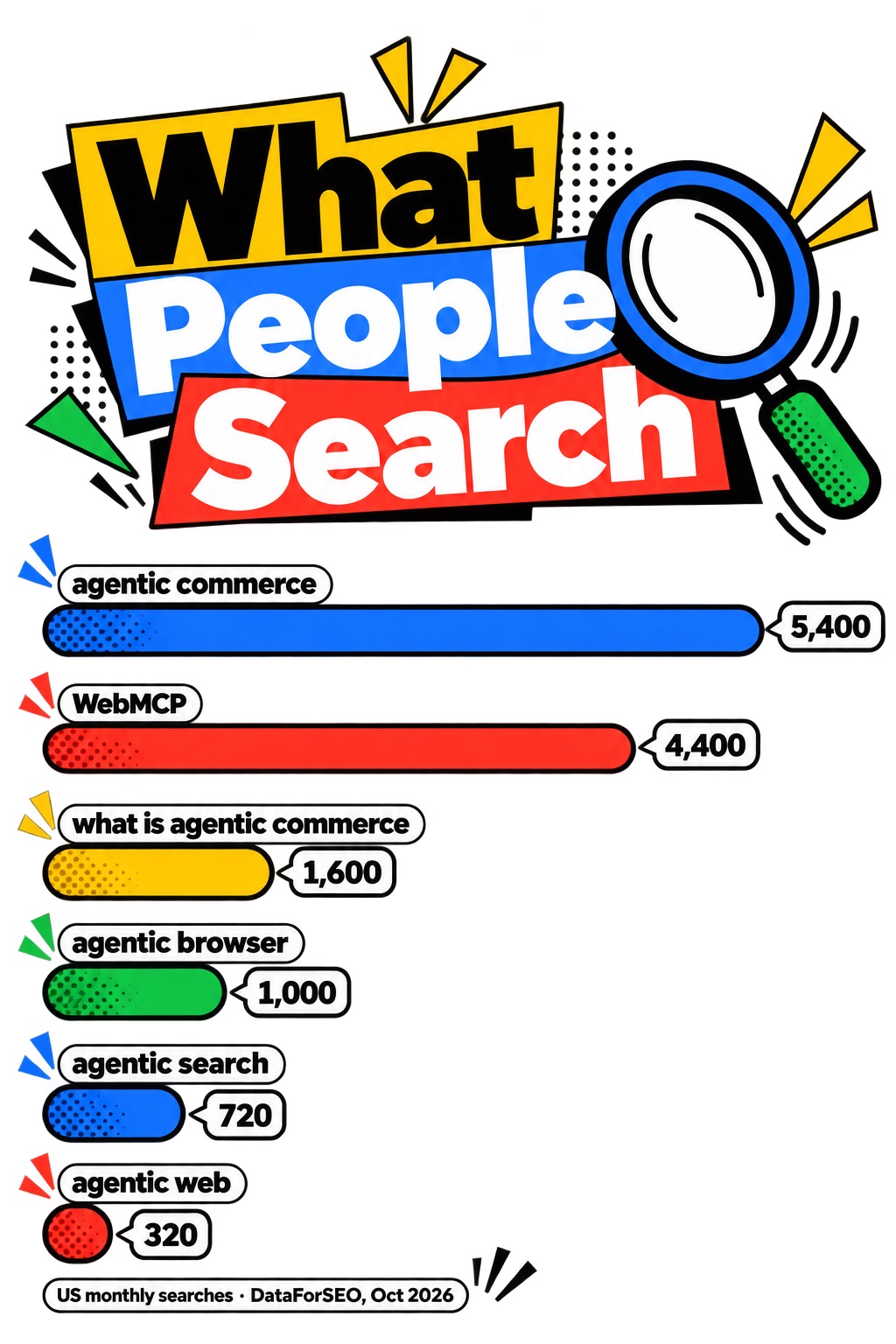
Monthly US searches: agentic web keyword cluster
Source: DataForSEO (Google Ads search volume and Labs keyword difficulty, US, pulled October 2026). KD is DataForSEO's 0 to 100 keyword difficulty score. For context, the broader term "agentic AI" draws 90,500 searches a month and "ChatGPT Atlas" 40,500.
Agentic web FAQ
What is the agentic web in simple terms?
The agentic web is the internet used by AI agents on your behalf. Instead of you clicking through sites, an AI agent reads the pages, compares options and completes tasks like booking or buying, then reports back to you for approval.
What is the difference between the agentic web and AI search?
AI search answers a question and cites sources. The agentic web goes a step further: the agent acts on the answer by filling forms, adding to cart and checking out. AI search optimization gets you mentioned. Agentic web optimization gets the task completed on your site.
What are some examples of the agentic web?
ChatGPT Instant Checkout, ChatGPT agent and the Atlas browser, Perplexity Comet, Google AI Mode reservations and UCP checkout, Amazon "Buy for Me," Claude for Chrome, and Visa Intelligent Commerce and Mastercard Agent Pay for agentic payments.
What is agentic commerce?
Agentic commerce is shopping where AI agents handle part or all of the purchase journey, from discovery to agentic checkout. McKinsey projects up to $1 trillion in US agentic commerce revenue by 2030 and $3 trillion to $5 trillion globally.
What protocols does the agentic web use?
The main ones are MCP (Model Context Protocol) for tools and data, A2A (Agent2Agent) for agent coordination, WebMCP and NLWeb for websites, and ACP, UCP and AP2 for agentic checkout and agentic payments.
What is an agentic browser?
An agentic browser is a web browser with a built-in AI agent that can see pages, click, type and complete multi-step tasks across tabs. Examples include Perplexity Comet, ChatGPT Atlas, Opera Neon and Chrome with Gemini.
How do I optimize my website for AI agents?
Render key content in server-side HTML, make forms and buttons accessible, keep schema and product feeds accurate, allow AI search and user agents in robots.txt, expose key actions through APIs or MCP, and build brand mentions on the sources AI engines trust.
Does llms.txt help with the agentic web?
Not much for search citations yet. No major AI engine has confirmed using llms.txt for ranking, and AI bots rarely request it. It's more useful for documentation sites and coding agents that pull docs on demand.
Jourdan runs Optimization Theory, a technical SEO and AI search consultancy, and has spent 15+ years in SEO across enterprise brands and agencies. He builds his own GEO tools, runs his own AI visibility tests and writes about where search is heading. Connect on LinkedIn or read more about Jourdan.
Sources
- Yang, Y., Ma, M., Huang, Y. et al. "Agentic Web: Weaving the Next Web with AI Agents." arXiv, July 2025.
- McKinsey & Company. "The agentic commerce opportunity." 2025. Summary via Digital Commerce 360.
- Gartner strategic predictions, IT Symposium/Xpo 2025, via Digital Commerce 360.
- Adobe Analytics 2025 holiday season data, via Digital Commerce 360.
- Salesforce. "AI and Agents Propel Cyber Week to Record $336.6B in Global Spend." December 2025.
- Cloudflare. "AI search crawl-to-refer ratio on Radar." 2025. 2025 Year in Review summary via MediaNama.
- Imperva 2025 Bad Bot Report, via Intelligent CIO.
- Google Universal Commerce Protocol announcement, via PYMNTS, January 2026.
- WebMCP spec status, via DEV Community, 2026.
- Microsoft NLWeb and the open agentic web, via MediaNama, May 2025.
- Keyword data: DataForSEO API, US, October 2026.
More Writing & Research by Jourdan Rombough
View all research
If AI can't find you, understand you and trust you, it won't recommend you.
Keywords tell you what they typed. Intent tells you what they meant. Fan-out tells you what they'll ask next.
Be a thing, not a string. AI remembers entities, not keywords.
The click isn't dead. It just has to be earned twice.
Schema is the business card you hand to every machine that reads your site.
If Googlebot can't reach it and AI can't parse it, it doesn't exist.
Good SEO grows quietly. Then all at once.
